What Is the Bitcoin Halving? A Complete Guide to Its Mechanism, Price Impact, and Investment Strategies

 2026-03-19

Many people have heard that Bitcoin prices tend to rise after a halving event, but still wonder, “Does the price really go up?” or “How does it actually work?” In reality, because Bitcoin is based on relatively new technology, its underlying mechanism can be difficult to understand. Moreover, its price is influenced by overall market conditions, so it cannot be guaranteed that prices will always increase.
In this article, we provide a beginner-friendly explanation of the mechanism of Bitcoin halving, its impact on price, and investment strategies based on halving cycles.
By reading this guide, you will gain a clear understanding of how Bitcoin halving works and how past halving events have affected price movements.
This knowledge can serve as a valuable reference for making informed investment decisions, so be sure to read through to the end.

What Is the Bitcoin Halving? Understanding Its Mechanism and Importance
Many people have heard of Bitcoin halving, but may not fully understand how it works or why it occurs. In this section, we will explain the fundamentals of Bitcoin halving from the following three perspectives.
-
The basic mechanism of halving
-
The reason halving is implemented
-
The halving schedule
By understanding these points, you will gain a clear understanding of how Bitcoin halving works and why it is
important.
Let’s take a closer look at each of these aspects below.
The Basic Mechanism of Bitcoin Halving
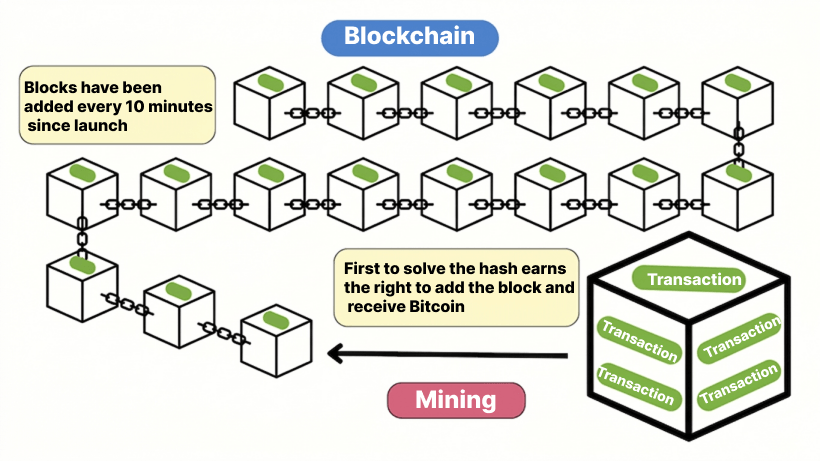
To understand Bitcoin halving, it is essential to first grasp blockchain technology, which forms the core of Bitcoin.
First, in blockchain technology, transaction data (transactions) are grouped into blocks approximately every 10
minutes and linked to the previous block.
Next, to add a block, participants must solve a complex mathematical problem known as a hash function to verify that the transaction data is valid.
The first participant to solve this hash function earns the right to add the block and receives newly issued Bitcoin as a reward.
This process is called mining, as it resembles gold mining, and those who perform it are known as miners.
Bitcoin halving is an event that occurs approximately every four years. Specifically, when 210,000 blocks have been generated (with each block created roughly every 10 minutes), the reward paid to miners is reduced by half.
Why Bitcoin Halving Exists
Bitcoin’s creator, Satoshi Nakamoto, designed Bitcoin as a form of digital gold.
Since the value of physical gold is derived from its limited supply,
Bitcoin was designed with a similar scarcity mechanism—halving.
This prevents all Bitcoin from entering the market at once and helps maintain its value over the long term.
Because the value of money is closely tied to scarcity, gradually reducing the issuance of Bitcoin increases its scarcity and helps prevent inflation.
Bitcoin Halving Schedule
Bitcoin halving occurs every 210,000 blocks, which translates to approximately once every four years.
The results of past halving events are as follows.
| Halving | Date | Mining Reward |
|---|---|---|
| 1st | Nov 28, 2012 | 50 BTC → 25 BTC |
| 2nd | Jul 9, 2016 | 25 BTC → 12.5 BTC |
| 3rd | May 11, 2020 | 12.5 BTC → 6.25 BTC |
| 4th | Apr 20, 2024 | 6.25 BTC → 3.125 BTC |
| 5th | Expected in 2028 | 3.125 BTC → 1.5625 BTC |
As shown above, Bitcoin halving occurs approximately every four years and will continue until the total supply reaches its cap of 21 million coins, which is expected around the year 2140.
Bitcoin Halving History and Price Movement Analysis
So, how has Bitcoin’s price actually moved following past halving events?
In this section, we take a closer look at the price behavior after the first three halvings, as well as the most recent fourth halving.
Let’s examine each halving cycle alongside real market charts.
First Halving (2012) | Market Reaction and Price Impact
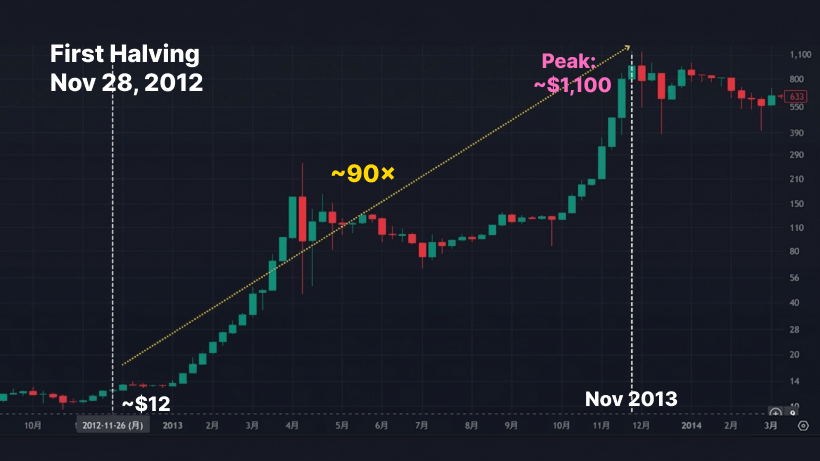
At the time of the first halving on November 28, 2012, Bitcoin was priced at around $12.
However, the market gradually began to respond, and about one year later, in November 2013, the price surged to approximately $1,100.
This represents an increase of about 90 times compared to the pre-halving level.
Key drivers behind this surge included increased trading activity in the Chinese market and market normalization following the shutdown of the illegal marketplace Silk Road.
Nevertheless, the reduction in supply caused by the halving should not be overlooked.
Second Halving (2016) | Market Maturity and Price Patterns
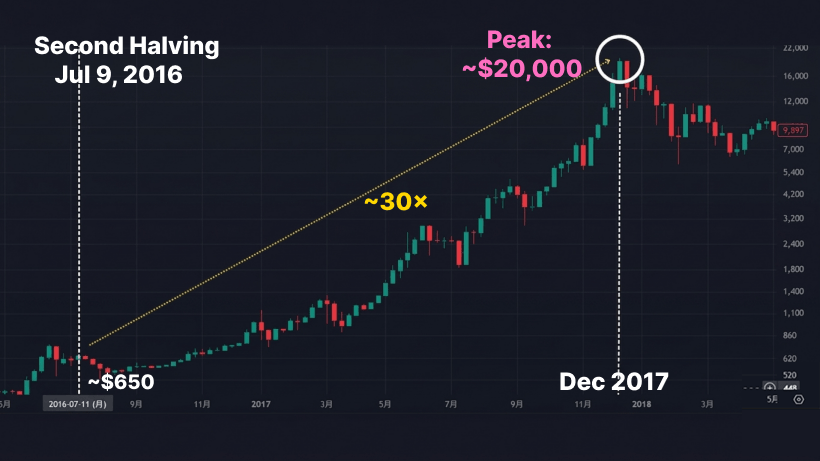
During the second halving on July 9, 2016, Bitcoin was trading at approximately $650, reflecting a more mature
market with improved liquidity.
On the day of the halving, there was a slight upward movement, but no significant price volatility.
However, about 18 months later, in December 2017, Bitcoin surged to an all-time high of around $20,000.
This represents roughly a 30-fold increase compared to the pre-halving level.
This period coincided with a broader cryptocurrency boom, during which many new digital assets were issued and the overall market experienced rapid growth.
Third Halving (2020) | Halving During the Pandemic and Market Trends
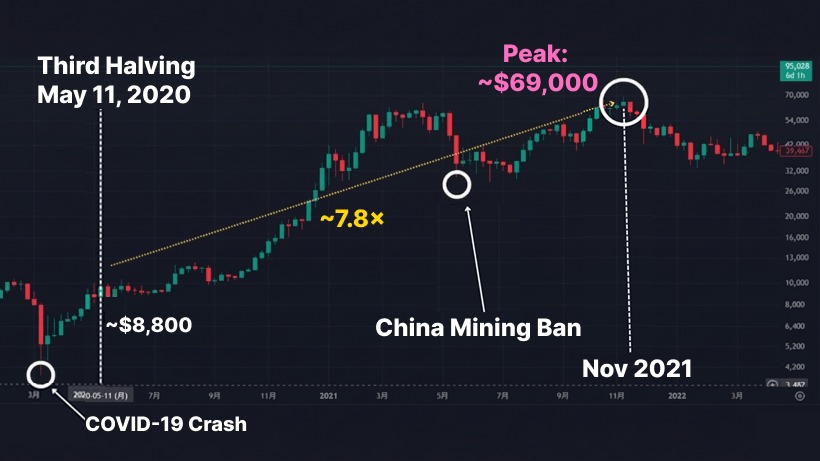
The third halving on May 11, 2020, took place amid global economic uncertainty caused by the COVID-19 pandemic,
with Bitcoin priced at around $8,800.
The immediate price reaction following the halving was relatively subdued, but prices gradually increased in the second half of 2020 and accelerated into 2021.
However, in May 2021, the market dropped by more than 50% following China’s crackdown on Bitcoin mining.
Afterward, the market gradually recovered, and in November 2021, Bitcoin surged to an all-time high of approximately $69,000.
This represents about a 7.8-fold increase compared to the pre-halving level.
During this period, institutional participation became more prominent, and demand for Bitcoin as an inflation hedge also increased.
Fourth Halving (2024) | ETF Approval and Price Trends
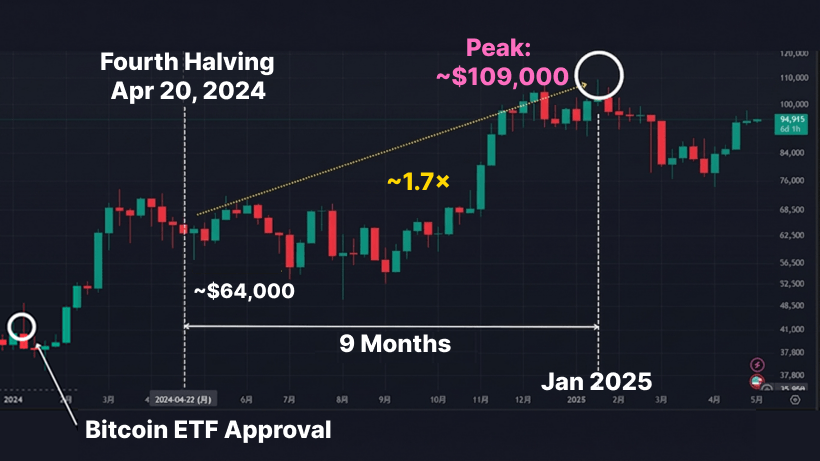
The fourth halving on April 20, 2024, occurred under unprecedented conditions, shortly after the U.S. Securities
and Exchange Commission (SEC) approved spot Bitcoin ETFs.
At the time of the halving, Bitcoin was trading at approximately $64,000.
Following the ETF approval, significant capital inflows were observed, with over $10 billion reportedly flowing into Bitcoin-related ETFs between January and March 2024.
Nine months after the halving, Bitcoin’s price rose to approximately $109,000.
Although the market experienced a temporary correction of around 30%, it gradually recovered and, as of May 2025, is trading at approximately $102,000.
Post-Halving Price Patterns and Data Insights
Analyzing the past four halving cycles reveals several common patterns.
First, sharp price increases do not occur immediately after the halving; rather,
a strong bullish phase tends to emerge 12 to 18 months after the event.
Additionally, the magnitude of price increases has diminished with each cycle, indicating
reduced speculative behavior.
This is likely due to increasing market maturity and a larger market capitalization, making it more difficult to achieve the same growth multiples as in earlier cycles.
Assuming this pattern continues after the fourth halving, a potential increase of 3 to 5 times within the coming
months may be expected.
However, there are no guarantees in the market. It is essential to consider multiple factors—such as macroeconomic conditions, regulatory developments, and market sentiment—when making trading decisions.
Investment Strategies Based on Bitcoin Halving
While you may now understand the typical price patterns following halving events, many investors still wonder what strategies to adopt in practice. In this section, we introduce four key investment strategies based on Bitcoin halving.
-

Long-term holding strategy and its rationale
-
Diversified investing using dollar-cost averaging
-
Profit-taking and stop-loss strategies
-
Correlation with other cryptocurrencies (altcoins)
By understanding these strategies, you can develop an investment style that suits your goals and adopt a more risk-controlled trading approach.
Let’s explore each of these strategies in detail.
Long-Term Holding Strategy and Its Rationale
Long-term holding, often referred to as “HODLing,” is an investment approach that
focuses on long-term value appreciation without being influenced by short-term price fluctuations.
The rationale behind this strategy lies in Bitcoin’s increasing scarcity, as each halving reduces the issuance rate and moves the asset closer to its maximum supply cap. Historical data shows that, regardless of entry timing, most investors who held Bitcoin for more than four years have achieved positive returns.
When adopting a long-term strategy, it is important to invest only surplus capital and maintain a long-term perspective without reacting emotionally to short-term market movements.
Diversified Investing with Dollar-Cost Averaging
Dollar-cost averaging (DCA) is an investment strategy that
reduces price volatility risk by investing a fixed amount at regular intervals.
For example, by investing a fixed amount each month, you will buy fewer units when prices are high and more units when prices are low. The key advantage of this approach is that it eliminates the need to time the market, reduces emotional decision-making, and allows investors to take advantage of price dips.
Given the unpredictability of price movements around halving events, DCA is an effective strategy for maintaining consistent and disciplined investing.
Profit-Taking and Stop-Loss Strategies
Effective risk management is essential in Bitcoin investing.
For profit-taking, strategies may include
gradually selling portions of holdings as prices rise, setting target price levels, and rebalancing portfolios.
On the other hand, stop-loss strategies to manage downside risk may involve predefined loss limits, technical indicator-based exit decisions, and periodic portfolio reviews.
Regardless of the approach, it is crucial to establish clear rules in advance and make decisions based on a disciplined strategy rather than emotions.
Relationship with Other Cryptocurrencies (Altcoins)
Bitcoin halving events also influence the broader altcoin market.
Historically, periods following Bitcoin rallies have often been accompanied by increased activity in altcoins, commonly referred to as
“altcoin season”. A practical strategy is to prioritize Bitcoin holdings around the halving period and gradually allocate funds to altcoins after Bitcoin’s major rally stabilizes.
Additionally, selecting altcoins with lower correlation to Bitcoin can help improve portfolio diversification.
However, altcoins typically exhibit higher volatility and carry greater project risk, so careful asset allocation based on individual risk tolerance is essential.
Frequently Asked Questions About Bitcoin Halving
While price increases have been observed after the past four halving events, a direct causal relationship between halving and price appreciation has not been definitively proven. Although halving reduces supply, price is ultimately determined by the balance between supply and demand. Factors such as macroeconomic conditions, regulatory developments, technological innovation, and market sentiment all influence price formation.
Therefore, investment decisions should not rely solely on halving events but should be based on a comprehensive analysis of the market environment.
Historically, prices have tended to rise gradually in the months leading up to a halving, while short-term corrections may occur shortly after the event.
For long-term investors, consistently investing through strategies such as dollar-cost averaging—regardless of timing—is often a prudent approach. Investors seeking capital appreciation may consider gradually building positions in the months before the halving and continuing to accumulate during post-halving pullbacks.
In all cases, it is essential to choose a strategy aligned with your personal circumstances and make disciplined decisions without being influenced by emotions.
From that point onward, miners will rely solely on transaction fees as their source of revenue.
Currently, miner income consists of both block rewards (newly issued Bitcoin) and transaction fees, but the proportion of block rewards decreases with each halving.
To sustain the Bitcoin network beyond 2140, potential scenarios may include higher transaction fees, improvements in mining efficiency, or changes in consensus mechanisms.
However, any projections over such a long time horizon involve significant uncertainty.
Examples include Litecoin (LTC), Bitcoin Cash (BCH), and Monacoin (MONA).
On the other hand, some cryptocurrencies—such as Ethereum (ETH), Ripple (XRP), and Solana (SOL)—do not use a halving mechanism.
The presence or absence of halving depends on each cryptocurrency’s economic model and intended use case.
When considering an investment, it is important to understand the issuance policy and tokenomics of each asset.
Key Takeaways: Using Bitcoin Halving in Your Investment Strategy
Bitcoin halving is a major event that occurs approximately every four years and serves as an important reference
point for investment decisions in the cryptocurrency market.
To effectively incorporate halving into your investment strategy, the following three principles are essential.
-

Maintain a long-term perspective
-
Diversify risk
-
Make disciplined, emotion-free investment decisions
Practical strategies include long-term holding, utilizing dollar-cost averaging, and allocating Bitcoin
appropriately within a diversified portfolio to manage risk. Additionally, factors such as macroeconomic
conditions, regulatory developments, and technological advancements can significantly impact Bitcoin’s price, so
it is important to continuously monitor these trends and incorporate them into your decision-making process.
For beginners, it is essential to remember that short-term price movements are difficult to predict—even for professionals—and that investing should be approached with a long-term mindset rather than speculation.
Enjoyed this article? Share it with your network!


RYOEX Official Media is an information platform created specifically for traders, offering the latest news, analysis, guides, and more. From beginners to experienced traders, we provide useful content to help you stay informed and succeed in your trading endeavors.