


Dollar Hovers Near Multi-Month Lows as Easing Yields Leave Yen Behind

 August 19, 2026


The dollar remained close to multi-month lows in early Asian trading on Wednesday as softer U.S. yields and weaker July data reduced the appeal of further Federal Reserve tightening. The DXY was last at 99.635, down 0.02% from its previous close, while the U.S. 10-year Treasury yield stood at 4.706%, 1.8 basis points lower.
The next test is the minutes of the Fed's July meeting, due at 2:00 p.m. ET. They will show how broadly policymakers shared the concerns of the three officials who voted for a rate increase. Before then, UK inflation data will test sterling's resilience, while the yen remains caught between lower U.S. yields and Japan's still-wide rate disadvantage.
FX Market Overview
EUR/USD was at 1.1579, marginally firmer on the session and close to the two-month high described by Reuters. GBP/USD held at 1.3527, down 0.04% from its previous close but still near a three-month high ahead of UK consumer-price data. USD/JPY eased 0.06% to 159.480, a small intraday yen gain that did little to reverse its broader weakness.
The pattern is not a uniform dollar retreat. Since just before the August 7 U.S. payroll report, the DXY has declined 0.24%, while the euro and pound have gained 0.37% and 0.57%, respectively. The yen has weakened 0.72% against the dollar over the same window. That divergence keeps domestic Japanese policy and intervention risk central to the yen outlook even when U.S. rate support for the dollar fades.
Key Currency Drivers and Analysis
Dollar: Softer Data Lower the Yield Advantage
The Fed held its target range at 3.50%-3.75% in July, but the 9-3 vote was unusually divided: Beth Hammack, Neel Kashkari and Lorie Logan preferred a 25-basis-point increase. The minutes therefore arrive with the market weighing a hawkish committee split against a run of softer data.
July nonfarm payrolls fell by 23,000, the unemployment rate was 4.1%, and May and June payroll estimates were revised down by a combined 103,000. Headline CPI rose 0.1% month-on-month and core CPI increased 0.2%; final-demand producer prices were unchanged. Annual inflation remains less comfortable—3.4% for headline CPI and 4.7% for final-demand PPI—but the monthly pulse and weaker employment report have limited the case for immediate tightening.
That tension is reflected in institutional research. Alpine Macro's Harvinder Kalirai told Reuters that the dollar's yield advantage should narrow if the Fed does not deliver the tightening priced by markets and labor and inflation surprises continue to soften. Scotiabank likewise sees lower rate differentials sustaining a bearish dollar drift, though geopolitical risk can interrupt it. MUFG's August outlook argues that the U.S. curve overprices Fed tightening, a view consistent with the recent fall in yields but vulnerable to hawkish language in the minutes.
Sterling: Cooling Jobs Meet a Live Inflation Test
Sterling's recent strength now faces conflicting domestic signals. Provisional UK payrolls fell by 13,000 in July, unemployment was 4.9% in April-June, and vacancies declined to 707,000 in May-July. Private-sector regular pay growth slowed to 2.8% year-on-year, evidence that labor-market pressure is easing.
The Bank of England nevertheless held Bank Rate at 3.75% by a 6-3 vote in July, with three members preferring a 25-basis-point increase. July CPI, scheduled for 7:00 a.m. UK time on Wednesday, will determine whether cooling employment or lingering price pressure carries more weight. Scotiabank's medium-term view that sterling can stay resilient rests partly on the possibility that the BOE tightens before year-end; a soft inflation result would challenge that premise.
Yen: Dollar Weakness Is Not Enough
The yen's failure to benefit from a softer DXY is the clearest cross-market anomaly. Reuters reported that it had surrendered much of a recent intervention-led advance. Japan's Ministry of Finance will not publish the aggregate intervention total covering July 30 through August 26 until August 28, leaving the scale of any action in the current window outside the official record for now.
The BOJ's policy rate is around 1.0%, far below the Fed's range, and its next policy meeting is scheduled for September 17-18. The central bank's July outlook expects core inflation to run clearly above 2% from the second half of fiscal 2026, which preserves a case for normalization. MUFG expects lower global yields and further BOJ action to support the yen later in the year, but the current price action shows that expectation has yet to overcome the carry disadvantage.
Key Charts and Market Data
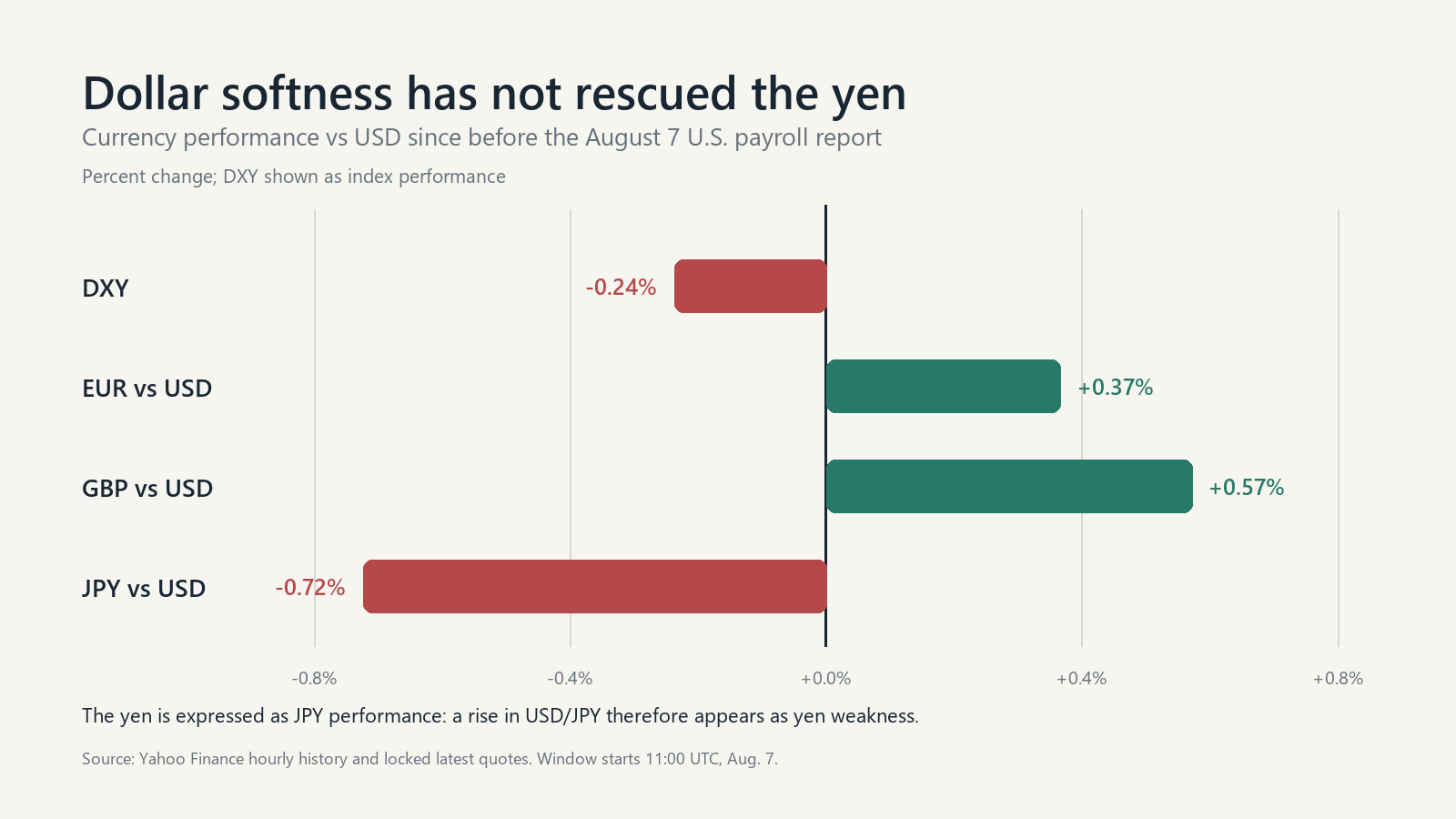
The comparison separates broad dollar weakness from yen-specific pressure. Sterling has led the move against the dollar, the euro has advanced more modestly, and the yen has lost ground even as the DXY declined.
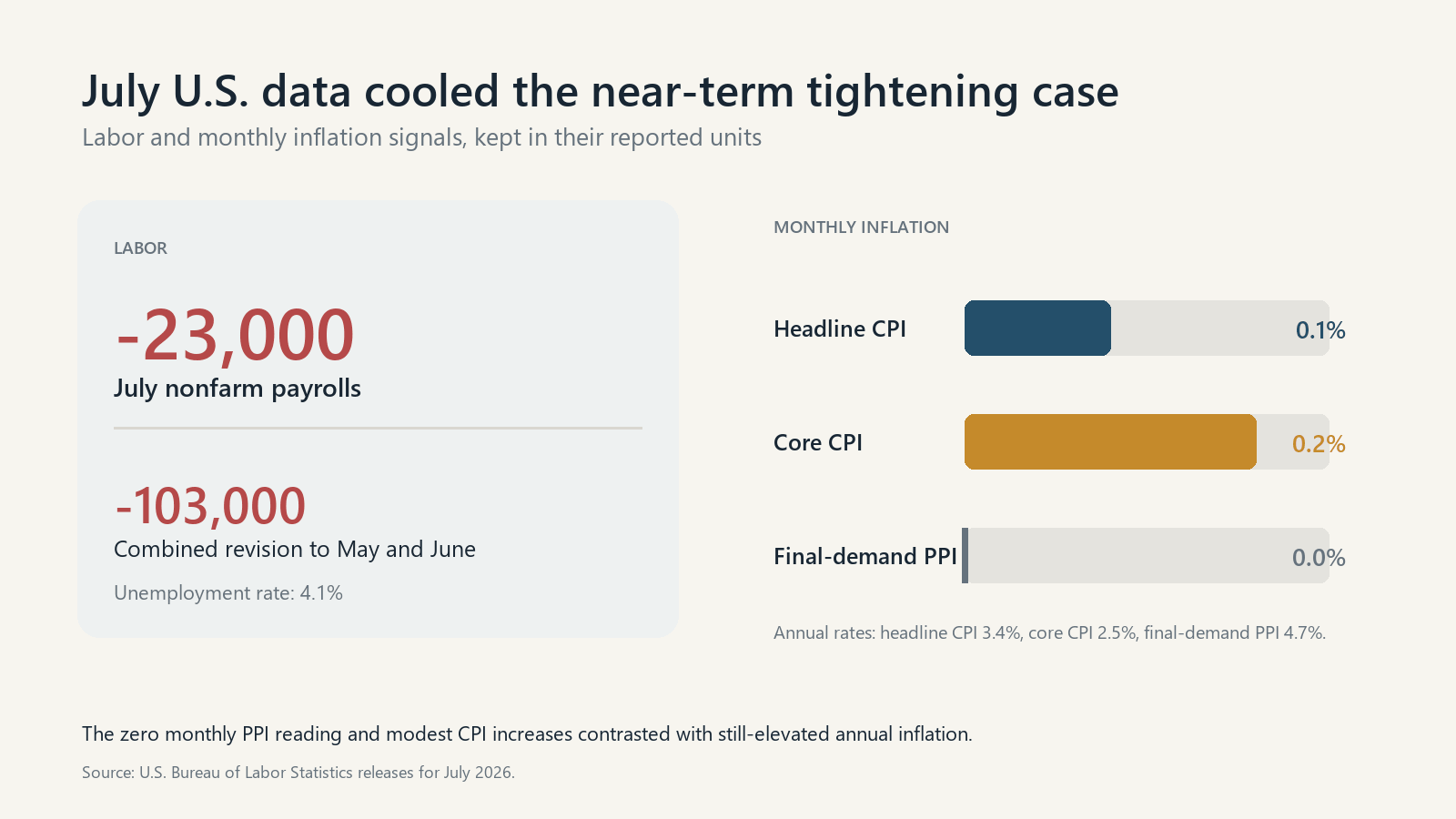
The labor shock and subdued monthly inflation readings explain why U.S. yields have eased. They do not eliminate inflation risk: annual headline CPI and PPI remain elevated, which is why the Fed minutes can still alter the rate narrative.
Market Outlook and Key Takeaways
The immediate dollar bias remains soft while Treasury yields fall and U.S. data reduce confidence in further tightening. The minutes could reinforce that view if concern about employment and cooling monthly inflation extends beyond the majority that held rates steady. A detailed defense of the dissenters' case would instead expose a market leaning toward lower yields.
For sterling, July CPI is the near-term hinge between weaker labor demand and the BOE's inflation concern. For the yen, the key question is whether lower global yields, BOJ normalization expectations or renewed official pressure can offset the rate gap. A renewed rise in oil from Middle East tensions is the main shared counter-risk because it could revive inflation concerns, lift yields and restore some safe-haven support for the dollar.
Sources and References
-
U.S. Bureau of Labor Statistics: employment, CPI and PPI
-
UK Office for National Statistics: August labour-market report and July CPI release calendar
Enjoyed this article? Share it with your network!


RYOEX Official Media is an information platform created specifically for traders, offering the latest news, analysis, guides, and more. From beginners to experienced traders, we provide useful content to help you stay informed and succeed in your trading endeavors.


