


Dollar Softens as U.S. Data Curb Hike Bets, Yen Risk Persists

 August 18, 2026


The dollar remained subdued in Tuesday's Asian session after a run of softer U.S. releases reduced the urgency markets attached to another near-term Federal Reserve rate increase. The dollar index stood at 99.598, while EUR/USD was at 1.1581 and USD/JPY at 159.518. Geopolitical risk linked to the Iran war and the possibility of further official support for the yen kept the move from becoming a simple one-way dollar decline.
The next test is the Federal Reserve's account of its July meeting, due Wednesday. It may show how broadly policymakers share the caution implied by the latest data, or whether inflation risks still dominate despite the pullback in market tightening expectations.
FX Market Overview
The dollar index was down 0.04% from its previous close at the Asian-session reading. The euro was essentially unchanged at 1.1581 after advancing in the prior session, while sterling at 1.3545 and the Australian dollar at 0.7108 held near recent gains. USD/JPY rose 0.09%, leaving the yen marginally softer on the day even though it remained stronger than at the end of July. These are delayed vendor quotes captured during Asian trading.
Reuters' latest fully readable market report described the dollar as edging lower after July retail sales and other U.S. releases led traders to reduce expectations for imminent Fed tightening. A newer Reuters headline at 01:51 GMT maintained that direction but put more emphasis on growing Iran-war concern. The combination matters: softer domestic data weighs on the dollar through rates, while renewed energy-price and safe-haven demand can provide an offset.
Key Currency Drivers and Analysis
Dollar: Softer Activity Meets an Inflation Caveat
The Federal Reserve held its target range at 3.50%-3.75% on July 29 and said inflation remained elevated. The vote was 9-3, with three policymakers preferring a 25-basis-point increase, so the official stance was hardly relaxed. Subsequent data nevertheless weakened the immediate case for tightening. July headline CPI rose 0.1% month-on-month and 3.4% year-on-year; core CPI increased 0.2% and 2.5%, respectively. Final-demand producer prices were unchanged on the month, while retail and food-services sales fell 0.6%.
That mix is softer at the margin, not uniformly disinflationary. Producer prices were still 4.7% above a year earlier, and retail sales remained 5.0% higher year-on-year. The market response therefore reflects a reduction in near-term hike risk rather than confidence that inflation has disappeared.
Société Générale's Kit Juckes, quoted by Reuters, linked the dollar's fall to the repricing caused by softer payroll and retail data and noted that a large net-long dollar position could magnify an unwind. MUFG's August outlook also judged the hurdle for another Fed hike to be high, while allowing that higher term premia or renewed risk aversion could support the currency in the near term. That distinction helps explain why the dollar has weakened without breaking sharply lower.
Yen: Intervention Risk Meets a Still-Wide Policy Gap
The yen's immediate problem is that official resistance to weakness has not removed the underlying yield disadvantage. Japan's first estimate showed real GDP rising 0.3% quarter-on-quarter in the second quarter, or 1.1% at an annualized rate. The result did little to strengthen expectations for rapid Bank of Japan tightening.
The BOJ kept the overnight call rate around 1.0% on July 31 in an 8-1 decision; the dissenting member preferred 1.25%. Reuters has reported rare coordinated yen buying by Japan and the United States, but Japan's Ministry of Finance had not published the monthly aggregate covering the late-July operation by the report cutoff. That means the policy signal is clear while the official amount remains pending.
OCBC's current outlook argues that intervention can limit USD/JPY upside, yet the real-yield gap may keep supporting the pair until the BOJ tightens more than markets already expect. A Morgan Stanley strategy view relayed by Reuters likewise sees scope for USD/JPY support from firm global risk sentiment and elevated U.S. terminal-rate pricing. The yen therefore sits between a policy ceiling on depreciation and a macro backdrop that has not delivered a durable floor.
Euro: Relative-Rate Support, Not an ECB Shift
EUR/USD's resilience has come mainly from the fading of U.S. tightening expectations rather than a new ECB signal. The European Central Bank held its deposit, main refinancing and marginal lending rates at 2.25%, 2.40% and 2.65% on July 23 and retained a data-dependent approach.
Scotiabank's July outlook described the dollar's medium-term drift as mildly bearish as relative policy expectations become less supportive, with improving rate differentials helping the euro. MUFG's August forecasts placed EUR/USD at 1.16 and DXY at 99.29 for the fourth quarter, a profile consistent with a modest extension of the present move rather than a disorderly dollar sell-off.
Key Charts and Market Data
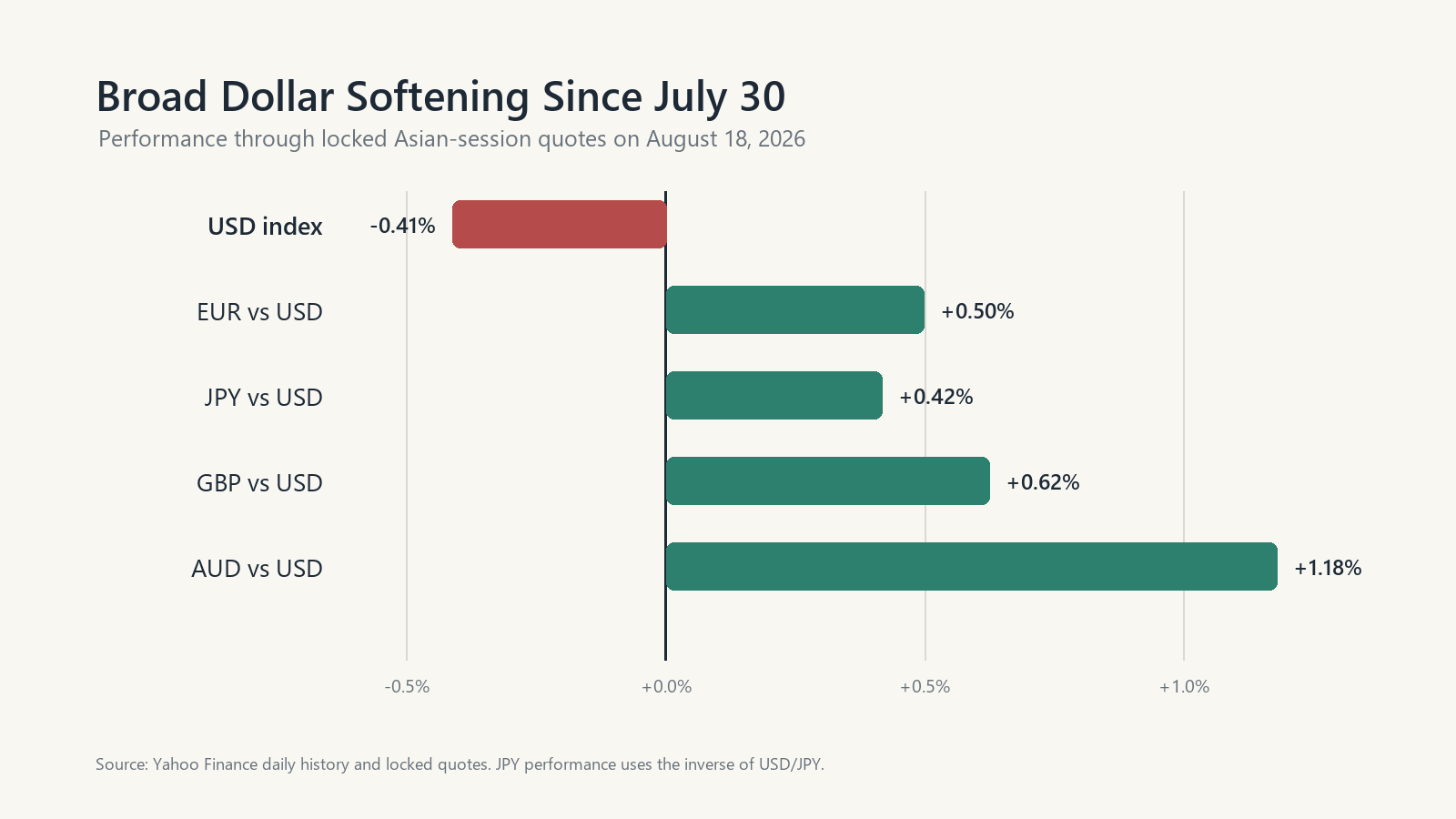
The Australian dollar led the group from the July 30 daily observation through the Asian-session readings, gaining 1.18% against the U.S. currency. Sterling rose 0.62%, the euro 0.50% and the yen 0.42%, while DXY fell 0.41%. The breadth shows that the latest move is not confined to one bilateral pair.
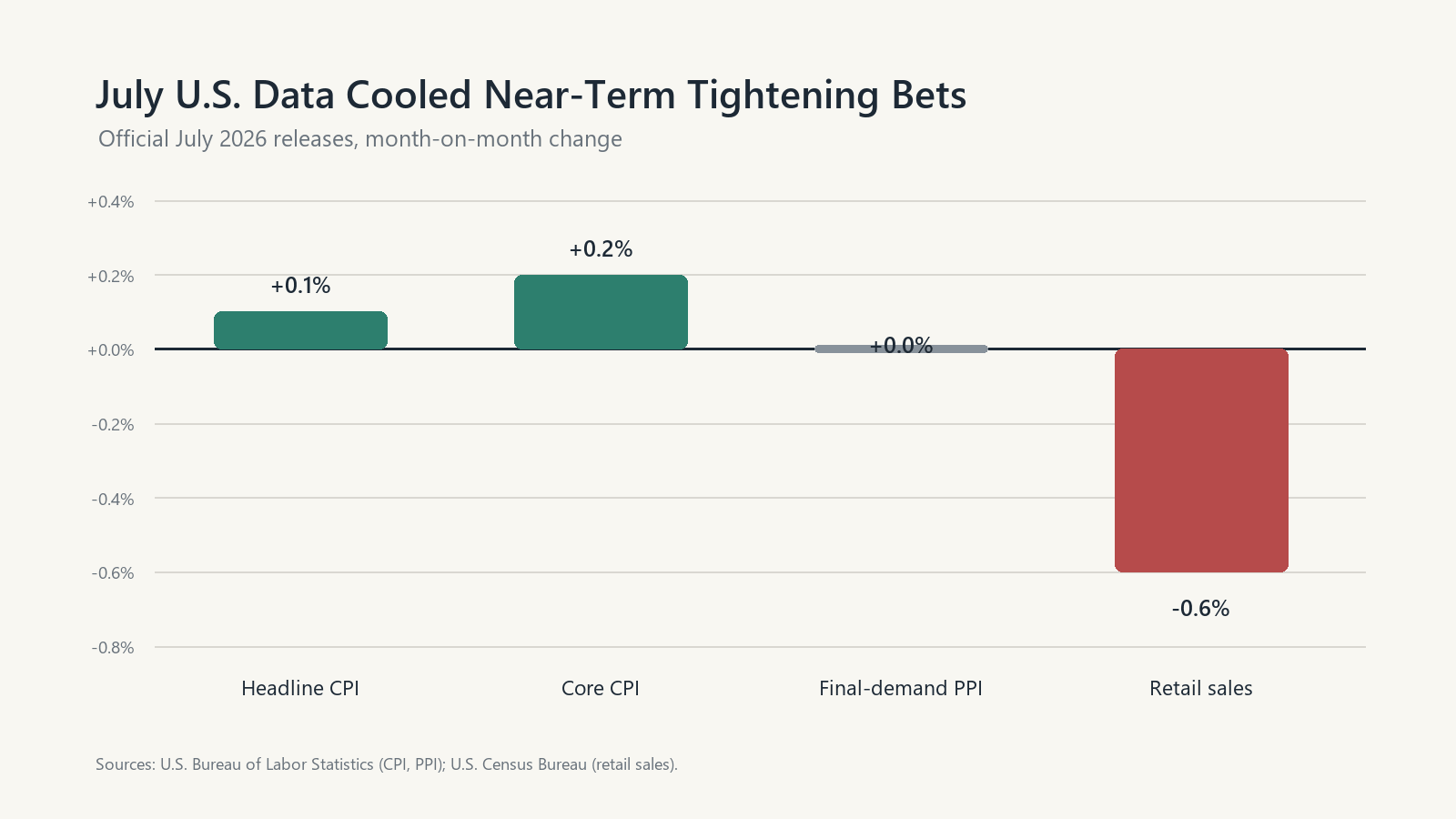
The July data pulse explains why near-term tightening expectations retreated: headline CPI rose 0.1%, core CPI 0.2%, final-demand PPI was flat and retail sales fell 0.6%, all month-on-month. The chart also shows why the policy conclusion should remain qualified—the releases softened momentum, but they do not by themselves settle the medium-term inflation outlook.
Market Outlook and Key Takeaways
The near-term base case is a softer but two-sided dollar. More weak U.S. activity or inflation data would reinforce the rate-driven pressure visible across major currencies. The counter-risk is that renewed Middle East stress lifts energy prices, inflation compensation or safe-haven demand, allowing the dollar to recover even as domestic data cool.
For the yen, intervention risk remains an important constraint, but the BOJ-Fed policy gap still argues against assuming a lasting reversal. The July FOMC minutes, scheduled for August 19 at 2:00 p.m. ET, are the next official test of how policymakers balance elevated inflation against softer demand. Further yen weakness would also refocus attention on Tokyo's communication and the Ministry of Finance's forthcoming intervention data.
Sources and References
-
MUFG, Scotiabank and OCBC — institutional FX outlooks
Enjoyed this article? Share it with your network!


RYOEX Official Media is an information platform created specifically for traders, offering the latest news, analysis, guides, and more. From beginners to experienced traders, we provide useful content to help you stay informed and succeed in your trading endeavors.


