


Dollar Softens as U.S. Data Cool Rate Bets, Yen Tests Intervention Support

 August 17, 2026


The dollar began Monday on the defensive after weaker U.S. retail sales reinforced the softer signal already coming from employment and inflation data. The U.S. Dollar Index stood at 99.57, down 0.10%, while EUR/USD was 1.1580, up 0.06%, and USD/JPY was 159.09, down 0.13%, in early-Asia reference readings.
Japan’s fresh second-quarter GDP release offered the yen only limited support, leaving the policy-rate gap and the credibility of earlier intervention as the larger forces around USD/JPY. China’s July activity release was scheduled for 10:00 Beijing time, but the official publication pages had not posted it by 10:04, so no activity figures are used here. The next tests include Canadian inflation, UK labour data, U.S. activity releases and the July FOMC minutes.
FX Market Overview
The early Asian session extended Friday’s mild dollar weakness rather than producing a major break. At 00:03 UTC, the delayed DXY reading was 99.57 versus a 99.67 previous close. EUR/USD was 1.1580 at 01:40 UTC and USD/JPY was 159.09 at 01:36 UTC. Sterling and the Australian dollar also edged higher: GBP/USD was 1.3546, up 0.08%, and AUD/USD was 0.7090, up 0.07%.
These readings have separate timestamps and are delayed, so the cross-section is directional rather than a synchronous executable snapshot. A Wall Street Journal Asia update at 00:52 GMT likewise described regional currencies as slightly stronger against the dollar as expectations of a September Fed increase receded. The move was orderly: the dollar was softer, but the yen’s small advance did not erase its broader underperformance.
Key Currency Drivers and Analysis
Softer U.S. data weigh on the dollar, but the Fed debate remains open
The immediate dollar headwind is the accumulation of softer official releases. July retail sales fell 0.6% from June. Payroll employment declined by 23,000 in July and the unemployment rate was 4.1%. Headline CPI rose 0.1% month on month and 3.4% year on year, while core CPI increased 0.2% and 2.5%, respectively. Headline producer prices were unchanged on the month, although the measure excluding food, energy and trade services rose 0.4%.
That mix weakens the case for an imminent rate increase without eliminating inflation risk. The Federal Reserve held its target range at 3.50%–3.75% on July 29, but the 9–3 vote included three dissents in favour of a 25-basis-point increase. The divergence matters: growth-sensitive releases are cooling, yet the committee is not uniformly comfortable with the inflation outlook.
MUFG argues that softer employment, wage and retail data give the Fed more room to hold in September and leave the dollar vulnerable in the near term. ING similarly sees moderate EUR/USD upside and estimated short-term fair value around 1.1600–1.1650, while noting that a cleaner break above 1.1600 may need more dovish Fed communication. The counter-risk is clear in MUFG’s own analysis: low volatility, carry demand and U.S. equity inflows can still support the dollar even when the data impulse softens.
Yen remains a policy battleground despite positive headline GDP
Japan’s first estimate showed real GDP growing 0.3% quarter on quarter in the second quarter, or 1.1% annualised. The composition was less supportive than the headline: domestic demand subtracted 0.2 percentage point, household consumption fell 0.1% and business investment declined 1.2%, while net exports contributed 0.5 percentage point.
The Bank of Japan had already held its overnight rate around 1.0% on July 31 in an 8–1 vote; the dissent favoured 1.25%. That gradual policy stance leaves the yen exposed to the U.S.–Japan rate gap. Reuters reported on August 3 that Japan and the United States had confirmed a rare joint yen-buying intervention. However, Japan’s Ministry of Finance has not yet published the intervention total for the current reporting window, so no amount can be verified.
The underlying pressure is visible beyond USD/JPY. ECB reference rates show EUR/JPY rising from 180.73 on August 3 to 183.93 on August 14. Institutional views also diverge. ING sees scope for USD/JPY below 158 if the Fed remains unchanged in September, while Westpac argues that, without renewed intervention, a move near 160 is more plausible than a return to 165 in the foreseeable future. Both views imply that intervention alone is unlikely to settle the yen debate; U.S. rate expectations and BOJ policy remain decisive.
Euro and Asian FX gain modestly, with China data still pending
The euro’s mild advance is consistent with a softer dollar rather than a fresh ECB shock. The ECB held its deposit, main refinancing and marginal lending rates at 2.25%, 2.40% and 2.65% on July 23. Its reference EUR/USD rate moved only from 1.1535 on August 3 to 1.1567 on August 14, underscoring that the recent move has been modest.
Westpac sees narrowing U.S. economic outperformance and fiscal strain as longer-term dollar headwinds, complementing ING’s more tactical euro view. Asian FX also drew some support from reduced Fed-tightening expectations. Still, the Australian-dollar reading preceded China’s scheduled July activity release. Because the official Chinese and English publication indexes remained unchanged at the cutoff, the report does not substitute forecasts or prior-month values for the missing release.
Key Charts and Market Data
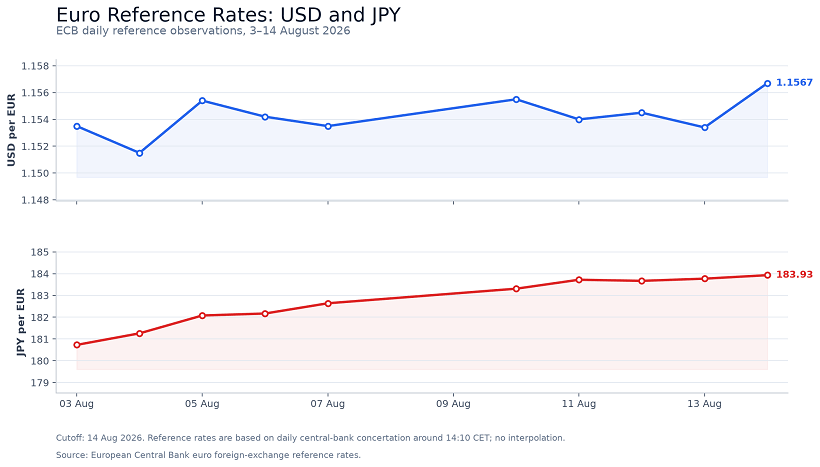
The ECB series shows a narrowly higher euro against the dollar but a much clearer rise in EUR/JPY through August 14. The contrast supports the view that broad dollar softness has not automatically translated into durable yen strength. The observations are official daily reference rates and are not intraday trading prices.
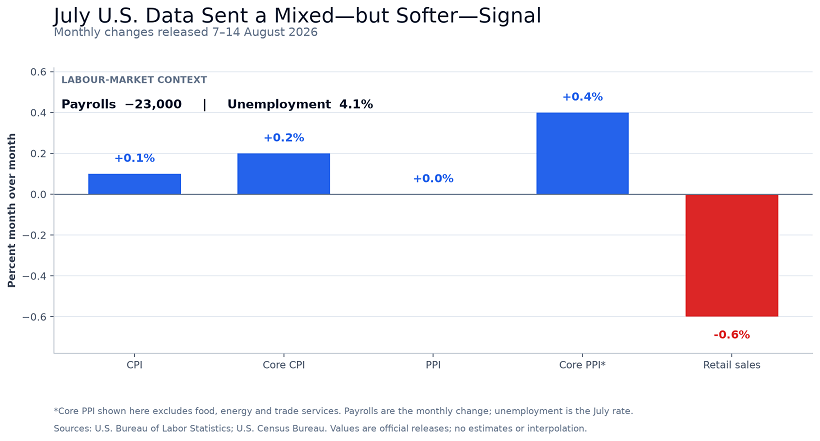
The U.S. data pulse is mixed rather than uniformly weak: headline inflation and producer prices were restrained, core measures were firmer, and retail sales and payrolls contracted. That combination explains both the dollar’s softer tone and the continuing disagreement inside the Fed.
Market Outlook and Key Takeaways
The near-term narrative favours a softer dollar, but it is not one-way. Weak retail sales and employment reduce the urgency of another Fed increase, while three FOMC dissents and firmer underlying producer prices preserve a hawkish counter-case. For the yen, intervention risk can generate sharp moves, but lasting direction still depends on the rate gap and whether the BOJ’s gradualism changes.
The calendar can quickly test that balance. Canada’s July CPI is due later Monday; UK labour data and U.S. import prices and industrial production follow Tuesday; July FOMC minutes arrive Wednesday; China’s loan prime rates are due Thursday; and Japan’s July CPI is scheduled Friday. China’s delayed activity release is an additional near-term uncertainty until an official publication becomes accessible.
Sources and References
-
U.S. official releases: Federal Reserve, CPI, PPI, employment and retail sales.
-
Japan official releases: Cabinet Office GDP, Bank of Japan and Ministry of Finance intervention schedule.
-
European Central Bank: monetary-policy decision and euro reference rates.
-
China NBS: 2026 release calendar and live data-release index.
-
Market reporting: Reuters on joint yen intervention and Wall Street Journal Asia FX update.
-
Official release calendars: Statistics Canada, ONS, BLS, Federal Reserve, ChinaMoney and Statistics Bureau of Japan.
Enjoyed this article? Share it with your network!


RYOEX Official Media is an information platform created specifically for traders, offering the latest news, analysis, guides, and more. From beginners to experienced traders, we provide useful content to help you stay informed and succeed in your trading endeavors.


