


Dollar Softens on Benign U.S. Inflation as Yen's Intervention Support Fades

 August 14, 2026


The dollar eased modestly in early Asian trade on Friday as a flat July U.S. producer-price reading reinforced signs that near-term inflation pressure is cooling. Delayed intraday observations showed the ICE U.S. Dollar Index at 99.91 at 00:06 UTC, EUR/USD at 1.1536 at 01:31 UTC and USD/JPY at 159.44 at 01:29 UTC. The moves were small: the index was down 0.05% from its previous close, the euro was up 0.06%, and USD/JPY was down 0.04%.
The restrained daily changes mask a sharper policy debate. Softer U.S. data have reduced the immediate case for another Federal Reserve increase, but elevated year-on-year producer inflation and geopolitical pressure on energy prices still limit the dollar's downside. For the yen, expectations of further Bank of Japan tightening are running against negative real rates, import-cost pressure and the fading impact of recent intervention. U.S. retail sales later Friday are the next scheduled test of that balance.
FX Market Overview
The dollar entered Asia on a mixed-to-softer footing after U.S. final-demand producer prices were unchanged in July. Reuters reported that federal-funds futures implied about a 35% probability of a September rate increase, below levels seen earlier in the week. At the same time, oil-market and Middle East risks continued to support defensive dollar demand, helping explain why the response to the inflation data was measured rather than disorderly.
The euro was the clearest beneficiary among the three reference markets, with EUR/USD at 1.1536. Its 0.06% rise from the previous close was consistent with a modest narrowing in perceived U.S. policy support rather than a fresh euro-area catalyst. The dollar index remained close to 100, underscoring that investors have not abandoned the U.S. currency while the Fed's next move remains uncertain.
USD/JPY slipped fractionally to 159.44 in the Asian reference window, indicating a small yen recovery on the day. That move did not reverse the broader picture. Reuters reported that the yen was heading for a weekly decline of about 1%, its largest in three months, after giving back roughly half of the gains associated with late-July and early-August intervention. The contrast between the daily tick and the weekly trend is important: intervention risk can alter short-term positioning, but the underlying yield and energy backdrop continues to constrain the currency.
Key Currency Drivers and Analysis
U.S. inflation data weaken the near-term rate case, not the dollar's floor
The July inflation releases delivered a softer monthly signal. Consumer prices rose 0.1% month on month and 3.4% from a year earlier, while core CPI increased 0.2% on the month and 2.5% on the year. The following day's producer-price report showed final demand unchanged on the month, with goods prices down 0.7% and services prices up 0.2%. Those figures support the view that the recent acceleration in pipeline pressure is not broadening at the same pace.
Policy settings nevertheless remain restrictive and contested. The Fed held its target range at 3.50%-3.75% on July 29, with three voting members preferring a 25-basis-point increase. Noel Dixon of State Street Global Markets told Reuters that the benign CPI and PPI releases strengthened the case for the Fed to remain on hold. MUFG's Lloyd Chan offered the counterweight: a dollar index near 100 and USD/JPY near 160, despite softer PPI, show that sticky inflation and the Fed's inflation-fighting posture still give the dollar resilience. The divergence is less about whether July's monthly data softened and more about whether they are sufficient to offset persistent annual inflation and energy risks.
The euro gains from relative repricing
The euro's advance primarily reflected the U.S. side of the pair. A reduced near-term probability of a Fed increase lowers the marginal yield support for the dollar, while the absence of a comparable negative euro-area surprise allowed EUR/USD to move above its previous close. The gain was limited, however, because the U.S. policy debate has shifted toward delay rather than a clear easing path. Incoming euro-area activity data and any renewed move in energy prices could quickly change that relative-rate interpretation.
Yen policy support collides with structural pressure
The BOJ kept its overnight rate around 1.0% on July 31 by an 8-1 vote; board member Hajime Takata preferred 1.25%. A subsequent Summary of Opinions showed that some meeting participants saw risks from yen weakness, oil prices and artificial-intelligence-related demand, and some thought the pace of increases could become faster than markets expected. These were individual meeting views, not a new committee commitment.
ING argues that modestly hawkish BOJ communication alone may not deliver sustained yen appreciation, because energy costs and the Fed's reaction function remain more powerful drivers of USD/JPY. Recent price action is consistent with that caution. Reuters has reported intervention around the late-July and early-August move, but official Japanese monthly operation data covering July 30 through August 26 are not scheduled for release until August 28. The operation's official scale therefore remains unavailable, and no official amount can yet anchor estimates of its durability.
Key Charts and Market Data
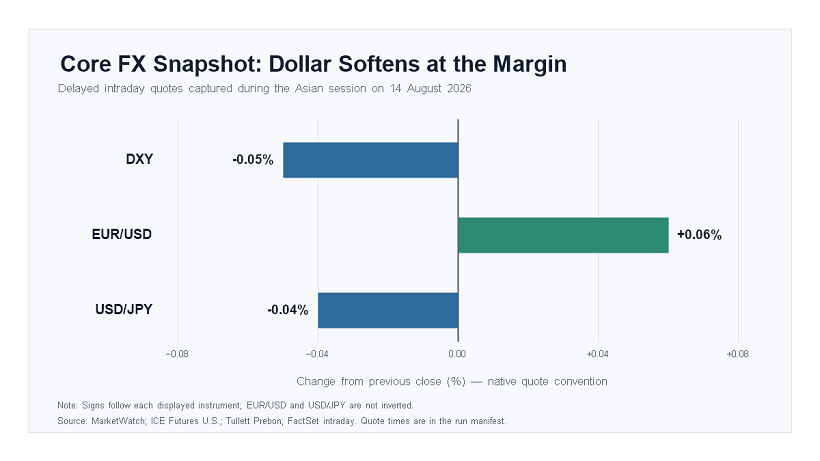
The core snapshot shows how narrow the latest daily moves were. The euro's 0.06% gain was the largest of the three reference changes, while the dollar index and USD/JPY were both only marginally lower. The chart uses each market's native quote direction, so the small decline in USD/JPY represents a slight yen gain against the dollar.
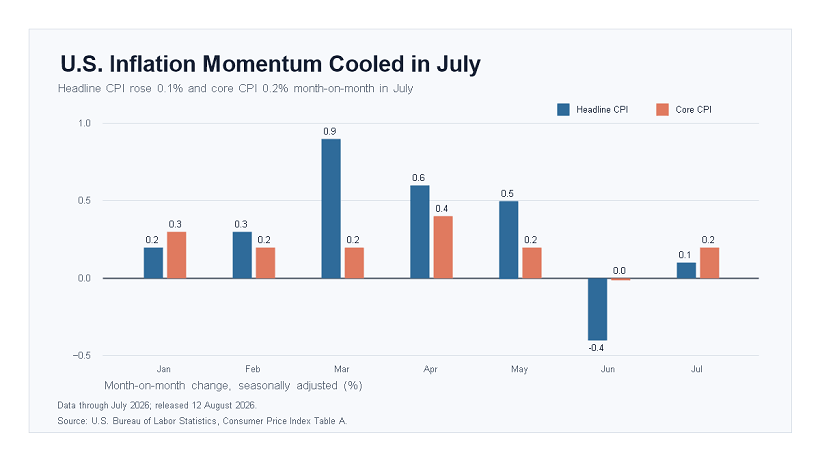
Monthly CPI momentum has been volatile in 2026, but July's 0.1% headline and 0.2% core readings were subdued relative to the spring. The chart also shows why one benign release is not decisive: headline inflation accelerated sharply earlier in the year, while core inflation has remained positive in every month except June's flat reading.
Market Outlook and Key Takeaways
The immediate FX narrative is a restrained dollar pullback rather than a decisive trend reversal. Softer CPI and PPI data have reduced near-term Fed tightening expectations, supporting the euro and allowing a modest yen recovery, but annual inflation, energy risks and the Fed's divided stance preserve a dollar floor. In Japan, faster-normalisation expectations and renewed intervention risk can create sharp counter-moves, yet the yen's weekly decline shows that those forces have not displaced the yield and import-cost constraints.
July U.S. retail sales, scheduled for 08:30 ET on Friday, are the next major data point. A strong demand reading would reopen the question of how long the Fed can remain on hold; a weak result would add to evidence from employment and monthly inflation that U.S. momentum is cooling. Beyond the calendar, oil prices, Middle East headlines and official Japanese currency-policy communication remain the most important unscheduled risks.
Sources and References
Enjoyed this article? Share it with your network!


RYOEX Official Media is an information platform created specifically for traders, offering the latest news, analysis, guides, and more. From beginners to experienced traders, we provide useful content to help you stay informed and succeed in your trading endeavors.


