


Dollar Slips Ahead of FOMC as July Rate-Hike Odds Hover Near 30%

 July 29, 2026

The U.S. dollar edged lower on Tuesday as markets weighed renewed geopolitical uncertainty, softer private-sector hiring and an implied probability of about 30% that the Federal Reserve would raise rates in July. The FOMC decision and Chair Kevin Warsh’s press conference are the main near-term catalysts, while the growing volume of short-term U.S. government debt may constrain the Fed’s room to maneuver.
Forex Market Overview
The U.S. Dollar Index ended Tuesday down 0.11% at 101.25 after recovering from its intraday low. The benchmark 10-year U.S. Treasury yield closed at 4.608%, while the two-year yield, which is more sensitive to Federal Reserve policy expectations, ended at 4.293%.
Tensions between the United States and Iran briefly showed signs of easing, but the risk of renewed conflict remained elevated. The confrontation between Houthi forces and Saudi Arabia added to the uncertainty.
FOMC Decision Takes Center Stage
Markets are assigning an implied probability of about 30% to a Federal Reserve rate increase in July. Open interest in federal funds futures has reached a record high, underscoring the scale of positioning ahead of the decision. The source material also argues that markets may be reinforcing their own hawkish expectations and that the dollar could continue to attract buyers unless Warsh clearly pushes back against those expectations.
The FOMC is scheduled to announce its rate decision at 6:00 p.m. UTC, followed by Warsh’s monetary policy press conference at 6:30 p.m. UTC. Markets will focus not only on whether rates change, but also on how the Fed characterizes renewed energy-related inflation risks, whether it keeps the possibility of a September rate increase open and how much concern it expresses about weakening labor-market conditions.
The June personal consumption expenditures price index is scheduled for release at 12:30 p.m. UTC later in the source’s event schedule. Other releases include Switzerland’s July ZEW investor confidence index at 8:00 a.m. UTC and the United Kingdom’s June mortgage approvals at 8:30 a.m. UTC, with the latter reported in units of 10,000.
Central Bank Expectations Shape Major Currencies
The Bank of Japan is widely expected to leave policy unchanged this week. According to the source material, a sustained yen rebound may require supportive developments from both the Federal Reserve and the Bank of Japan.
Sterling may also face increased volatility as the Fed and the Bank of England announce their latest policy decisions. Markets broadly expect both central banks to leave rates unchanged, shifting attention to their policy language and subsequent press conferences. Any unexpected rate change, however, would put the decision itself back at the center of market attention.
The European Central Bank left its deposit rate unchanged at 2.25% last week, but its language was sufficiently hawkish for markets to begin pricing in the possibility of a 25-basis-point increase in September. The source material attributes much of that hawkishness to energy prices, leaving the euro outlook sensitive to how those inflation pressures develop.
Short-Term Treasury Supply Has Conflicting Implications for the Dollar
The volume of short-term U.S. government debt has exceeded $8.3 trillion, creating unusually heavy refinancing pressure. The source material says the 10-year Treasury yield has risen to 4.7%, while annualized federal interest expenditure has reached $1.35 trillion, one-quarter more than defense spending. It also reports that foreign buyers have continued to reduce their holdings, adding to concerns about Treasury-market liquidity.
The expansion of short-term Treasury issuance is described as a double-edged factor for the dollar. In the near term, continued issuance may push yields higher, attract foreign capital and combine with safe-haven demand to support the currency. Over the longer term, the $8.3 trillion stock of short-term debt and its associated interest burden may weaken confidence in U.S. government debt. Expectations of debt monetization could also erode the dollar’s longer-term credibility.
Forex Outlook: Global Market Views
This section reviews the main views on the foreign exchange market from global financial institutions and market participants. Each view has been summarized and restructured by the RYOEX Research Team based on publicly available information. References to any institution or individual do not imply endorsement of RYOEX or its views.
Mohammed Taha Boukhari | The Fed’s Tone Will Test the Dollar’s Rebound
Boukhari argues that the dollar’s decline in 2025 was not driven solely by “de-dollarization.” Uncertainty over tariff policy, concerns about U.S. economic policy, the large fiscal deficit and questions about policy credibility have also weighed on U.S. assets and the dollar. The current rebound is testing whether stronger cyclical factors can overcome those broader concerns.
In a bullish scenario, the Fed would need either to deliver an unexpected rate increase or leave rates unchanged while sending a strongly hawkish signal. Renewed strength in oil prices and higher U.S. Treasury yields would also be required. Under that scenario, a sustained break by the U.S. Dollar Index above 102 would confirm stronger upside momentum and create room for a broader rebound.
Boukhari’s more realistic baseline is for the Fed to leave rates unchanged while maintaining a hawkish stance and keeping a possible September increase on the table. If oil remains volatile but below last week’s highs, the Dollar Index could stay within a 100.60-102.00 range as markets await the next inflation and economic reports.
In a bearish scenario, the Fed would place greater emphasis on weaker employment growth and the recent cooling in inflation. Progress in diplomatic negotiations could also push oil prices and Treasury yields lower. A decline in the Dollar Index below the 100.60-100.70 area would weaken the current rebound structure, while a move below 100 would put the broader bullish structure under greater pressure.
Boukhari says the immediate reaction in Treasury yields and the Dollar Index near resistance at 102 will offer the clearest indication of whether the dollar’s rebound can continue or the currency will remain within a broader range.
Kris Allen | Fed and Bank of England Meetings Could Increase GBP/USD Volatility
Allen expects GBP/USD volatility to increase around this week’s Federal Reserve and Bank of England decisions. If both central banks leave rates unchanged as expected, attention is likely to shift quickly to their statements and press conferences. An unexpected move by either central bank would instead make the rate decision the primary focus.
For the Fed, resilient economic data and easing inflation pressures mean policymakers have little urgency to signal their next step clearly. The Bank of England faces a different balance. U.K. inflation has declined and economic growth remains weak, but the recent rebound in oil prices has renewed concerns about how quickly inflation could rise again in the second half of the year.
With baseline expectations for both meetings relatively stable, even small changes in policy language could alter investors’ views of the rate path over the coming months.
Since mid-July, GBP/USD has traded within a clear descending channel, forming lower highs and lower lows. Allen describes the decline as orderly rather than severe, suggesting that sellers remain in control but the market has not experienced the panic selling often associated with a major breakdown.
The channel’s upper boundary remains the key level in Allen’s framework. As long as the pair stays below it, the short-term downward structure remains intact. A clear break above the boundary would suggest that the structure is beginning to change. A move below the recent low could signal that sellers are trying to extend the decline and bring longer-term support areas back into focus.
James Stanley | Hawkish Pricing Sets a High Bar for Further Dollar Gains
Stanley describes an unusual degree of hesitation ahead of the FOMC meeting. Markets assign an implied probability of about 30% to an immediate rate increase. The Fed has historically used policy communications and media interviews to prepare markets for major decisions, limiting surprises and volatility, but Stanley says it has not done so this time. That could produce a relatively pronounced market reaction.
Looking toward year-end, markets see a probability of nearly 90% that the Fed will raise rates at least once and about a 50% probability of at least two increases. Stanley notes that such an outcome would make a Fed chair personally selected by President Trump appear to be rejecting the president’s preference for lower interest rates. He also highlights the political context of a U.S. election in November.
The dollar broke higher after the previous Fed meeting on June 17 and continued rising to its current highs. That performance has set a high bar for further gains. Stanley argues that the Fed would need to deliver a very hawkish message and show clear concern that inflation is not moving in the right direction for markets to price an even more hawkish policy path.
The June meeting included updated policy guidance and economic projections. The upcoming meeting will include only a policy statement and press conference, without new economic forecasts, putting greater focus on Warsh’s comments. After last month’s policy decision and Summary of Economic Projections, the Dollar Index rose sharply to a new high for the year before encountering resistance near a Fibonacci level around 101.80.
Stanley says the Fed only needs to sound less hawkish than markets expect to trigger a dollar pullback. He considers that outcome potentially preferable from Warsh’s perspective, particularly given conditions in USD/JPY and the possible response at the long end of the Treasury yield curve if market sentiment is disrupted. Even so, Stanley says the dollar’s short-term bullish structure remains consistent with the longer-term backdrop.
Joshua Gibson | Energy-Driven ECB Expectations May Offer Limited Euro Support
Gibson says the ECB’s decision to leave its deposit rate at 2.25% was accompanied by language hawkish enough for markets to consider a 25-basis-point increase in September. However, he argues that nearly every component of that hawkish stance stems from energy prices.
Eurozone inflation slowed to 2.8% year over year in June from 3.2% in May. ECB staff expect average inflation to be close to 3.0% in 2026, with the projection driven almost entirely by the energy component.
In Gibson’s view, removing the war-related premium would lower the inflation forecast and weaken expectations for a September rate increase. Lower energy costs would improve the eurozone’s terms of trade, but that benefit would come alongside a reduced interest-rate advantage, which he considers the more important effect.
The shift in U.S. rate expectations has not been symmetrical. Interest-rate futures show a probability slightly above 30% of a July Fed increase, down from just under 36% over the weekend. At the same time, the cumulative probability of at least one increase by December remains above 91%, while the probability of two or more increases is close to 58%. Near-term rate-hike expectations have therefore eased, but expectations for the eventual policy rate have risen further.
Gibson attributes that resilience to structural U.S. inflation pressures. Import prices are up more than 7% year over year, the tariff list continues to expand, and higher prices are passing through to food and raw materials. He argues that this transmission is affected by lags such as planting seasons rather than gasoline prices. Peace in the Strait of Hormuz would therefore not change those pressures, even if the same development reduced the case for an ECB rate increase.
Growth expectations also weigh on the euro in Gibson’s analysis. Markets expect eurozone growth of about 0.8% in 2026, compared with an annualized U.S. growth rate of about 2.1% in the second quarter. He therefore sees capital-flow and interest-rate considerations pointing in the same direction. At least one of those factors would need to improve before the bottom of the euro’s range could be viewed as a genuine base rather than a temporary pause in a continuing decline.
Key Forex Market Charts
This section highlights charts that help explain recent moves in the foreign exchange market, with a focus on changes in monetary policy expectations, interest-rate differentials, economic data and market sentiment. The charts and data are based on third-party information and do not represent RYOEX's views or indicate future exchange-rate movements. Given the risk of sudden market swings, appropriate risk management remains essential.
Four-Week Average of ADP Employment Gains Falls to a Record Low
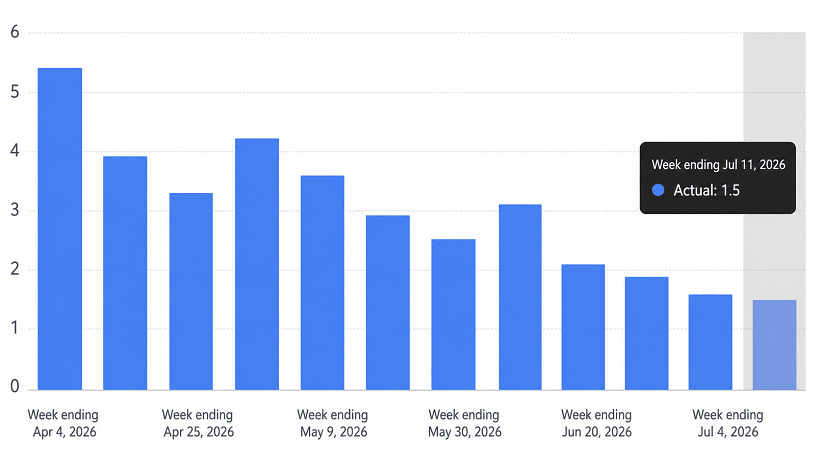
Data released overnight showed that the four-week average increase in ADP employment was only 15,000 in the week ended July 11. The measure has declined since June and reached the lowest level in the series. Continued cooling in private-sector hiring suggests that a near-term Fed rate increase could put further pressure on an already weak labor market. The source material views the development as negative for the dollar.
Implied Probability of a July Fed Rate Increase Falls to 30.5%
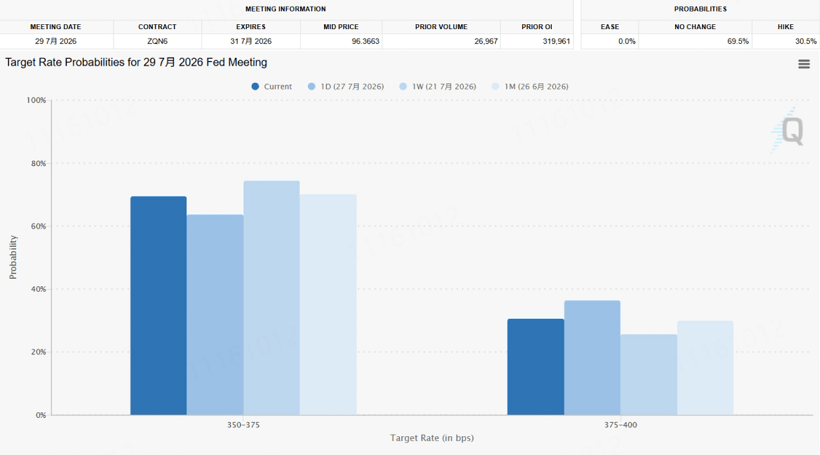
Markets modestly reduced expectations for a rate increase after the employment data. CME data showed that the implied probability of a July increase had fallen to 30.5%. The source describes this as a highly uncertain level because neither a rate increase nor an unchanged decision is fully priced in. Volatility could therefore be significantly higher than usual during the FOMC announcement and Warsh’s press conference.
U.S. Dollar Index Remains Within the 101-102 Range
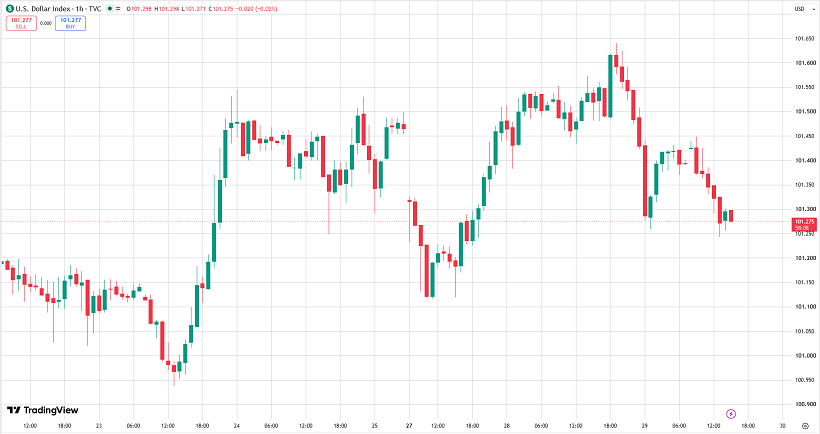
The U.S. Dollar Index has continued to fluctuate between 101 and 102 this week as investors avoid aggressive positioning ahead of the July FOMC decision. The source material says a dovish decision and press conference could give Japanese authorities an opportunity to intervene in the foreign-exchange market, potentially pushing USD/JPY sharply lower. However, it considers that scenario less likely because Warsh previously said he would try to avoid providing forward guidance.
Short-Term U.S. Treasury Debt Exceeds $8.3 Trillion
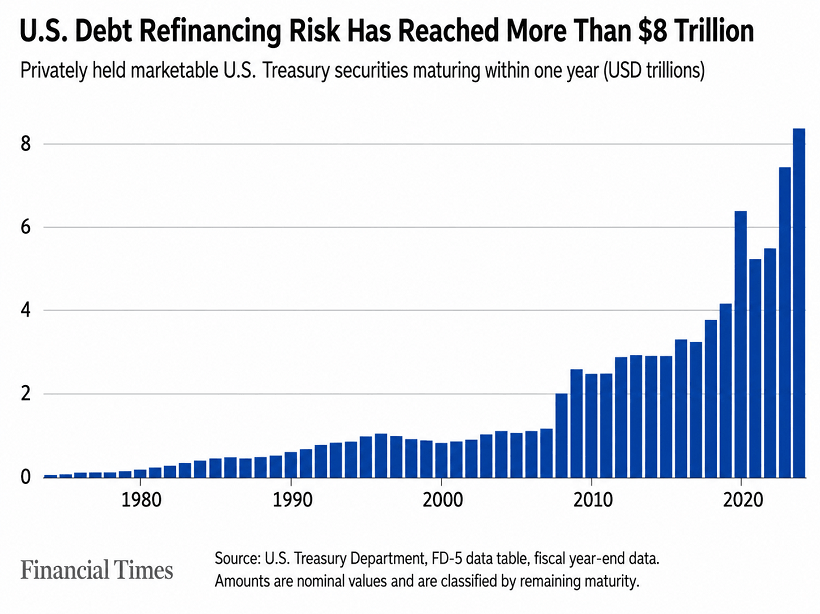
The chart tracks privately held marketable U.S. Treasury securities maturing within one year, measured in trillions of dollars. The total has exceeded $8.3 trillion, creating concentrated refinancing pressure. The source material says higher issuance may support the dollar in the short term by lifting yields and attracting foreign capital. However, the associated interest burden and declining foreign demand could weaken confidence in U.S. government debt and the dollar over the longer term.
Summary
The dollar ended modestly lower ahead of an FOMC decision for which markets assign roughly a 30% probability of a July rate increase. Softer private-sector hiring, elevated geopolitical uncertainty and the Fed’s limited advance signaling leave the outlook unsettled. Heavy short-term Treasury issuance may support the dollar through higher yields but raise longer-term credibility concerns. The FOMC statement, Warsh’s press conference, the June PCE price index and policy signals from the Bank of England and Bank of Japan are the main upcoming market focuses.
Enjoyed this article? Share it with your network!


RYOEX Official Media is an information platform created specifically for traders, offering the latest news, analysis, guides, and more. From beginners to experienced traders, we provide useful content to help you stay informed and succeed in your trading endeavors.


