


Dollar Pullback Remains Limited as Crowded Long Positions and Fed Risks Persist

 July 27, 2026

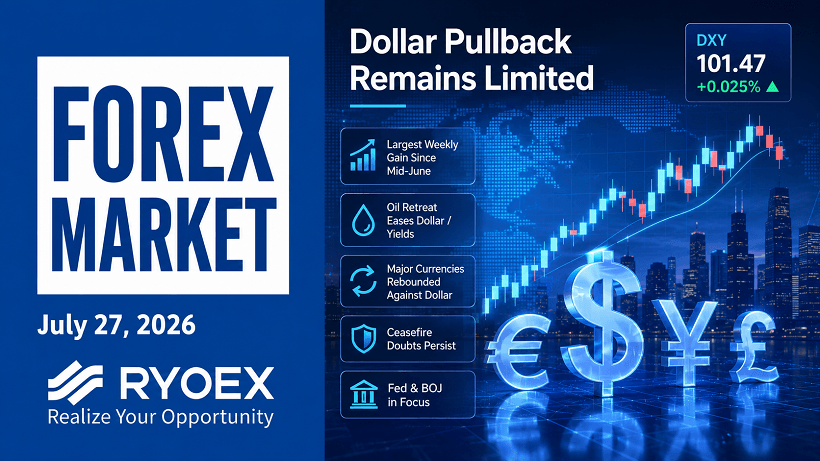
The U.S. Dollar Index ended Friday 0.025% higher at 101.47, posting its largest weekly gain since mid-June. A retreat in oil prices later pulled the dollar and U.S. Treasury yields away from recent highs, supporting a rebound in major currencies against the dollar. However, doubts about whether the U.S.-Iran ceasefire will hold and uncertainty ahead of Federal Reserve and Bank of Japan decisions kept sentiment cautious.
Forex Market Overview
Dollar and Treasury Yields Retreat From Recent Highs
The U.S. Dollar Index traded sideways near elevated levels on Friday before closing 0.025% higher at 101.47. The benchmark 10-year U.S. Treasury yield ended at 4.687%, while the policy-sensitive two-year yield closed at 4.342%.
Lower oil prices helped drive declines in the dollar and Treasury yields, allowing major currencies to rebound against the dollar. Sentiment improved somewhat amid signs of easing U.S.-Iran tensions. However, the pullback in both the dollar and yields remained modest, while oil showed signs of recovering, suggesting investors remained uncertain about whether the de-escalation would last.
Interest-rate markets sharply increased the implied probability of a Federal Reserve rate increase at its July meeting after oil prices surged last week. The probability rose to 36.3% from about 13% a week earlier. Although an increase was still not considered the most likely outcome, the shift in expectations could help keep the dollar and Treasury yields elevated.
U.S.-Iran De-escalation Supports Sentiment, but Doubts Remain
President Donald Trump ordered a pause in U.S. airstrikes on Iran, prompting Tehran to suspend retaliatory attacks. A senior Iranian source said Iran would continue to refrain from attacks as long as the United States maintained the ceasefire. Saudi media reported that Iran had not withdrawn from negotiations and remained willing to continue talks with the United States at multiple locations in Geneva.
Iran also reported progress in talks with Oman over shipping management in the Strait of Hormuz. Separately, Iranian media said an oil tanker struck a mine and exploded in the strait, while an Iranian official said facilities in Hormuz were “currently empty.” Qatar’s Ministry of Transport said all forms of maritime transport and vessel navigation would fully resume from July 26. Saudi Arabia also confirmed that a multinational coalition had struck Houthi forces in Yemen.
The United States and Iran carried out no further attacks for two consecutive nights after Trump halted nearly two weeks of airstrikes. Even so, investors remained skeptical following repeated reversals since the conflict began. Prediction-market data showed a probability of less than 10% that the two sides would reach a final nuclear agreement by August 31 and about a 33% probability that an agreement would be signed by year-end. These expectations may limit any further decline in oil prices.
In a separate geopolitical and trade development, Trump accused the European Union of “plundering” U.S. companies and threatened to launch a Section 301 investigation and impose large-scale tariffs.
Central Bank Decisions and U.S. Data Take Center Stage
The Federal Reserve’s policy decision on Wednesday is the week’s main scheduled risk event. Markets will focus on whether the central bank changes rates, as well as the tone of its policy statement and Chair Warsh’s press conference. The Bank of Japan decision will follow, with the policy rate expected to remain unchanged. Investors will instead focus on the BOJ’s updated forecasts and Governor Kazuo Ueda’s press conference.
The advance estimate of U.S. second-quarter gross domestic product is expected to be the week’s most potentially volatile data release, providing the first broad reading of the U.S. economy during the war with Iran. June personal income, spending and core PCE data are due Thursday, followed by the Employment Cost Index on Friday.
The day’s U.S. calendar includes June durable goods orders at 12:30 p.m. UTC and the July Dallas Fed Business Activity Index at 2:30 p.m. UTC.
Forex Outlook: Global Market Views
This section reviews the main views on the foreign exchange market from global financial institutions and market participants. Each view has been summarized and restructured by the RYOEX Research Team based on publicly available information. References to any institution or individual do not imply endorsement of RYOEX or its views.
David Scutt | USD/JPY Outlook Hinges on Fed and BOJ Decisions
David Scutt said USD/JPY delivered the expected bullish breakout last week and reached a new multi-decade high. Whether the pair can extend its advance this week will depend on the Federal Reserve and Bank of Japan policy decisions, along with economic data from both countries.
Overnight index swaps implied roughly a one-third probability of a Fed rate increase. The meeting will not include a Summary of Economic Projections or dot plot, leaving the policy statement and Warsh’s press conference as the main sources of guidance. Scutt said another brief statement echoing June’s wording that “the Committee will achieve price stability” would add to the uncertainty. Warsh has repeatedly said he does not provide forward guidance, preferring markets to assess the data rather than rely on central bank signals.
If the Fed leaves rates unchanged, the dollar could face selling pressure because markets have priced in a relatively high probability of an increase. The subsequent reaction would depend on the statement’s tone and Warsh’s responses during the press conference.
The BOJ is expected to leave its policy rate unchanged. In April, the central bank lowered its fiscal-year 2026 growth forecast but raised its core CPI projection to 2.8% from 1.9%, while maintaining its assessment that inflation risks were tilted to the upside.
Because Japan relies heavily on imported energy, the recent rebound in oil and liquefied natural gas prices may increase inflationary pressure and worsen the country’s terms of trade, creating headwinds for the yen. Tuesday’s core CPI report will exclude subsidies and other government measures, offering a clearer measure of underlying inflation. Traders will assess whether the rebound in energy prices reinforces the BOJ’s view that yen weakness and higher import prices could add to inflation.
Scutt also identified U.S. second-quarter GDP as the week’s release most likely to generate volatility. For Thursday’s personal income and spending report, the key question is whether income growth can sustain spending or whether households will need to draw down savings further. A stronger-than-expected Employment Cost Index on Friday would intensify concerns about persistent services inflation as higher energy prices add further pressure.
Earnings from Microsoft, Meta and Amazon also warrant attention. Scutt said a sharper deterioration in their results could trigger risk aversion and increase the risk of carry-trade unwinding.
Julian Pineda | Yield Differentials May Keep EUR/USD Under Pressure
Julian Pineda noted that the European Central Bank left its deposit facility rate unchanged at 2.25% last week and maintained its main refinancing rate at 2.40%. Its post-meeting statement retained a cautious, wait-and-see stance.
The ECB said inflationary pressures could remain persistent but also emphasized that the European economy might lack sufficient momentum to support continued rate increases. It maintained a broadly neutral stance on future policy adjustments and reiterated that decisions would be made meeting by meeting based on economic data, without committing in advance to a specific policy path.
Pineda said the ECB’s neutral stance did not materially improve the euro’s relative appeal. The central bank did not explicitly confirm the prospect of further rate increases, while the Federal Reserve continued to signal that a more aggressive policy stance could be possible in the coming months.
U.S. 10-year Treasury yields remained above 4.6%, while European bond yields were around 3.6%. Pineda said the yield differential continued to favor dollar-denominated assets. If the U.S.-European yield gap remains unchanged, EUR/USD could continue to face selling pressure over the next several sessions.
Ghiles Guezout | Australian Dollar Remains Resilient as External Risks Grow
Ghiles Guezout maintained a moderately positive baseline view on the Australian dollar. He said the currency continued to benefit from attractive yields, sound institutions, Australia’s AAA sovereign credit rating and an economy that had so far avoided recession. Elevated speculative net short positions also reduced the scope for another large selloff driven solely by speculative activity.
However, conditions were less favorable than earlier in the year. Australia’s housing market was slowing, consumer spending was weakening and productivity remained subdued. China’s economy was stabilizing rather than accelerating, while geopolitical risks and expectations of a further rise in U.S. interest rates were again supporting the dollar.
Guezout said the 0.7000 area could remain a key price level for AUD/USD rather than merely serving as conventional resistance. If U.S. inflation continues to ease and U.S.-Iran tensions subside, a sustained move toward 0.7200 to 0.7500 could become increasingly likely. Conversely, another sharp rise in oil prices combined with further Fed tightening could push the pair back below 0.6900.
The main risk for investors is assuming that Australia’s attractive yield advantage alone can provide lasting support for the currency. Carry trades can support the Australian dollar under stable market conditions, but in a risk-averse, stagflationary environment, the U.S. dollar’s liquidity and safe-haven appeal could again dominate.
Upcoming Australian inflation and labor-market data, energy prices and U.S. inflation reports will help determine which scenario begins to materialize. Guezout said the Australian dollar remained resilient, but its next major move was more likely to depend on developments in Washington, Tehran and Beijing than in Canberra.
Haresh Menghani | Easing Hostilities Weigh on the Safe-Haven Dollar
Haresh Menghani said the United States paused its bombing campaign on Friday night after 13 consecutive nights of airstrikes against Iranian targets. Tehran then suspended retaliatory attacks against U.S. allies in the Middle East.
U.S. Ambassador to the United Nations Mike Waltz said the U.S. military remained on high alert and ready to act, but Trump wanted to leave room for negotiations. The development improved investor sentiment and reduced the dollar’s safe-haven appeal.
The easing of hostilities also drove a sharp decline in oil prices, reducing inflation concerns and cooling expectations for a Fed rate increase. This added pressure on the dollar and pushed the U.S. Dollar Index away from the monthly high it retested last week.
Menghani said traders might avoid large bets on further EUR/USD gains ahead of major central bank decisions. The Fed is due to conclude its two-day policy meeting on Wednesday, and traders will look for new indications about the future policy path. Further developments in the Middle East crisis will also continue to influence demand for the dollar and may generate more substantial moves in EUR/USD.
TD Securities | Fed Expected to Leave Rates Unchanged
TD Securities expects the Federal Open Market Committee to leave its policy rate unchanged at this meeting. The firm acknowledged that the rise in oil prices caused by Middle East tensions had increased inflation risks and strengthened the case for another rate increase.
However, TD Securities said more evidence would still be needed to secure support from a majority of committee members. Hawkish momentum within the committee was increasing, but the firm did not expect Chair Warsh to provide clear policy guidance at this meeting. Hammack and Logan could oppose leaving rates unchanged and cast dissenting votes.
Key Forex Market Charts
This section highlights charts that help explain recent moves in the foreign exchange market, with a focus on changes in monetary policy expectations, interest-rate differentials, economic data and market sentiment. The charts and data are based on third-party information and do not represent RYOEX's views or indicate future exchange-rate movements. Given the risk of sudden market swings, appropriate risk management remains essential.
Markets Remain Pessimistic About a Final U.S.-Iran Agreement
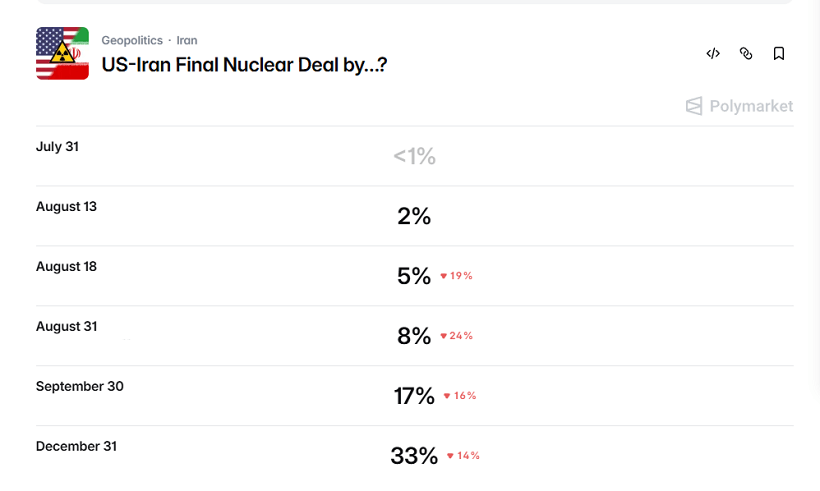
Prediction-market data showed a probability of less than 10% that the United States and Iran would reach a final nuclear agreement by August 31 and about a 33% probability that they would sign an agreement by year-end. The figures illustrate why investors remained cautious despite the recent pause in hostilities and why the decline in oil prices could be limited.
Implied Probability of a July Fed Rate Increase Rises
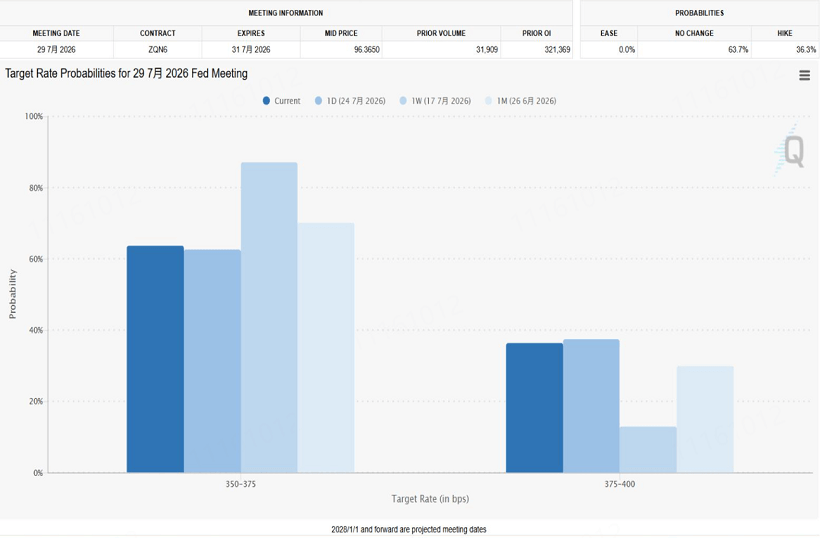
The market-implied probability of a Fed rate increase in July rose to 36.3% from about 13% a week earlier after last week’s surge in oil prices. Although an increase was not the base-case outcome, the shift in expectations could help keep the dollar and Treasury yields elevated.
Dollar and Treasury Yields Pull Back Together
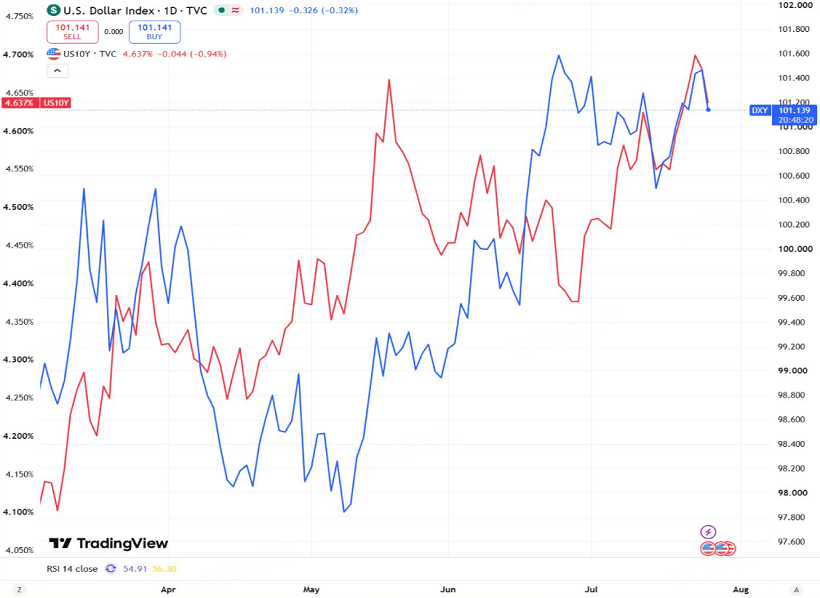
The dollar and U.S. Treasury yields retreated modestly from recent highs as markets responded to signs of easing U.S.-Iran tensions. Major currencies rebounded against the dollar and sentiment improved, but the limited pullback showed that investors remained skeptical about the prospects for lasting peace.
Speculative Dollar Net Positions Rise for a Ninth Week
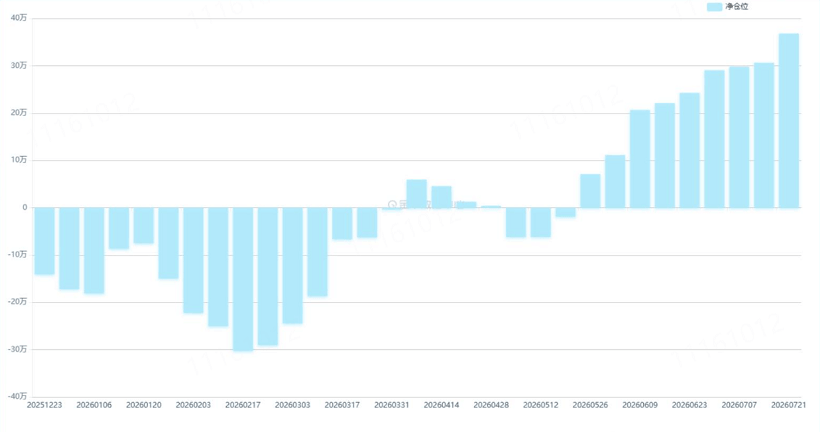
In the week ended July 21, CFTC non-commercial net positioning in the dollar increased for a ninth consecutive week, reaching its highest level since the week of December 15, 2015. The data indicated strong bullish sentiment but also showed that long-dollar positioning had become crowded. If the Fed adopts a softer stance, an unwinding of long positions could expose the U.S. Dollar Index to substantial selling pressure.
At the same time, elevated oil prices and recurring U.S.-Iran tensions may keep the Fed cautious. As long as expectations for a Fed rate increase before year-end do not reverse, the dollar could retain an advantage over major non-U.S. currencies.
Summary
The dollar and U.S. Treasury yields pulled back modestly as lower oil prices and signs of easing U.S.-Iran tensions improved sentiment and supported major currencies against the dollar. The move remained limited, however, as investors questioned whether the ceasefire would hold and markets continued to price in a meaningful probability of a July Fed rate increase. The Federal Reserve and Bank of Japan decisions, U.S. growth and inflation data, Australian economic releases and further Middle East developments will shape the next phase of trading, while crowded speculative dollar positioning leaves the currency vulnerable if the Fed adopts a softer tone.
Enjoyed this article? Share it with your network!


RYOEX Official Media is an information platform created specifically for traders, offering the latest news, analysis, guides, and more. From beginners to experienced traders, we provide useful content to help you stay informed and succeed in your trading endeavors.


