


Dollar Rebounds as U.S.-Iran Tensions Persist and Treasury Yields Rise

 July 24, 2026


The U.S. dollar recovered from an early decline on Thursday as tensions between the United States and Iran persisted, Treasury yields rose and U.S. labor-market data exceeded expectations. The European Central Bank left rates unchanged as expected but kept the door open to a September increase, while markets awaited inflation, retail sales, business activity and housing data.
Forex Market Overview
Dollar Recovers as 10-Year Treasury Yield Hits an 18-Month High
The U.S. Dollar Index initially fell before reaching an intraday high of 101.54. It ended Thursday up 0.33% at 101.44 amid continued U.S.-Iran tensions.
The benchmark 10-year U.S. Treasury yield closed at 4.700%, an 18-month high, while the policy-sensitive two-year yield finished at 4.355%. The rise in long-term yields reflected expectations that U.S. interest rates could remain higher for longer.
Initial U.S. jobless claims fell to 187,000 in the week ended July 18, well below the expected 212,000. Continuing claims also declined to 1.796 million. The figures suggested that companies remained reluctant to cut existing staff even as hiring demand may have cooled, reinforcing the view that the U.S. labor market remained resilient.
FedWatch pricing indicated a roughly 64% implied probability that the Federal Reserve would leave rates unchanged at 3.50%-3.75% on July 29. The implied probability of a 25-basis-point increase to 3.75%-4.00% stood at about 36%, up from approximately 12% a week earlier. The source material attributed this shift to strong employment data and higher oil prices.
Geopolitical risks remained elevated. President Donald Trump said he was “seriously considering” restarting large-scale military operations against Iran and was nearing a decision. He said Iran wanted negotiations but was not yet ready, and warned that the United States would hold Iran responsible if the Houthis resumed attacks on ships. Trump also said damage to ships, cargo or related property would be paid for with Iranian funds currently held and controlled by the United States.
The United States deployed B-1 bombers as attacks on Iran intensified. Washington was also reported to be pressuring Saudi Arabia to sign the Abraham Accords, warning that a nuclear agreement would otherwise be void. Separately, the United States imposed tariffs of 10% to 12.5% on 60 economies, replacing global import tariffs that were due to expire.
The White House was reportedly considering using a report on the collapse of Silicon Valley Bank to remove Federal Reserve Governor Barr. The U.S. Treasury, meanwhile, said yen weakness had persisted despite a narrowing U.S.-Japan interest-rate differential and that excessive yen volatility was undesirable.
ECB Holds Rates but Leaves September Increase on the Table
The ECB left its deposit rate unchanged at 2.25% on Thursday, in line with expectations. Its statement and press conference nevertheless left room for a 25-basis-point increase at the September meeting. The reported probability of a September rate increase had risen above 50%.
The euro declined after the decision. Analyst Matthew Ryan described the move as a typical “buy the rumor, sell the fact” reaction, noting that interest-rate swaps had already largely priced in a September increase. With the threshold for a hawkish surprise already high, the ECB’s lack of a firm commitment to raise rates at its next meeting put some downward pressure on the euro.
Underlying inflation remained slightly above target but broadly contained, with no clear signs yet of second-round effects from higher energy prices. Economic growth also remained weak, leaving policymakers alert to the risk that further tightening could cause a sharper slowdown or even a recession.
At the same time, renewed U.S.-Iran tensions and the associated rise in energy prices could push the ECB toward preventive action. Policymakers have said they are closely monitoring developments in the Middle East. A prolonged conflict and sustained rise in oil prices could reverse some of the progress made in reducing inflation, while a rapid peace agreement could ease pressure to raise rates.
Inflation, PMIs and U.S. Housing Data in Focus
The upcoming data schedule begins with Japan’s June core consumer price index at 11:30 p.m. UTC on the preceding calendar day. The following day, Germany’s August GfK consumer confidence index and the United Kingdom’s seasonally adjusted June retail sales are due at 6:00 a.m. UTC.
Preliminary July manufacturing PMIs will follow from France at 7:15 a.m. UTC, Germany at 7:30 a.m. UTC and the eurozone at 8:00 a.m. UTC. The United Kingdom will release its preliminary manufacturing and services PMIs at 8:30 a.m. UTC. Preliminary U.S. S&P Global manufacturing and services PMIs are scheduled for 1:45 p.m. UTC, followed by annualized June new-home sales at 2:00 p.m. UTC.
Forex Outlook: Global Market Views
This section reviews the main views on the foreign exchange market from global financial institutions and market participants. Each view has been summarized and restructured by the RYOEX Research Team based on publicly available information. References to any institution or individual do not imply endorsement of RYOEX or its views.
Nordea | Two More ECB Rate Increases Expected This Year
Nordea expects the ECB to raise rates twice more this year. The bank said a further escalation in the Middle East could prompt the central bank to act more quickly.
Matthew Ryan | September ECB Increase More Likely Than No Change
Ryan said the ECB now appeared more likely to raise rates at its September meeting than to leave them unchanged. Although current data did not indicate an urgent need for additional tightening, renewed U.S.-Iran tensions and higher energy prices could force policymakers to take preventive action.
He said a sustained rise in oil prices could reverse much of the ECB’s recent progress on inflation. If the conflict persisted without a clear path toward de-escalation, the central bank might have little choice but to act to preserve its inflation-fighting credibility.
Matthew Ryan | Three Additional 25-Basis-Point Increases Remain the Baseline
In a separate assessment, Ryan said the ECB’s decision to keep the deposit rate at 2.25% was expected and that its communications left the door open to a 25-basis-point increase in September.
An initial peace agreement, a sharp drop in oil prices and somewhat weaker June inflation data had reduced pressure for faster action. Even so, Ryan continued to view the ECB as being in a rate-increase cycle rather than making one or two isolated adjustments.
His revised baseline calls for 25-basis-point increases in September, December and March 2027, taking the deposit rate to 3%, in line with his previous forecast. The projected pace has slowed to quarterly increases, but broader price pressures and a resilient economy are expected to keep the ECB on a tightening path for longer. A rapid peace agreement in the Middle East could reduce the need for further increases, while a significant escalation and a longer war could lead to faster and larger moves.
UBS | Data-Center Demand Supports U.S. Natural Gas, but Supply and Exports Matter More
UBS cited U.S. Energy Information Administration forecasts showing that U.S. electricity consumption is expected to rise to a record 4.268 trillion kilowatt-hours this year, up about 74 billion kilowatt-hours, or 1.8%, from last year. Most of the growth is expected to come from the commercial sector, where consumption is projected to increase by 57 billion kilowatt-hours, including electricity used by data centers.
Commercial electricity consumption could exceed residential demand for the first time this year. Data centers accounted for about 7% of total commercial-sector electricity use last year, according to the EIA. That share is projected to reach 22%-33% of electricity consumption by commercial buildings by 2050.
Natural gas has held the largest share of U.S. power generation since surpassing coal in 2016. Its share increased from 15% in 1999 to a peak of 43.4% in 2024, but the EIA expects it to ease to 40.8% this year.
UBS continues to view data-center-driven electricity demand as supportive of the U.S. natural gas market. However, it considers supply growth and changes in U.S. natural gas exports more important price drivers. Competition from coal and renewable energy is also expected to limit growth in natural gas demand.
ING | UK Fiscal Risks Persist Ahead of Burnham’s First Budget
ING said the United Kingdom faced rising spending pressures in areas including defense, health care and social care. Debt-interest costs were high and increasing, compounded by the country’s large stock of inflation-linked bonds and growing reliance on foreign investors, particularly hedge funds.
The bank also noted that the United Kingdom was one of the few European countries undertaking meaningful fiscal consolidation. Tax thresholds have been frozen in cash terms since 2021, and subsequent inflation has pushed more people into higher tax brackets, increasing tax revenue as a share of gross domestic product.
Investor concerns about Burnham’s appointment had eased after he pledged to follow the existing fiscal rules. In principle, that would rule out an autumn stimulus package that would materially increase gilt issuance or alter the Bank of England’s policy calculations.
However, Burnham has recently shown openness to broader reforms, including higher tax-free allowances and additional funding for social care. ING said a more ambitious budget therefore could not be ruled out. Investors are likely to be particularly sensitive to any indication that the fiscal rules could change before Burnham’s first budget in October or November.
Key Forex Market Charts
This section highlights charts that help explain recent moves in the foreign exchange market, with a focus on changes in monetary policy expectations, interest-rate differentials, economic data and market sentiment. The charts and data are based on third-party information and do not represent RYOEX's views or indicate future exchange-rate movements. Given the risk of sudden market swings, appropriate risk management remains essential.
U.S. Initial Jobless Claims Fall to 187,000
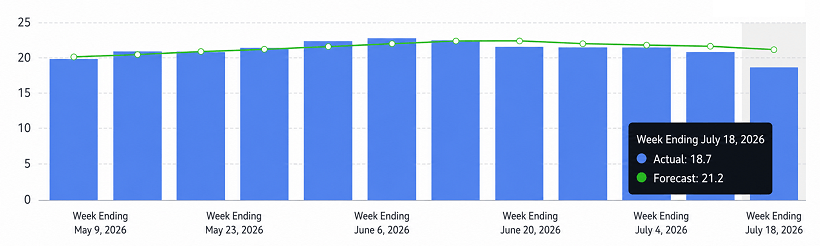
Initial jobless claims declined to 187,000 in the week ended July 18, substantially below the market forecast of 212,000 and lower than in previous weeks. The reading remained extremely low by historical standards, supporting the view that the U.S. labor market had not come under significant pressure.
Continuing Jobless Claims Decline to 1.796 Million
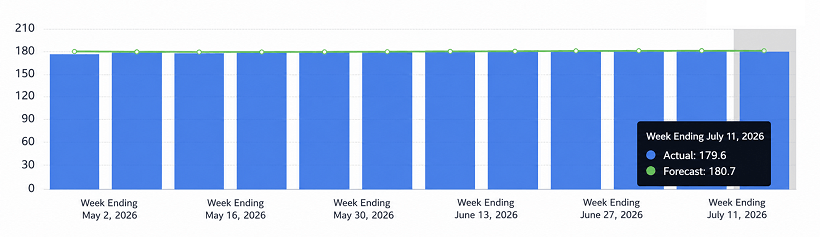
Continuing claims fell to 1.796 million, indicating that companies remained reluctant to dismiss existing workers. The data showed no signs of large-scale job losses caused by artificial intelligence. Together with initial claims, the figures were consistent with a labor market characterized by limited hiring but few layoffs.
Implied Probability of a July Fed Rate Increase Rises to 36%
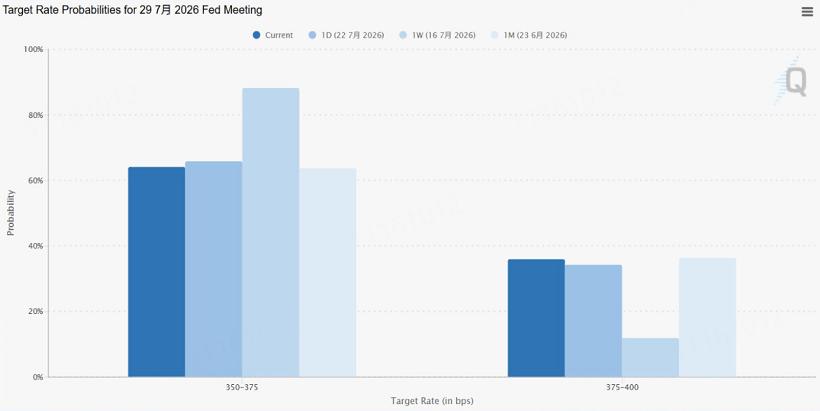
FedWatch pricing showed an implied probability of about 36% that the Federal Reserve would raise rates by 25 basis points to 3.75%-4.00% on July 29, up from roughly 12% a week earlier. The implied probability of no change at 3.50%-3.75% remained higher at approximately 64%.
The source material said resilient employment and higher oil prices had increased expectations that the Fed could tighten policy in the near term, supporting the dollar and U.S. Treasury yields.
10-Year Treasury Yield Reaches Its Highest Level Since January 2025
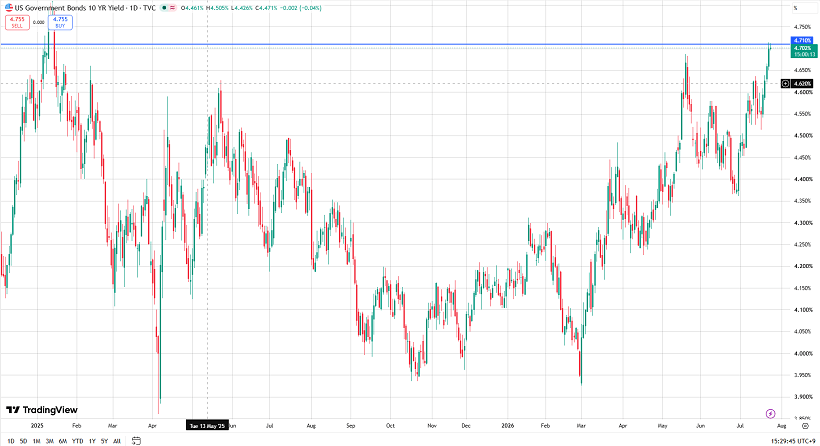
The 10-year U.S. Treasury yield recently rose to about 4.71%, surpassing its previous May high and reaching its highest level since January 2025. The increase pressured Treasury prices and reflected renewed expectations that interest rates could remain higher for longer.
The source material attributed the rise in long-term yields to labor-market resilience, inflation risks associated with higher oil prices and a reduced need for the Federal Reserve to shift toward easier policy in the near term. A yield above 4.7% also increased the relative appeal of dollar-denominated assets.
Higher yields raised the discount rates used in equity valuations and increased corporate financing costs. Technology stocks with high valuations and a larger share of expected earnings further in the future were described as particularly sensitive when earnings-growth forecasts did not rise at the same pace. Google sold off in the latest session after raising capital spending further, as high financing costs added to concerns about lower free cash flow, higher depreciation and pressure on profit margins.
Summary
The dollar recovered on Thursday as U.S.-Iran tensions remained elevated, Treasury yields rose and jobless claims pointed to a resilient labor market. The ECB left its deposit rate at 2.25% but preserved the option of a September increase, with energy prices and developments in the Middle East remaining important unresolved risks. Markets are now focused on inflation data from Japan, European and U.S. business surveys, UK retail sales and U.S. new-home sales.
Enjoyed this article? Share it with your network!


RYOEX Official Media is an information platform created specifically for traders, offering the latest news, analysis, guides, and more. From beginners to experienced traders, we provide useful content to help you stay informed and succeed in your trading endeavors.


