


Dollar Index Slips Near 101 as Geopolitical Risks and Rate Expectations Drive Markets

 July 23, 2026

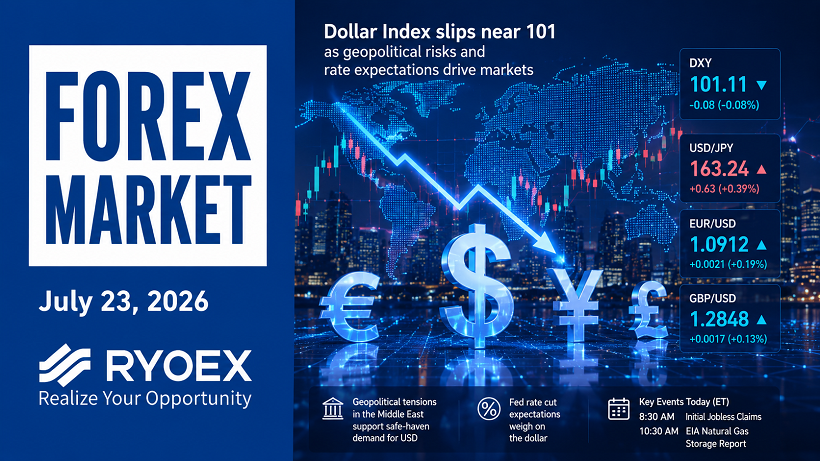
The U.S. Dollar Index edged lower on Wednesday but remained near 101 as investors assessed the U.S.-Iran conflict, higher energy prices and shifting expectations for Federal Reserve policy. Safe-haven demand supported the dollar, while softer U.S. inflation data limited its rebound. Markets are now focused on the European Central Bank’s rate decision, U.S. jobless claims and economic releases from Australia, the United Kingdom and the euro area.
Forex Market Overview
Dollar Holds Near 101 as U.S.-Iran Tensions Support Safe-Haven Demand
The U.S. Dollar Index traded around 101 throughout Wednesday before closing 0.08% lower at 101.11. The benchmark 10-year U.S. Treasury yield ended at 4.668%, while the two-year yield, which is more sensitive to Federal Reserve policy expectations, closed at 4.302%.
Investors continued to assess developments in the U.S.-Iran conflict. An Iranian official described President Donald Trump’s claim that Tehran had requested negotiations as “completely baseless.” U.S. Secretary of State Rubio said Washington was willing to pursue a diplomatic solution with Iran but argued that Tehran lacked sincerity.
Trump said the United States would destroy Iranian bridges or power plants if Iran attacked vessels in the Strait of Hormuz. Iran’s military said that if the United States carried out its threat, Iran would halt all oil flows in the Gulf and strike oil, natural gas, electricity and economic infrastructure across the region.
Israeli media reported that the United States had informed Israel of plans to intensify strikes against Iran in the coming days. The United Kingdom withdrew its diplomatic personnel from Iran. Escalating tensions and the sharp rise in oil prices supported safe-haven demand for the dollar, offsetting some concerns about the near-term direction of Federal Reserve policy.
Trump also said he expected a U.S. federal government shutdown in September. Separately, he said a zero-tariff policy for generic drugs would remain in place for two years, after which tariffs of 100% or 200% would be imposed.
Rate Markets Reprice Inflation Risk Despite Softer U.S. Data
U.S. inflation data released last week reduced concerns that the Federal Reserve could raise rates in July, initially limiting the dollar’s rebound. Expectations later shifted again as the U.S.-Iran conflict intensified and markets priced in renewed upside risks from oil and transportation costs.
The market-implied probability of a July rate increase has risen to 33.1%, while the probability for September stands at 56.4%. By the final meeting of the year, the probability of two cumulative rate increases has reached 38.1%.
This pricing contrasts with recent economic data. The U.S. inflation data surprise index has fallen sharply to around 0.084, indicating that the latest inflation releases were notably weaker than markets expected. The economic growth data surprise index remains near 0.22, suggesting that the U.S. economy has not slowed rapidly but also shows no clear evidence of overheating demand.
The data therefore point to continued cooling in core inflation alongside a resilient economy, rather than renewed acceleration in wages, consumption and credit demand. If future inflation comes mainly from energy supply disruptions and higher transportation costs, Federal Reserve rate increases would not increase oil supply, restore shipping activity or resolve geopolitical tensions. Instead, they would weaken domestic demand through housing, credit, business investment and household consumption.
Earlier rate increases are still affecting real estate, refinancing costs and credit markets with a lag. If the Federal Reserve continues tightening in response to an external supply shock, oil prices could remain high even as private-sector demand and employment weaken further. Market pricing for rate increases may therefore exceed levels supported by current economic fundamentals unless core inflation, wages and credit demand accelerate again.
Yen Weakness Raises Intervention and Bank of Japan Policy Risks
USD/JPY moved above 163 for the first time since July 1986, highlighting renewed pressure on the yen. Japan’s Finance Minister Akizuki Katayama said the country would take decisive action in the foreign-exchange market if necessary. Chief Cabinet Secretary Kihara said the government was prepared to “take appropriate measures at any time.”
Many observers viewed the warnings as a sign that Japanese authorities could intervene. Separately, people familiar with the matter said the Bank of Japan was open to accelerating the pace of interest-rate increases because yen weakness was adding to inflation risks.
Japan’s overnight interest rate currently stands at 1%, up from zero in June and at its highest level in 31 years. Reuters again cited its June survey, which showed that the Bank of Japan could raise the rate further to 1.25% by year-end. Even at that level, however, Japanese interest rates and bond yields would remain well below those of other Group of Seven economies.
Higher energy costs could prompt the Bank of Japan to raise rates somewhat earlier. The effect on the U.S.-Japan interest-rate differential would remain limited, however, and would also depend on how high U.S. Treasury yields rise.
ECB Decision and Economic Data Lead the Upcoming Calendar
Australia will release its seasonally adjusted unemployment rate for June at 1:30 a.m. UTC. The United Kingdom’s July CBI industrial orders balance is due at 10:00 a.m. UTC.
The ECB will announce its rate decision at 12:15 p.m. UTC, followed by President Christine Lagarde’s news conference at 12:45 p.m. UTC. The United States will publish initial jobless claims for the week ended July 18 at 12:30 p.m. UTC, while the euro area’s preliminary July consumer confidence index is scheduled for 2:00 p.m. UTC.
Forex Outlook: Global Market Views
This section reviews the main views on the foreign exchange market from global financial institutions and market participants. Each view has been summarized and restructured by the RYOEX Research Team based on publicly available information. References to any institution or individual do not imply endorsement of RYOEX or its views.
Rabobank | BOJ Policy, Fiscal Concerns and the Yen
Rabobank said Bank of Japan Governor Kazuo Ueda remained optimistic about progress in positive wage-setting behavior among Japanese companies and the prospect that this momentum would sustainably move underlying CPI inflation toward the 2% target.
In a speech on Christmas Day last year, Ueda said the BOJ would continue raising its policy rate and adjusting the degree of monetary accommodation as economic activity and prices improved. In a speech last month, he discussed the temporary drag from higher oil prices while also pointing to relief from the use of the government’s strategic oil reserves and growth support from artificial intelligence-related demand.
Rabobank said these factors had allowed Japanese exports and production to remain broadly stable despite uncertainty surrounding higher energy prices and U.S. tariffs. Interest-rate differentials, however, were not the only factor weighing on the yen.
The BOJ has reduced its bond-purchase program since 2024 and allowed its balance sheet to shrink. Rabobank said this had heightened fiscal concerns, including worries about the prime minister’s expansionary reputation. The government may therefore need to provide greater assurance about the impact of its budget on Japanese government bonds.
ING | ECB Pricing Supports the Euro but May Fade Quickly
ING said EUR/USD had performed relatively well despite the rebound in energy prices. Interest-rate differentials may have contributed, as higher oil prices led investors to expect a more aggressive tightening response from the ECB than from the Federal Reserve.
ING said it was difficult to see markets pricing in substantially higher ECB rates, regardless of the language used at the ECB meeting and news conference. As a result, support for the euro from ECB expectations could fade quickly.
The dollar remained firm as safe-haven demand offset uncertainty about the Federal Reserve’s near-term policy direction. Softer U.S. inflation data had reduced concerns about a July rate increase and limited the dollar’s rebound, while escalating tensions involving Iran and sharply higher oil prices supported demand for the U.S. currency. Expectations for further ECB tightening remained the euro’s main source of support.
Deutsche Bank | Japan’s Policy Shift Could Increase Yen Volatility
Deutsche Bank said Japan might be approaching a major transformation in fiscal and industrial policy comparable to the Meiji Restoration. The shift would seek to address the challenges of reindustrialization and rearmament through investment-led growth.
Given Japan’s high starting level of public debt, Deutsche Bank said the country would need to expand spending capacity while maintaining fiscal sustainability. This would involve keeping nominal GDP growth above funding costs to create room for deficits and using excess domestic savings to finance investment in Japan, thereby easing upward pressure on yields.
About half of roughly $15 trillion in Japanese household savings is held in cash deposits, while half of the Government Pension Investment Fund’s $1.8 trillion in assets is allocated overseas. As demand related to defense and industry returns to Japan, capital repatriation has already become a trend.
Policymakers have focused in recent months on stabilizing the yen. Deutsche Bank said that if fiscal capacity became the main priority, policy incentives could shift from foreign-exchange intervention toward yield management. The effect on USD/JPY would depend on the instruments used.
Allowing the GPIF to repatriate overseas funds and allocate them to Japanese assets would strongly support the yen. By contrast, relying on expanded BOJ bond purchases to suppress yields would be highly negative for the Japanese currency. A policy focused on limiting yield volatility would transfer pressure to the foreign-exchange market and could significantly increase yen volatility.
Deutsche Bank said intervention might simply waste funds and viewed a rise in USD/JPY to 165 as entirely possible. One reason was the BOJ’s independence: materially narrowing the U.S.-Japan interest-rate differential would require government intervention in interest-rate policy.
Key Forex Market Charts
This section highlights charts that help explain recent moves in the foreign exchange market, with a focus on changes in monetary policy expectations, interest-rate differentials, economic data and market sentiment. The charts and data are based on third-party information and do not represent RYOEX's views or indicate future exchange-rate movements. Given the risk of sudden market swings, appropriate risk management remains essential.
Market-Implied Probability of a July Rate Increase Rises to 33%
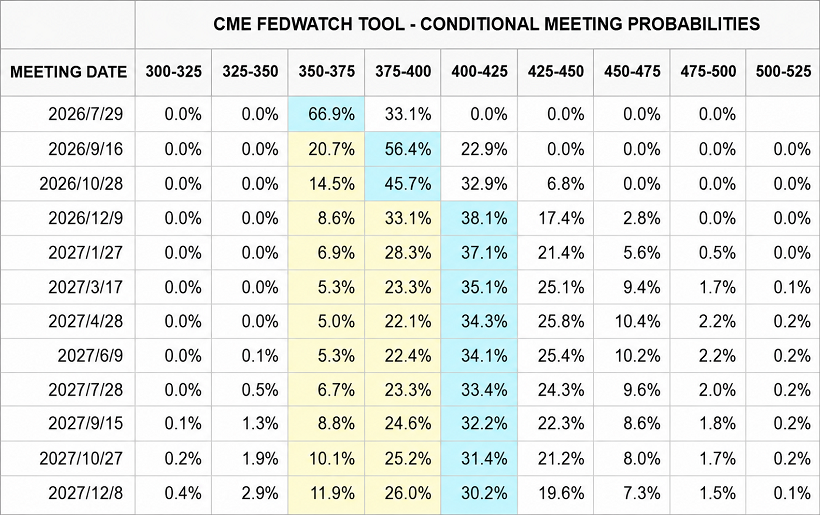
The chart shows the renewed rise in market expectations for Federal Reserve rate increases. The market-implied probability of a July increase has climbed to 33.1%, while the September probability has reached 56.4%. The probability of two cumulative increases by the final meeting of the year stands at 38.1%.
Rate Pricing Diverges From Recent Inflation Data
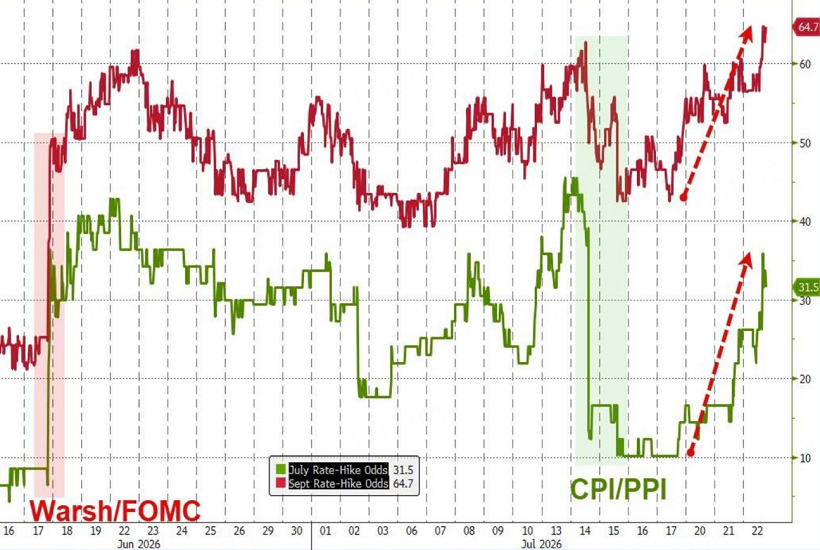
The chart highlights the divergence between rate-market pricing and recent inflation releases. Although markets have raised their expectations for further tightening amid geopolitical, oil-price and supply-chain risks, the U.S. inflation data surprise index has fallen to around 0.084, showing that recent inflation data were weaker than expected.
Rate Expectations May Exceed Levels Supported by Current Fundamentals
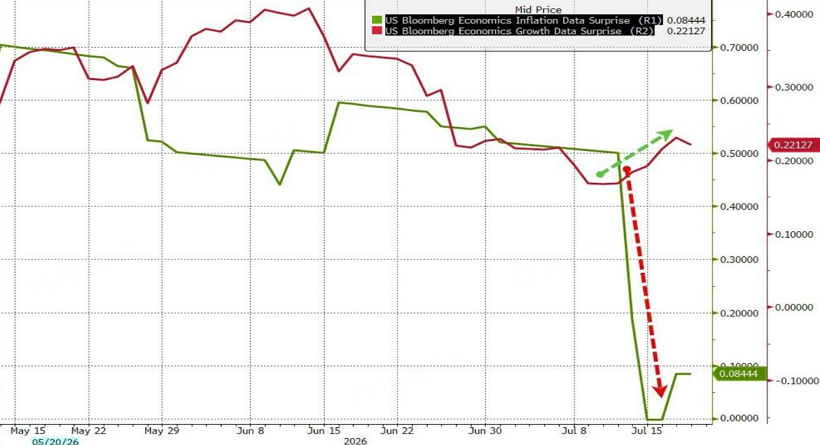
Since Warsh first presided over an FOMC meeting, expectations for rate increases have shifted substantially. The June FOMC meeting and Warsh’s hawkish comments initially pushed expectations higher before weaker-than-expected June CPI and PPI data reduced the implied probabilities for July and September. The escalation of the U.S.-Iran conflict and renewed risks from oil and transportation costs subsequently revived expectations for higher future inflation.
The economic growth data surprise index remains around 0.22. This suggests that the economy remains resilient but provides no clear evidence that demand is overheating. The divergence indicates that current rate pricing is being shaped partly by geopolitical and supply risks rather than renewed strength in core inflation, wages or credit demand.
Google Raises Capital Expenditure Guidance as AI Investment Expands
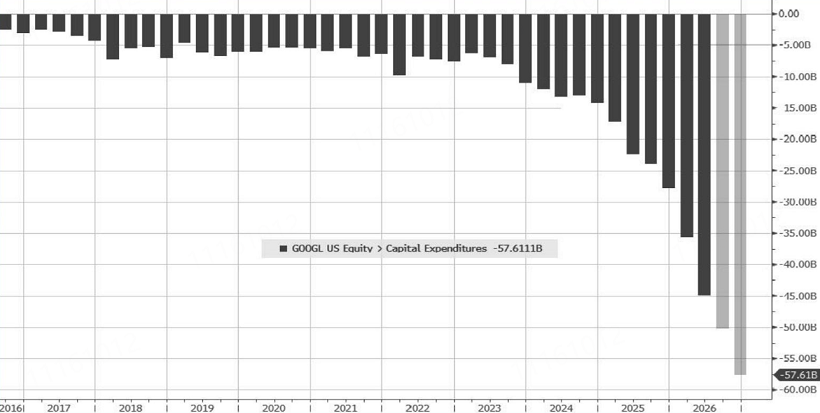
The latest data show that capital expenditure by Google’s parent company reached about $57.6 billion in the latest reporting period. The company raised its capital expenditure guidance for the current fiscal year from $180 billion-$190 billion to $195 billion-$205 billion and expects spending to grow “significantly” in fiscal 2027.
The increase reflects continued investment in data centers, servers, chips, networks and power infrastructure to meet demand for artificial intelligence computing capacity. Google also plans to expand its use of third-party computing capacity in the third quarter, indicating that its internal capacity is not yet sufficient to meet demand related to Gemini, cloud computing and AI inference.
Third-party capacity carries higher costs and could pressure margins. Following the increase in capital expenditure guidance, the market initially focused on heavier spending, pressure on cash flow and a longer timeline for earnings. Alphabet shares fell again in after-hours trading.
The broader wave of AI capital expenditure was viewed as generally supportive of the dollar. Continued investment by major U.S. technology companies could strengthen the U.S. economy’s relative growth advantage and attract global capital to U.S. equities, dollar-denominated assets and the U.S. technology supply chain. If AI investment further increases demand for equipment, electricity and financing, it could also support U.S. Treasury yields and help the dollar remain firm.
Summary
The U.S. Dollar Index ended slightly lower at 101.11 but remained supported by safe-haven demand as investors assessed escalating U.S.-Iran tensions and higher oil prices. Rate markets have increased expectations for Federal Reserve tightening despite softer recent inflation data, creating a divergence between policy pricing and current economic fundamentals. Yen weakness, possible Japanese intervention and the BOJ’s openness to faster rate increases remain key risks, while the ECB decision, U.S. jobless claims and economic releases from Australia, the United Kingdom and the euro area are the next major market catalysts.
Enjoyed this article? Share it with your network!


RYOEX Official Media is an information platform created specifically for traders, offering the latest news, analysis, guides, and more. From beginners to experienced traders, we provide useful content to help you stay informed and succeed in your trading endeavors.


