


Yen Falls to Lowest Since 1986 as Dollar Strengthens and Intervention Risk Rises

 July 22, 2026

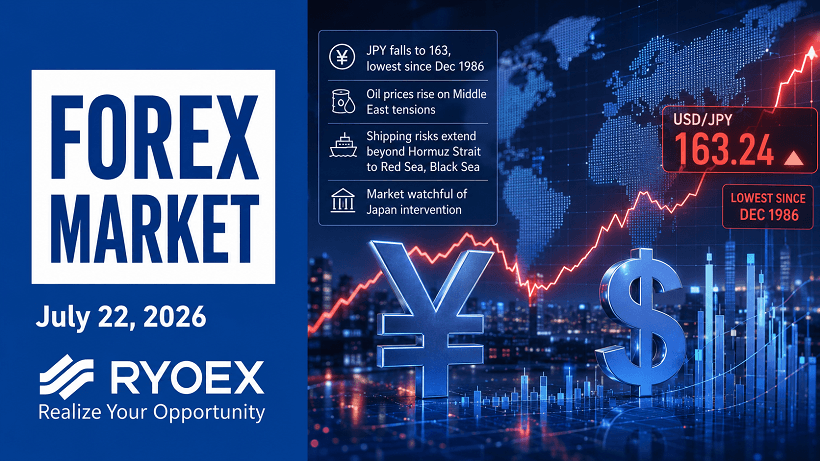
The U.S. dollar strengthened on Tuesday as the ongoing U.S.-Iran conflict supported safe-haven demand and Treasury yields remained elevated. The U.S. Dollar Index closed above 101, while USD/JPY broke through 163 to its highest level in nearly 40 years. Markets are increasingly alert to possible Japanese intervention as wider U.S.-Japan interest-rate differentials, higher energy import costs and geopolitical uncertainty continue to weigh on the yen. Attention now turns to UK inflation data and U.S. oil inventory figures.
Forex Market Overview
Dollar Gains as Treasury Yields and Geopolitical Risks Remain Elevated
The U.S. Dollar Index advanced ahead of Tuesday’s U.S. trading session and closed 0.24% higher at 101.19. The benchmark 10-year U.S. Treasury yield finished at 4.629%, while the policy-sensitive two-year yield ended at 4.278%.
Market pricing remained relatively hawkish. Markets assigned a 74.9% probability to the Federal Reserve leaving its policy rate unchanged at 3.50%-3.75% on July 29, compared with a 25.1% probability of a 25-basis-point increase. By September, the implied probability of at least one rate increase exceeded 70%, while the year-end distribution shifted further toward the 4.00%-4.50% range. This indicated that markets continued to price in a delayed rate increase and higher-for-longer rates rather than a renewed shift toward monetary easing.
High-frequency labor-market indicators pointed to some moderation in hiring. ADP employment increased by about 16,500 in the week ended July 4, down from 19,250 previously and well below the more than 50,000 recorded in early April. The weekly series is volatile, however, and the latest decline alone was insufficient to confirm a rapid deterioration in the labor market. Instead, it suggested that employment growth remained positive while hiring momentum continued to cool gradually.
USD/JPY Breaks Above 163 as the Yen Comes Under Pressure
USD/JPY rose above 163, its highest level since December 1986. The yen’s weakness against the dollar reflected a combination of broad dollar strength, higher U.S. Treasury yields and rising oil prices linked to the conflict in the Middle East.
The U.S.-Japan interest-rate differential remained the main driver. The Federal Reserve maintained a relatively hawkish policy stance, and markets continued to price a high U.S. rate path. The Bank of Japan has raised its policy rate to 1%, the highest since 1995, but investors remained skeptical about the scope for substantial further tightening amid concerns that additional increases could constrain economic growth.
Higher oil prices also increased Japan’s energy import costs and added pressure through the country’s terms of trade. Although more expensive energy may raise inflation in Japan, that does not necessarily translate directly into yen appreciation. At the same time, uncertainty surrounding the U.S.-Iran conflict strengthened safe-haven demand for the dollar while weighing on the yen through higher import costs, further diminishing its traditional safe-haven role.
Japan has previously committed substantial funds to foreign-exchange intervention, although the effects have usually been short-lived. With USD/JPY above 163, expectations of official warnings or actual intervention are likely to rise. The yen may remain weak as long as U.S.-Japan rate differentials, oil prices and safe-haven demand for the dollar do not reverse materially. However, the risk of sharp short-term volatility and sudden pullbacks increases as the pair approaches levels considered sensitive to intervention.
Conflict Risks Spread Across Major Energy Routes
Military escalation and diplomatic mediation continued in parallel. U.S. President Donald Trump said Iran wanted to meet but that the United States was not interested. He also threatened a severe strike on Iran’s Xishan area, where nuclear facilities are reportedly located, and said the United States would “take action” if the Houthis blocked the Red Sea.
Iran’s military struck a U.S. Air Force base in Bahrain and said all U.S. and allied interests in the region would become targets if Washington attacked Iranian nuclear facilities. Pakistan’s prime minister met Iran’s interior minister and said Pakistan would continue to act as a mediator. Iranian officials were also reported to have met mediators in Pakistan on Tuesday. Israeli media reported that Iran had proposed a 10-day ceasefire, while Trump demanded that Iran “pay a price.”
Transportation risks extended beyond the Strait of Hormuz. Data showed that two tankers carrying Saudi crude turned around in the Red Sea and headed toward the Suez Canal. The vessels, originally bound for Asia, changed course after a Houthi warning. In the Black Sea, attacks on a tanker and terminal temporarily forced the Caspian Pipeline Consortium to halt loading, while Kazakhstan was set to suspend oil shipments toward the Black Sea following the tanker attack. These developments suggested that supply risks were spreading across several transportation routes rather than remaining concentrated in a single strait.
Upcoming releases include the UK’s June Consumer Price Index and monthly Retail Price Index at 6:00 a.m. UTC. At 2:30 p.m. UTC, the United States will publish EIA figures covering crude oil inventories, Cushing stocks and Strategic Petroleum Reserve holdings for the week ended July 17.
Forex Outlook: Global Market Views
This section reviews the main views on the foreign exchange market from global financial institutions and market participants. Each view has been summarized and restructured by the RYOEX Research Team based on publicly available information. References to any institution or individual do not imply endorsement of RYOEX or its views.
Morgan Stanley | Lower Corporate Bond Supply Could Support Treasuries
Morgan Stanley said optimism had become excessive after the Nasdaq 100 and Philadelphia Semiconductor Index rebounded sharply from their late-March lows, supported by expectations for artificial-intelligence capital spending and a resilient labor market. Since peaking in mid-June, the two indexes had fallen 7% and 20%, respectively.
Derivatives markets continued to price a relatively hawkish Federal Reserve path. Implied rates were significantly above economists’ consensus forecasts but, in Morgan Stanley’s view, still did not adequately reflect the risk that strong economic growth and renewed inflation could lead to rate increases. Although stronger-than-expected data had broken previous seasonal patterns, the prevailing market narrative was being recalibrated.
Treasuries had come under pressure as surging energy prices raised inflation risks and a wave of investment-grade corporate bond issuance added to supply. The bond market absorbed a record amount of duration supply during the first six months of the year, and the usual summer slowdown in June issuance did not occur.
Morgan Stanley said a deep technology-stock correction would typically discourage corporate borrowing. With the Nasdaq approaching correction territory and semiconductor shares in a bear market, corporate bond supply was likely to decline substantially in the third quarter, easing the supply-demand imbalance facing Treasuries.
The firm therefore expected Treasuries to rebound despite continued uncertainty surrounding the Strait of Hormuz. Its preferred strategy focused on long exposure to the five- to seven-year portion of the curve and a 7s30s steepener, which it said offered an attractive Sharpe ratio and roll return.
Money Metals Exchange Analyst Mike Maharrey | Term Premium and Fiscal Risks Are Reshaping Long-Term Yields
Mike Maharrey said long-term interest rates had been driven mainly by monetary policy expectations over the past two decades, but that relationship was breaking down. Since the Federal Reserve began cutting rates in September 2024, the 10-year Treasury yield had risen from 3.65% to 4.79%, showing that lower policy rates had not reduced long-term yields.
A New York Fed model showed that the term premium had turned positive again and briefly exceeded 0.8% in January 2025. Research from Massif Capital indicated that this explained more than half of the increase in long-term rates over the same period. Maharrey said geopolitical and fiscal risks were becoming more important pricing factors than monetary policy expectations.
Marginal demand had shifted from price-insensitive official institutions toward return-sensitive private investors. China had reduced its Treasury holdings to their lowest level since 2008, the Federal Reserve continued to shrink its holdings through quantitative tightening, and private investors required higher yields to absorb additional supply.
Grant offered a longer historical perspective, arguing that interest rates followed generational cycles and that the rise in long-term yields since 2021 represented the early stage of a prolonged bond bear market rather than a temporary disruption. Markets could tolerate current fiscal deficits when policy rates were near zero, but that tolerance was narrowing rapidly in a 4% interest-rate environment.
Under this view, long-term yields were increasingly determined by who would finance government borrowing rather than by the Federal Reserve’s next action. When shocks originated from supply, duration assets traditionally used to hedge equity declines could instead amplify losses, weakening the assumption that bonds remained a reliable hedge.
Goldman Sachs | Potential Changes to Federal Reserve Communication and Balance-Sheet Policy
Goldman Sachs said Warsh, as Federal Reserve chair, would have considerable authority to change the central bank’s communication practices. He had already reduced the amount of information provided during post-meeting news conferences. If the Federal Open Market Committee adopted Na Ruan’s recommendation to stop publishing median projections in the Summary of Economic Projections, Warsh might view it as an important step away from forward guidance.
Other Fed officials might see the practical effect as limited because investors could calculate the median forecasts themselves. They could also argue that any discussion of the economic outlook would inevitably provide at least some mild and noncommittal guidance. More extensive changes to the Fed’s communication policy were possible but would likely be more controversial.
Warsh might also regard it as a significant change if the Fed emphasized the federal funds rate rather than quantitative easing as its main policy tool and explicitly set a high threshold for restarting asset purchases. Other officials might view that as merely restating the existing policy position.
If the Fed shifted toward holding mainly short-term Treasury bills, Warsh could describe the change as a step away from involvement in fiscal policy. Based on his previous comments, he may believe the current composition of the Fed’s assets effectively subsidizes the government and increases the risk of politicizing the central bank. Other officials may not share that view, but they could conclude that the Treasury would ultimately adjust to the Fed’s chosen balance-sheet strategy, limiting the practical significance of the change.
On artificial intelligence, productivity and inflation, Warsh could cite the Greenspan era to argue that the FOMC should not raise rates solely because GDP growth is strong when productivity is also rising rapidly. Other officials might accept that argument. However, he could struggle to gain broad support if he argued that the possibility of future productivity gains justified a more dovish policy stance today.
Source Material, Attribution Not Provided | A Prolonged Conflict Could Support Yields and the Dollar
The source material said intelligence experts believed the current intensity of attacks and retaliation was insufficient to change Tehran’s position. Trump was also concerned that the conflict could develop into a full-scale war requiring the deployment of ground forces.
Even if mediators succeeded in restarting negotiations, the commentary questioned whether they would be more credible or effective than the previous ceasefire, talks and memorandum of understanding. Reports of renewed negotiations could periodically encourage market optimism and push bond yields and oil prices lower, but the emerging market consensus was that the conflict would be prolonged.
Under this scenario, oil prices, refineries, inventories and other petroleum-related products would remain under pressure. Supply chains were flexible and adaptable, but the disruption involved a large industrial system across a broad geographic area. The commentary said oil prices might not return to around $70 for a prolonged period.
If that assessment proved correct, the recent one-time decline in U.S. inflation would have little significance. Inflation would rise across economies, while interest rates could also increase if the European Central Bank and Federal Reserve remained committed to controlling inflation.
From a longer-term perspective, the commentary expected U.S. Treasury yields and the dollar to continue rising. Previous breakouts by the euro, sterling and most emerging-market currencies were described as increasingly fragile. It also noted that equities had begun moving not only with Treasury yields but also with oil prices, reflecting a possible sequence of higher inflation, higher interest rates and lower stock prices.
Key Forex Market Charts
This section highlights charts that help explain recent moves in the foreign exchange market, with a focus on changes in monetary policy expectations, interest-rate differentials, economic data and market sentiment. The charts and data are based on third-party information and do not represent RYOEX's views or indicate future exchange-rate movements. Given the risk of sudden market swings, appropriate risk management remains essential.
ADP Weekly Employment Growth Slows From Early-April Levels
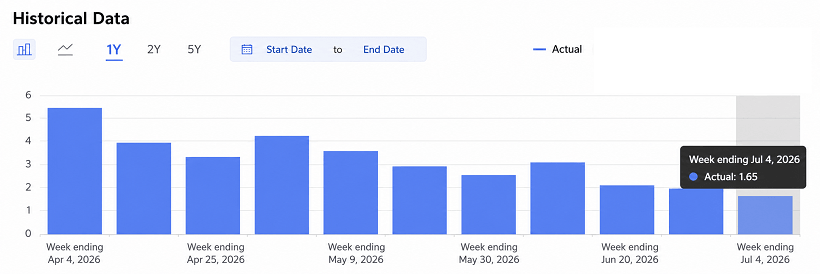
ADP employment increased by approximately 16,500 in the week ended July 4, down from 19,250 in the previous reading and more than 50,000 in early April. The figures suggest that U.S. private-sector hiring remained positive but continued to lose momentum. Because the weekly series is volatile, one weaker reading does not by itself confirm a rapid deterioration in the labor market. With few major economic releases ahead of the next Federal Reserve decision, high-frequency indicators are contributing to assessments of labor-market conditions.
Markets Favor a July Hold but Price a Higher Rate Path
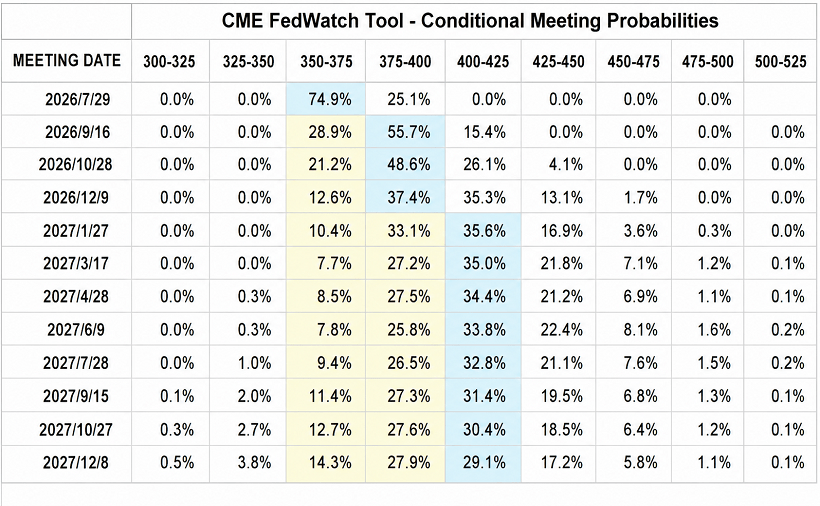
The chart shows a 74.9% market-implied probability that the Federal Reserve will leave rates unchanged at 3.50%-3.75% on July 29, compared with a 25.1% probability of a 25-basis-point increase. By September, the probability of at least one increase exceeds 70%, while the year-end distribution shifts further toward 4.00%-4.50%. The pricing indicates that markets continue to favor a delayed rate increase and higher-for-longer rates rather than a return to easing.
USD/JPY Rises Above 163 to Its Highest Since 1986
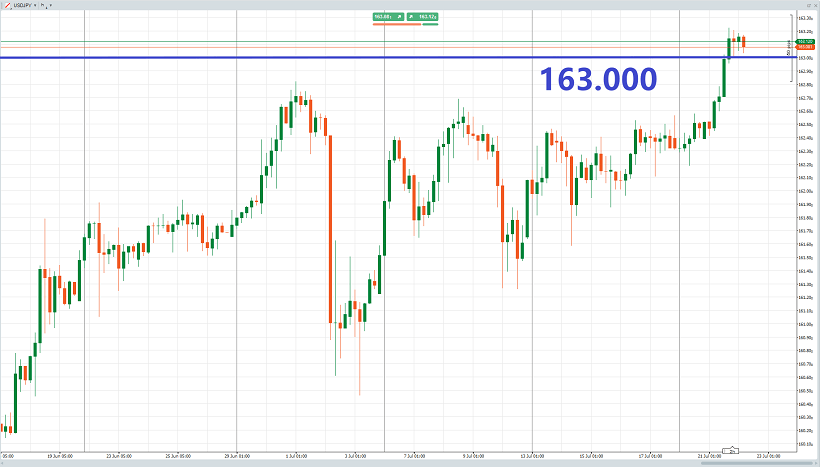
USD/JPY moved above 163, reaching its highest level since December 1986. The pair was supported by a stronger dollar, elevated U.S. Treasury yields and a wide U.S.-Japan interest-rate differential. Higher oil prices also increased pressure on the yen through Japan’s energy import costs. As the exchange rate rises, market sensitivity to official warnings or possible Japanese intervention is likely to increase.
Summary
The dollar strengthened as the U.S.-Iran conflict supported safe-haven demand and Treasury yields remained elevated, with the U.S. Dollar Index closing at 101.19. USD/JPY broke above 163 to its highest level since 1986 as interest-rate differentials, higher energy import costs and dollar demand weighed on the yen, increasing concern about possible Japanese intervention. Markets continue to favor a July Federal Reserve hold while pricing a higher rate path later in the year. UK inflation data, U.S. oil inventories, geopolitical developments and signs of labor-market cooling remain the main areas of focus.
Enjoyed this article? Share it with your network!


RYOEX Official Media is an information platform created specifically for traders, offering the latest news, analysis, guides, and more. From beginners to experienced traders, we provide useful content to help you stay informed and succeed in your trading endeavors.


