


Dollar Rebounds as Markets Weigh Iran Ceasefire Proposal and U.S. Rate Risks

 July 21, 2026


The U.S. dollar recovered on Monday as investors assessed competing developments in the U.S.-Iran conflict. The U.S. Dollar Index briefly rose above 101 during U.S. trading and closed 0.2% higher at 100.95. Geopolitical tensions, higher oil prices and renewed concerns about inflation and Federal Reserve rate increases supported demand for the currency. Markets are now focused on labor-market data from the United Kingdom and the United States, as well as July economic sentiment readings from Germany and the eurozone.
Forex Market Overview
Dollar Recovers as Geopolitical Risks Boost Safe-Haven Demand
The U.S. Dollar Index initially fell on Monday before reversing course and briefly crossing 101 during U.S. trading. It ended the session at 100.95, up 0.2%.
The benchmark 10-year U.S. Treasury yield closed at 4.597%, while the two-year yield, which is more sensitive to Federal Reserve policy expectations, finished at 4.215%.
During Tuesday’s Asian session, the Dollar Index remained in positive territory near 101.00. Analyst Akhtar Faruqui said the escalating conflict between the United States and Iran had increased safe-haven demand, pushed oil prices higher and revived concerns about inflation and possible Federal Reserve rate increases.
According to Faruqui, the market-implied probability of a Fed rate increase in September rose to about 55% from 51% the previous day. Federal Reserve officials have entered their quiet period ahead of next week’s policy meeting, at which markets broadly expect rates to remain unchanged.
AUD/USD recovered above 0.70 early in the week, although it later gave back some of its initial gains. Market analyst Pablo Piovano said the Australian dollar remained resilient despite a stronger U.S. dollar, as markets had largely priced in weaker-than-expected U.S. inflation data and shifting expectations for Fed rate increases.
Ceasefire Proposal Offers Possible Pause, but Regional Risks Persist
Iranian sources said mediators had proposed a 10-day ceasefire between the United States and Iran to provide an opportunity to resume implementation of a memorandum of understanding. Iran’s Foreign Ministry confirmed that it had received the proposal and said negotiations with the United States could be considered based on the national interest.
U.S. media reported that President Trump remained focused on making Iran pay for recent events, even as negotiations between the two countries continued. U.S. strikes on Iran had entered their 10th day, while Iran continued to attack targets in neighboring countries. Trump warned that Iran would be held directly responsible for the deaths of three U.S. military personnel.
The Iran-backed Houthis announced a maritime ban targeting Saudi Arabia, threatening a major energy transportation route through the Red Sea. Saudi Arabia said it was taking necessary military action to protect shipping through the Bab el-Mandeb Strait.
In other political developments, the United States announced a 50% tariff on most Canadian products. The tariffs will not apply to energy products, potash, fish or critical minerals. The Kremlin said Russia and the United States were maintaining technical contacts at the foreign-ministry level, while U.S. media reported that the FBI director planned to visit Russia.
In the United Kingdom, the King appointed Burnham as the new prime minister following Starmer’s departure. Burnham subsequently named several members of his cabinet.
U.K., Eurozone and U.S. Data Move Into Focus
The United Kingdom will release its three-month ILO unemployment rate for May, public-sector net borrowing for June, the June unemployment rate and the June claimant count at 7:00 a.m. BST.
Germany and the eurozone will publish their July ZEW economic sentiment indexes at 11:00 a.m. CEST.
The United States will report the weekly ADP employment change for the week ended July 4 at 8:15 a.m. ET.
Forex Outlook: Global Market Views
This section reviews the main views on the foreign exchange market from global financial institutions and market participants. Each view has been summarized and restructured by the RYOEX Research Team based on publicly available information. References to any institution or individual do not imply endorsement of RYOEX or its views.
Morgan Stanley | The Cycle May Have Further to Run, Favoring Long Positions in Rates and FX Volatility
Morgan Stanley said in its latest annual outlook that 1997-1998 and 2005-2006 offer useful comparisons with the current environment. The bank believes the bull-market cycle may have further to run, equities are likely to outperform credit, and long positions in rates and foreign-exchange volatility may be more attractive.
Both historical periods featured stronger corporate activity, a relatively stable macroeconomic backdrop and regulatory easing that encouraged risk-taking. Capital expenditure by Russell 1000 companies grew by an annual average of about 7% between 2010 and 2025 but jumped 33% in 2025. Morgan Stanley expects increases of 23% in 2026 and 26% in 2027, led by artificial intelligence and supported by energy infrastructure and the “Big Beautiful Bill Act.” The trend has been particularly visible in Asian markets.
Global merger and acquisition activity remained near a more than 30-year low in early 2024, but announced transactions have since increased 64% year over year. Capital expenditure is rising faster than in comparable periods, while the increase in M&A has been smaller. Morgan Stanley said both periods nevertheless showed corporate ambitions expanding before the credit cycle peaked, suggesting the current cycle is not yet over.
Core personal consumption expenditures inflation, unemployment and U.S. Treasury yields are also close to the averages recorded in 1997-1998 and 2005-2006. Morgan Stanley said steady growth and manageable interest rates could support risk-taking for longer. It also sees a broadly consistent direction in regulatory developments, ranging from the final stage of the Basel framework to regional savings reforms.
The bank compared the current artificial intelligence-driven narrative with the internet transformation of the late 1990s and the “K-shaped” economy and emerging-market demand of the mid-2000s. One difference is that today’s capital-expenditure borrowers have stronger balance sheets, which may extend the credit cycle and limit the widening of credit spreads relative to earlier periods.
Morgan Stanley said the volatility outlook remains uncertain. However, expanding corporate ambitions, a less predictable policy environment and limited visibility into central-bank policy make 1997-1998 the more useful comparison. The historical signal is not simply to take more risk. Rather, the cycle may have further to run, equities may be preferable to credit, and owning optionality may be preferable to selling it. The bank believes this view can be expressed effectively through rates and foreign-exchange markets.
Commerzbank | ECB May Emphasize Inflation Risks Without Committing to a September Increase
Commerzbank said higher oil prices and weak growth signals are likely to dominate Thursday’s European Central Bank meeting. A July rate increase has effectively been ruled out, while markets have fully priced in another 25-basis-point increase in September.
The bank expects ECB President Christine Lagarde to emphasize inflation risks without making a firm commitment. Preliminary eurozone purchasing managers’ indexes due Friday may show that the recovery remains fragile.
Commerzbank said the ECB decision will be the main focus on Thursday, followed by the Federal Reserve’s policy decision next week. Although Lagarde may use firm language on inflation, growing headwinds and a changing economic environment make it unlikely that she will commit in advance to a September increase. This week’s data may indicate that an economic recovery remains distant.
Akhtar Faruqui | Geopolitical Tensions and Rate Expectations May Keep the Dollar Firm
Akhtar Faruqui said the U.S. Dollar Index traded near 101.00 in positive territory during Tuesday’s Asian session. The escalating U.S.-Iran conflict has increased safe-haven demand and pushed oil prices higher, reviving concerns about inflation and possible Federal Reserve rate increases.
The market-implied probability of a Fed rate increase in September rose to about 55% from 51% the previous day. Fed officials have also entered their quiet period ahead of next week’s policy meeting, at which markets broadly expect rates to remain unchanged.
Faruqui said the combination of geopolitical risks, higher oil prices and expectations for higher interest rates could keep the dollar firm in the near term.
Pablo Piovano | Australian Dollar Resilience Reflects Relatively Stable Fundamentals
Pablo Piovano said the Australian dollar started the week strongly before giving back part of its gains, although AUD/USD still moved back above 0.70. The pair recovered despite a stronger U.S. dollar, suggesting that markets had largely priced in weaker-than-expected U.S. inflation and shifting expectations for Fed rate increases.
Australia’s manufacturing purchasing managers’ index rose to 51.5 in June, while the services PMI increased to 50.5, putting both indicators back in expansionary territory. The labor market also remained relatively firm: the unemployment rate declined to 4.4% in May, and employment increased by 40,600. These developments partly offset a wider trade deficit and slower first-quarter economic growth.
The inflation picture was more mixed. Headline consumer price inflation slowed to 4.0% year over year in May, but the trimmed mean and weighted median measures both rose to 3.6%, indicating persistent underlying inflation. Consumer inflation expectations declined to 4.7% in July, but the Reserve Bank of Australia remains some distance from achieving its goal of returning inflation to target.
Markets expect the RBA to leave policy unchanged in August and are pricing in only about 19 basis points of additional tightening for the rest of the year. Piovano said the U.S. dollar, global risk sentiment and geopolitical developments will remain the main short-term influences on the Australian currency. Australia’s next key event will be the monthly labor-market report on July 23. Continued caution from the Fed, changes in investor risk appetite or a shift in the RBA’s stance could quickly affect the Australian dollar.
Key Forex Market Charts
This section highlights charts that help explain recent moves in the foreign exchange market, with a focus on changes in monetary policy expectations, interest-rate differentials, economic data and market sentiment. The charts and data are based on third-party information and do not represent RYOEX's views or indicate future exchange-rate movements. Given the risk of sudden market swings, appropriate risk management remains essential.
Market-Implied Probability of U.S. Military Operations Against Iran Ending by August 31
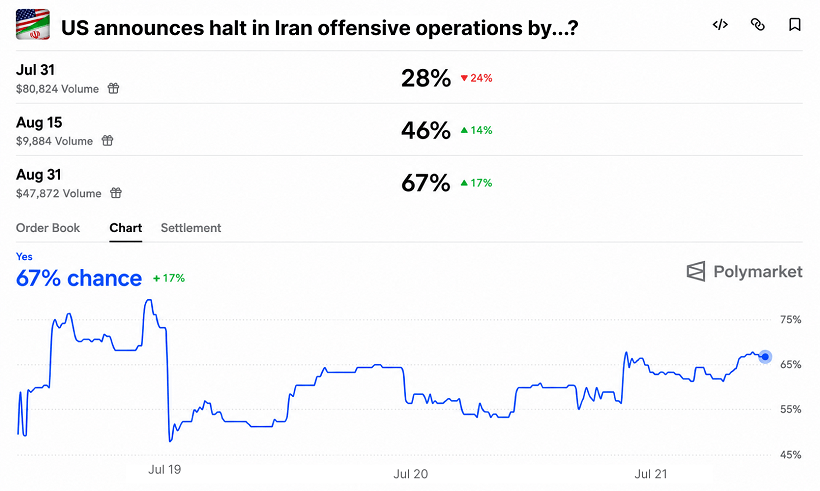
The chart shows market pricing for when the United States may end its military operations against Iran. The implied probability of operations ending by August 31 remained at 67%.
The pricing suggests traders do not expect the conflict to end immediately but remain relatively optimistic about a temporary ceasefire or military de-escalation over the next several weeks. This expectation is linked to reports that mediators proposed a 10-day halt to strikes to allow time to restore an interim U.S.-Iran agreement.
However, the implied probability of operations ending by the close of the current month remained below 30%, indicating continued caution about the immediate outlook. If the probability of a ceasefire by the end of August rises further, the risk premium in oil prices and energy inflation may decline, potentially easing inflation concerns and related interest-rate pressures. If mediation fails and the probability falls, markets may again price in a prolonged conflict and greater risks to energy supplies.
U.S. Leading Economic Index Points to Weaker Forward Momentum
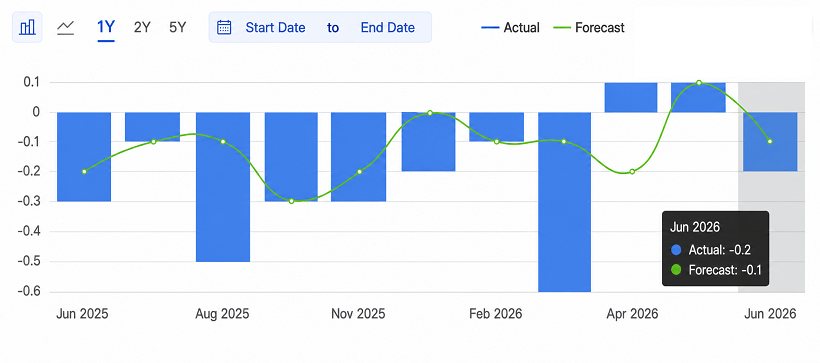
The Conference Board’s U.S. Leading Economic Index fell 0.2% month over month in June. That was weaker than the expected 0.1% decline and marked a clear reversal from May’s 0.1% increase, indicating that growth momentum may weaken again over the coming months.
The index was negative in most months over the past year, with only brief improvements in April and May. That temporary recovery may have reflected better U.S. Treasury-market conditions, an equity-market rebound, persistently low initial jobless claims and stronger components related to financial conditions and interest-rate spreads.
These sources of support did not develop into a sustained trend. The index turned negative again in June, suggesting that forward-looking components such as manufacturing orders, consumer expectations and credit conditions remained weak. Alongside resilient initial jobless claims and retail sales, the data suggest that current employment and consumption remain stable while future growth momentum gradually slows, rather than indicating that the economy has already entered a rapid recession.
Mortgage-Rate Gap Continues to Constrain the U.S. Existing-Home Market
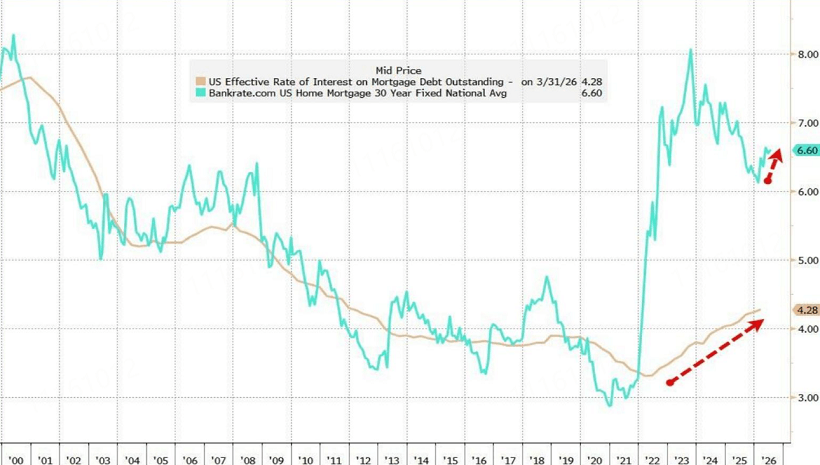
The chart compares current U.S. 30-year fixed mortgage rates with the average effective rate on existing mortgages. New mortgage rates were recently about 6.55%-6.60%, while the average rate on existing mortgages was approximately 4.28% as of the first quarter of 2026, leaving a gap of more than 2 percentage points.
This difference has created a strong low-rate lock-in effect. Homeowners with low-cost mortgages are reluctant to sell and replace them with loans carrying rates of around 6.5%, limiting the supply of existing homes. At the same time, high interest rates and record home prices have increased monthly payment burdens for first-time buyers.
The 30-year mortgage rate recently increased for two consecutive weeks, while pending home sales declined. Pending existing-home sales fell 5.4% month over month in June, indicating that high financing costs continue to weigh on the U.S. housing market.
Demand has not disappeared completely, but many buyers cannot afford current costs, and many sellers are unwilling to give up low-rate mortgages. This dynamic is suppressing transaction volumes and intensifying competition for the limited supply of lower-priced homes. A clear recovery will remain difficult unless long-term Treasury yields and mortgage rates decline on a sustained basis.
High mortgage rates are not independently positive for the dollar. They reflect elevated long-term U.S. Treasury yields and continued market pricing of a high-interest-rate environment. However, this structure is also creating medium-term risks. If high borrowing costs further weaken transactions, construction and housing-related consumption, markets could increase expectations for Federal Reserve easing. Treasury yields could then decline, reducing the dollar’s interest-rate advantage.
Summary
The dollar recovered as investors weighed a proposed 10-day U.S.-Iran ceasefire against continued military escalation, threats to regional shipping and renewed concerns about inflation and Federal Reserve rate increases. U.S. Treasury yields remained elevated, while markets broadly expected the Fed to leave rates unchanged at its next meeting despite higher implied odds of a September increase. Attention now turns to U.K. labor and borrowing data, German and eurozone ZEW sentiment indexes, and the weekly U.S. ADP employment reading. Geopolitical developments and their implications for oil prices, inflation expectations and interest rates remain unresolved.
Enjoyed this article? Share it with your network!


RYOEX Official Media is an information platform created specifically for traders, offering the latest news, analysis, guides, and more. From beginners to experienced traders, we provide useful content to help you stay informed and succeed in your trading endeavors.


