


Oil Extends Gains as Hormuz Uncertainty Outweighs Demand Headwinds

 August 19, 2026


Crude oil extended its advance in early Asian trade on Wednesday as uncertainty over exports through the Strait of Hormuz outweighed a large U.S. inventory build and weak Chinese refinery throughput. As of 01:27 UTC on August 19, delayed CME data showed October 2026 West Texas Intermediate futures at $84.93 a barrel. Delayed ICE data put October 2026 Brent at $91.90 a barrel at 01:26 UTC.
Reuters reported that nearby WTI and Brent futures were both higher at 00:04 UTC, marking a fourth consecutive session of gains. The immediate support came from conflicting U.S. and Iranian messages over whether the Strait was open to shipping. The market's central tension is therefore clear: physical-supply risk is keeping a premium in prompt oil, while U.S. inventories and Asian refining demand argue against an unchecked rise.
Crude Oil Market Overview
WTI and Brent Hold a Firm Tone
The exchange data showed a strongly downward-sloping curve across the first six listed contracts examined. WTI declined from $84.93 for October 2026 to $77.87 for March 2027, while Brent fell from $91.90 to $83.48 over the same delivery window. This backwardation is consistent with a market assigning greater value to near-term barrels, although the curve alone cannot identify how much of that premium reflects shipping risk, inventory tightness or other factors.
Reuters' latest oil-specific report reinforced the positive short-term direction without changing the exchange reference prices. At 00:04 UTC, Reuters put Brent nearby futures up $0.26 at $91.28 and WTI up $0.37 at $85.31. It did not specify the contract months, so those synchronized quotes are most useful as a direction check rather than as substitutes for the CME and ICE contract data.
U.S. Crude Stocks Send a Counter-Signal
The latest available U.S. Energy Information Administration data, covering the week ended August 7, showed commercial crude inventories excluding the Strategic Petroleum Reserve rising by 17.422 million barrels to 424.410 million. Stocks at Cushing increased by 1.611 million barrels to 22.566 million. The next official weekly release was scheduled for later on August 19, making any confirmation or reversal of that build an important near-term test.
The inventory increase is a bearish counterweight to the geopolitical premium. It does not, however, erase the broader concern about internationally traded barrels: the EIA's August outlook expects U.S. commercial crude stocks to remain below the 2021-2025 five-year low through the end of 2026.
Key Market Drivers and Analysis
Hormuz Risk Still Dominates the Prompt Market
The latest Reuters update said traders were weighing conflicting statements from Tehran and Washington about whether the Strait of Hormuz was open. That uncertainty matters because the market needs evidence of sustained loadings and safe vessel passage, not only diplomatic statements, before removing a large part of the supply-risk premium.
The EIA's August Short-Term Energy Outlook assumes severe transit constraints persist through August. It expects most regional crude production to return close to pre-conflict averages in early 2027, but still projects disruptions of about 0.6 million barrels per day through the end of 2027. Under that path, the agency forecasts Brent spot crude near $85 a barrel in the third quarter of 2026 before an average of $69 in 2027 as inventories rebuild.
Kpler's July 31 vessel analysis adds an important physical-market caution. It found that a rebound in commodity-related Hormuz crossings on July 28-29 did not hold on July 30 and argued that prices had been responding more to geopolitical headlines than to observed flows. Kpler framed $110 a barrel as realistic Brent upside while China remained absent as a marginal buyer, highlighting the asymmetry created by fragile shipping conditions.
China Refining Data Limit the Demand Case
China's National Bureau of Statistics reported that July crude processing by industrial enterprises above designated size fell 15.8% from a year earlier to 53.11 million tonnes. Domestic crude production, by contrast, edged up 0.8% to 18.27 million tonnes. The processing decline provides a concrete demand-side restraint at a time when the supply narrative is otherwise dominant.
ING Research similarly identifies the timing of a return in Chinese buying as one of the market's largest uncertainties. Its July 9 base case put Brent at $80 a barrel in the third quarter and $74 in the fourth, conditional on no further meaningful disruption to Hormuz flows. ING also allowed for a more aggressive scenario in which Brent could test $100 in the third quarter if supply conditions deteriorated again.
Institutional Views Differ Mainly on the Recovery Path
The EIA, ING and Kpler broadly agree that shipping through the Persian Gulf remains the decisive near-term variable. Their disagreement is chiefly about the speed and durability of normalization. The EIA's $85 third-quarter Brent view assumes continued severe constraints through August; ING's lower base case depends on avoiding another meaningful disruption; and Kpler's higher upside scenario reflects the possibility that physical flows fail to recover even when diplomatic headlines improve.
That range of views makes the market unusually sensitive to high-frequency evidence. Vessel traffic, actual export loadings and the shape of the prompt curve are likely to carry more information than unverified claims about reopening. Meanwhile, the U.S. inventory build and China's lower refinery throughput show why prices could retreat quickly if shipping conditions genuinely improve.
Key Charts and Market Data
WTI Curve Retains a Near-Term Premium
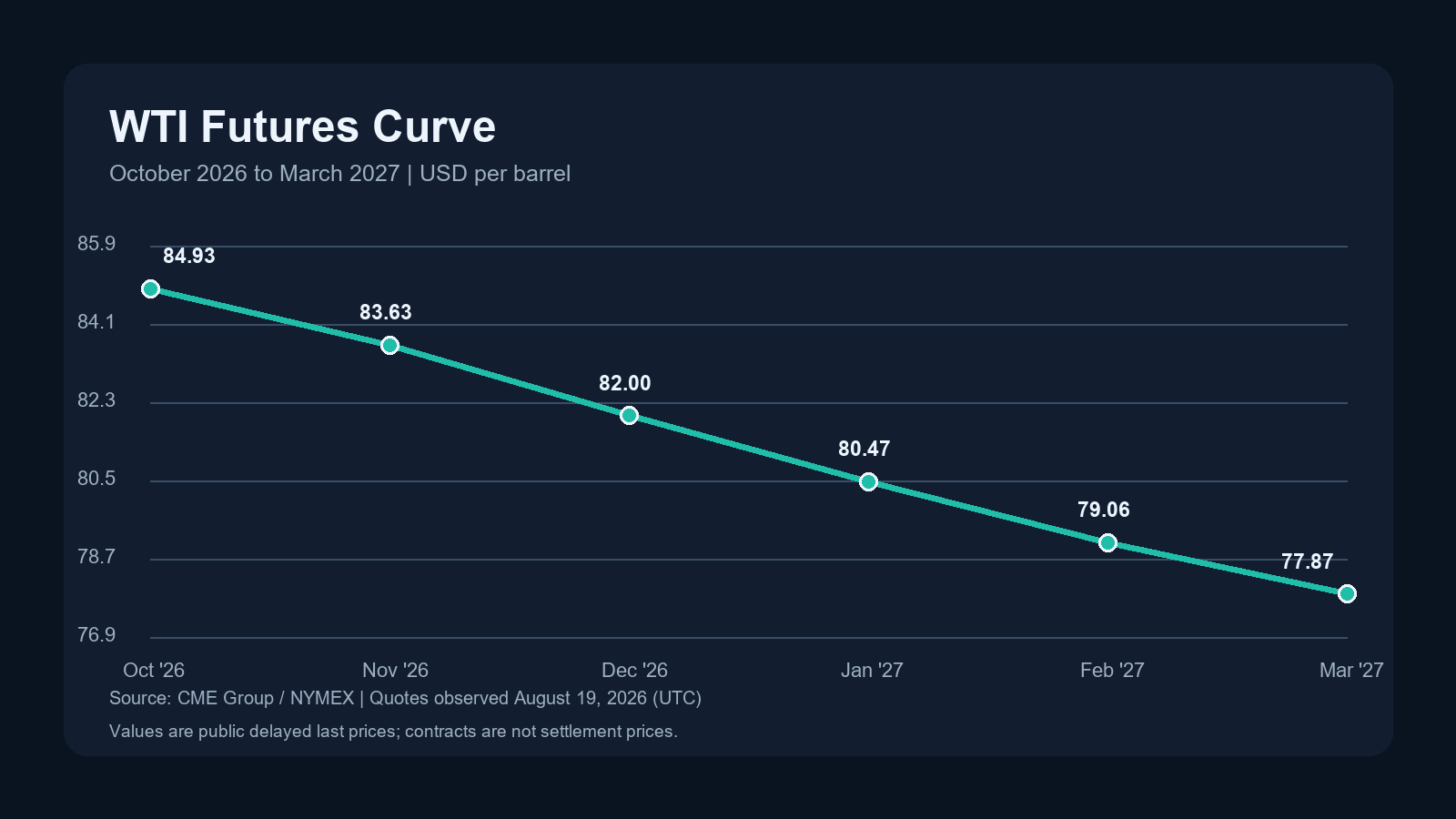
The delayed CME curve falls across each contract from October 2026 through March 2027. The pattern indicates a premium for nearer delivery, but it should be interpreted alongside inventory and shipping data rather than as proof of a single cause.
Brent Curve Shows an Even Steeper Decline
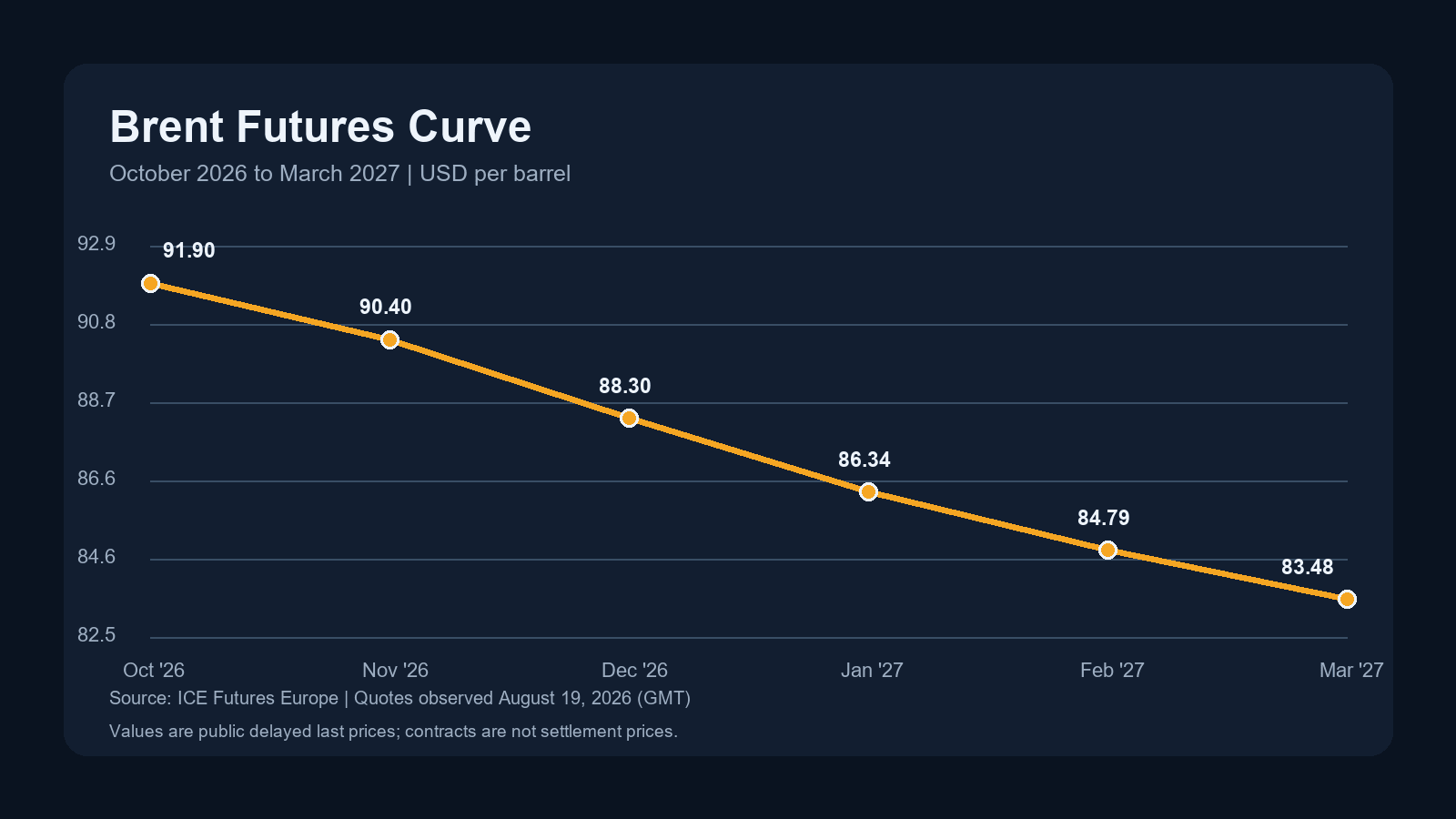
The delayed ICE curve also declines through March 2027. The front of the Brent curve remains particularly elevated relative to later contracts, consistent with persistent concern over the availability and transport of internationally traded crude.
Market Outlook and Key Takeaways
Near-term support rests on continued uncertainty over Hormuz exports, the risk of renewed attacks on shipping and the absence of a verified, durable recovery in vessel traffic. The backwardated WTI and Brent curves reinforce the importance of prompt supply, while the EIA's August outlook suggests that the effects of the disruption may outlast the immediate diplomatic cycle.
The main downside risks are equally visible. U.S. commercial crude inventories posted a substantial weekly increase, China's July refinery throughput contracted sharply from a year earlier, and both EIA and ING expect prices to ease as regional production and inventories recover. A sustained increase in Gulf loadings would therefore remove risk premium at the same time that demand indicators remain soft.
The next signals to watch are the August 19 EIA inventory release, verified Hormuz vessel crossings and export loadings, China's crude-processing and import data, and whether the front of the futures curves remains elevated. Until those indicators align, crude is likely to remain headline-sensitive, with a firm prompt market coexisting with meaningful medium-term downside risk.
Sources and References
-
CME Group / NYMEX — Crude Oil Futures Quotes, delayed data observed August 19, 2026.
-
ICE Futures Europe — Brent Crude Futures Pricing, delayed data observed August 19, 2026.
-
Reuters — Oil edges up on uncertainty over exports through Hormuz, August 19, 2026.
-
U.S. Energy Information Administration — Weekly Petroleum Status Report, week ended August 7, released August 12, 2026.
-
U.S. Energy Information Administration — Short-Term Energy Outlook, August 11, 2026.
-
National Bureau of Statistics of China — Energy Production in July 2026, August 17, 2026.
-
ING Research — Oil off its highs but risks return, July 9, 2026.
Enjoyed this article? Share it with your network!


RYOEX Official Media is an information platform created specifically for traders, offering the latest news, analysis, guides, and more. From beginners to experienced traders, we provide useful content to help you stay informed and succeed in your trading endeavors.


