


Oil Steadies as Hormuz Traffic Slows and Demand Signals Weaken

 August 17, 2026


Oil prices were little changed in early Monday trading as the market weighed another slowdown in Strait of Hormuz shipping against mounting evidence of demand destruction and a large U.S. crude inventory build. Publicly available delayed exchange data showed September 2026 WTI crude futures at $82.07 a barrel at 01:07 UTC on August 17, while October 2026 Brent crude futures stood at $88.45 a barrel at 01:08 UTC.
The near-term balance remains unusually tight, but the forces shaping it point in opposite directions. Restricted Gulf flows and depleted inventories support prices; weaker consumption forecasts, softer Chinese refinery activity and a sharp rise in U.S. crude stocks cap that support. The key question is how quickly Gulf shipping and shut-in production can recover.
Crude Oil Market Overview
A Quiet Price Response to a Material Shipping Risk
Reuters reported that only five commodity vessels transited the Strait of Hormuz on Saturday and none were registered on Sunday, compared with 31 during the previous weekend. Some movements may have gone unrecorded because ships can switch off their tracking transponders, but the slowdown followed attacks on vessels operated by ADNOC and came while U.S.-Iran peace talks remained stalled. The market response was restrained rather than disorderly, reflecting confidence that alternative routes and informal channels can continue to move some barrels.
The U.S. inventory picture added a clear counterweight. The U.S. Energy Information Administration (EIA) estimated commercial crude inventories excluding lease stocks at 424.4 million barrels in the week ended August 7, up 17.4 million barrels from a week earlier. Imports rose to 7.339 million barrels per day, exports fell to 3.058 million barrels per day and refinery inputs edged up to 17.179 million barrels per day. Gasoline stocks declined by about 1.0 million barrels, while distillate stocks were nearly unchanged, so the build was concentrated in crude rather than spread across the main products.
China's latest official energy release also points to softer refinery demand. Crude processing by large industrial enterprises fell 17.7% from a year earlier to 51.24 million tonnes in June, while domestic crude output was broadly steady at 18.12 million tonnes, down 0.5%. The comparison is affected by conditions a year earlier, but the scale of the processing decline reinforces concern about Asian crude intake.
Key Market Drivers and Analysis
Supply Constraints Still Dominate the Near Term
The EIA's August outlook assumes Hormuz shipments remain severely constrained through August and begin rising only gradually in September. Under that path, the agency expects global inventories to fall by an average 3.8 million barrels per day in the third quarter. It sees Brent averaging about $85 a barrel in the quarter before easing toward $78 in the fourth quarter and averaging $69 in 2027 as shipping, production and inventories recover. Those price figures are scenario forecasts, not current market quotations.
The International Energy Agency (IEA) reaches a similar near-term conclusion through a different set of estimates. It cut projected third-quarter supply by 1.7 million barrels per day, estimated that 8.3 million barrels per day of Gulf production remained shut in, and put the third-quarter market deficit at 1.8 million barrels per day. The agency also said observed oil inventories fell by 69 million barrels in July. Both official outlooks therefore describe a near-term draw, but each makes that result conditional on continued disruption to Gulf production and transport.
Demand Destruction Limits the Upside
The same price shock that supports crude benchmarks is weakening consumption. The IEA now expects global oil demand to contract by 1.6 million barrels per day in 2026, a reduction 510,000 barrels per day larger than in its July forecast. It nevertheless expects demand to rebound by 2.4 million barrels per day in 2027 and the market to return to surplus toward the end of 2026 as supply recovers.
ING analysts Warren Patterson and Ewa Manthey described the latest U.S. commercial crude build as bearish and questioned whether prevailing demand-growth expectations were too optimistic. They also warned that renewed Hormuz disruption could stall the supply recovery expected in August. Their assessment captures the central tension: weak demand and rising U.S. crude stocks argue against an unchecked price advance, while transport risk and tight product markets prevent a clean bearish turn.
Refining and Product Markets Remain an Important Buffer
Crude availability is only part of the problem. The IEA estimated global refinery throughput at 80.9 million barrels per day in July, nearly 5 million barrels per day below a year earlier, while Atlantic Basin product cracks and refining margins reached record levels. In the United States, refinery utilization remained high at 96.2% during the latest reporting week and gasoline inventories fell even as crude stocks surged. These conditions suggest that easing the crude bottleneck would not immediately remove pressure from transport-fuel markets.
Key Charts and Market Data
U.S. Weekly Petroleum Inventory Changes
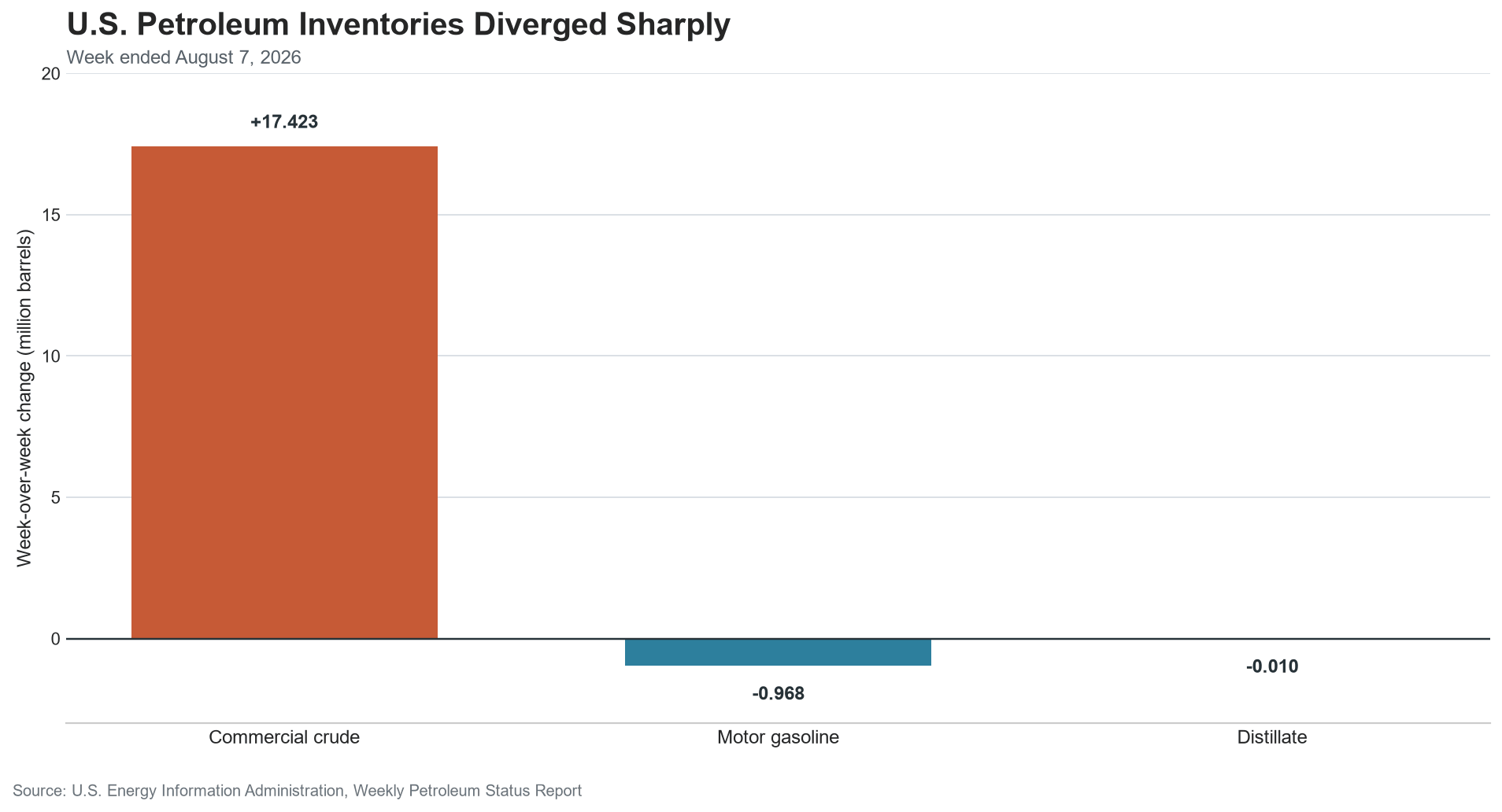
The chart shows the week-over-week change for the period ended August 7. Commercial crude inventories rose by 17.423 million barrels, while gasoline stocks fell by 0.968 million barrels and distillate stocks slipped by 0.010 million barrels. The divergence matters because it points to a crude-side accumulation driven partly by the week's trade flows, not a broad increase across the main petroleum products. Source: U.S. Energy Information Administration.
Market Outlook and Key Takeaways
Oil prices enter the week supported by exceptionally weak Hormuz traffic, continuing Gulf production outages and projected third-quarter inventory draws. High refinery utilization and tight product markets add another layer of support even when crude stocks rise in the United States.
The restraints are equally visible: the latest U.S. crude build was unusually large, Chinese refinery processing contracted sharply in June and the IEA has deepened its forecast for a 2026 decline in global oil demand. The largest disagreement is therefore not whether the current disruption is significant, but how long it lasts and how quickly demand adjusts.
The next signals to watch are tracked vessel movements through Hormuz, evidence that Gulf shipments begin the EIA's assumed September recovery, the EIA's next weekly inventory release on August 19, and whether U.S. product inventories remain tight. A sustained reopening would shift attention quickly toward demand weakness and rebuilding stocks; renewed attacks or further shipping delays would keep the risk premium embedded in prices.
Sources and References
Enjoyed this article? Share it with your network!


RYOEX Official Media is an information platform created specifically for traders, offering the latest news, analysis, guides, and more. From beginners to experienced traders, we provide useful content to help you stay informed and succeed in your trading endeavors.


