


Oil Prices Slip as Large U.S. Crude Build Meets Supply Risks

 August 13, 2026


Crude futures moved lower in early Thursday electronic trade, with a large U.S. inventory build testing a market that still carries a substantial Middle East supply-risk premium. At about 01:10 UTC on August 13, publicly available delayed exchange data showed September 2026 NYMEX WTI futures at $82.06 a barrel and October 2026 ICE Brent futures at $87.75 a barrel. Both exchange pages displayed negative changes at the observation time.
The market is weighing two different signals. U.S. commercial crude stocks rose sharply in the latest week, but the build was heavily influenced by higher imports and lower exports rather than a collapse in refinery intake. At the same time, the U.S. Energy Information Administration (EIA) continues to assume severe constraints on Strait of Hormuz transit through August. The next decisive test is whether physical shipping flows normalize in a sustained, verifiable way.
Crude Oil Market Overview
Delayed Exchange Quotes Point Lower
The September 2026 WTI contract was quoted at $82.06 a barrel on CME, where the displayed change was down $1.21, or 1.45%. ICE showed October 2026 Brent at $87.75 a barrel with a displayed change of negative 1.305%. The WTI page did not provide a prior-settlement value in the relevant field, while the ICE page did not provide a dollar change, so those exchange change measures should not be treated as independently verified settlement comparisons.
The two reference contracts were observed within the same minute. Their direction was consistent: the market was giving back part of its recent risk premium even as the underlying shipping outlook remained unsettled.
A Large Crude Build With Important Flow Details
The EIA reported that U.S. commercial crude inventories excluding the Strategic Petroleum Reserve rose by 17.4 million barrels to 424.4 million barrels in the week ending August 7. Cushing stocks increased by 1.6 million barrels, while Gulf Coast inventories accounted for 14.7 million barrels of the national build. Estimated U.S. crude production was broadly unchanged at 13.805 million barrels per day.
The weekly flow data qualify the bearish headline. Crude imports rose by 1.140 million barrels per day to 7.339 million, while exports fell by 627,000 barrels per day to 3.058 million. Refinery crude inputs still increased slightly to 17.179 million barrels per day, and utilization remained high at 96.2%. In other words, the stock increase was associated with a sharp swing in cross-border flows rather than a sudden retreat in refinery demand.
Product balances also looked tighter than the crude headline alone suggests. Gasoline stocks fell by 1.0 million barrels to 208.7 million and were about 6% below their five-year seasonal average. Distillate stocks declined by 0.1 million barrels to 107.1 million and were about 12% below the five-year average. That combination leaves the crude side of the barrel under pressure while supporting refining economics for scarce products.
Key Market Drivers and Analysis
Near-Term Supply Risk Still Sets a Floor
The EIA's August Short-Term Energy Outlook assumes severe restrictions on Strait of Hormuz transit through August, followed by only a gradual increase in flows from September. Under that assumption, the agency estimates global oil inventory withdrawals of 4.2 million barrels per day in the second quarter and forecasts draws averaging 3.8 million barrels per day in the third quarter. It expects Brent spot prices to average about $85 a barrel in the third quarter before easing to $78 in the fourth quarter as flows improve.
That forecast frames the current market tension. A single large U.S. weekly build can pressure prompt prices, but it does not by itself resolve a global logistics constraint. Conversely, a durable reopening of the main transit route and the restoration of disrupted regional production would remove an important part of the near-term premium. The physical evidence on shipments therefore matters more than negotiating headlines alone.
China Adds a Demand-Side Brake
The latest available official Chinese production release covers June rather than August. It showed crude oil processing by industrial enterprises above the designated size falling 17.7% from a year earlier in June and 4.9% in the first half of 2026. Domestic crude output was comparatively steady, declining 0.5% year over year in June while rising 0.9% in the first half.
The processing decline is a meaningful counterweight to the disruption story because it points to weaker refinery demand in the world's largest crude-importing economy. It does not establish the pace of August consumption, but it raises the bar for any assumption that Chinese buying will fully absorb disrupted or rerouted barrels.
Forecasters Share the Shape, Not the Speed
Institutional views converge on a two-stage market but differ on the size and timing of the transition.
- ING Research's Warren Patterson and Ewa Manthey see near-term risks skewed upward if U.S.-Iran negotiations remain stalled and supply disruptions persist. They also argue that tight middle distillates could keep gasoil cracks seasonally firm into the Northern Hemisphere winter.
- J.P. Morgan's Natasha Kaneva forecast Brent averaging $86 a barrel in the third quarter and $80 in the fourth quarter, with a $78 year-end level. That path depends on demand losses, particularly in China, and weaker-than-expected OECD stock draws continuing to weigh on the market.
- OCBC Global Markets Research presents a more extended downward trajectory rather than quarter-end point forecasts: Brent at $80 in September 2026, $75 in December and $69 by September 2027. Its path assumes the acute supply shock fades and looser balances re-emerge.
The common thread is that near-term disruption can keep prices elevated, but normalization in flows, production and inventories would shift the balance lower. The disagreement is how quickly that normalization arrives and how much demand has already been permanently lost.
What Would Change the Balance
A sustained increase in verified Hormuz transits and regional loadings would weaken the near-term supply-risk case. Continued large U.S. commercial crude builds, especially if accompanied by softer refinery runs rather than import and export swings, would reinforce the downside. On the other side, renewed shipping interruptions, further production shut-ins or a deeper draw in product inventories would strengthen the case for a persistent premium.
Key Charts and Market Data
Commercial Crude Inventories Jump in the Latest Week
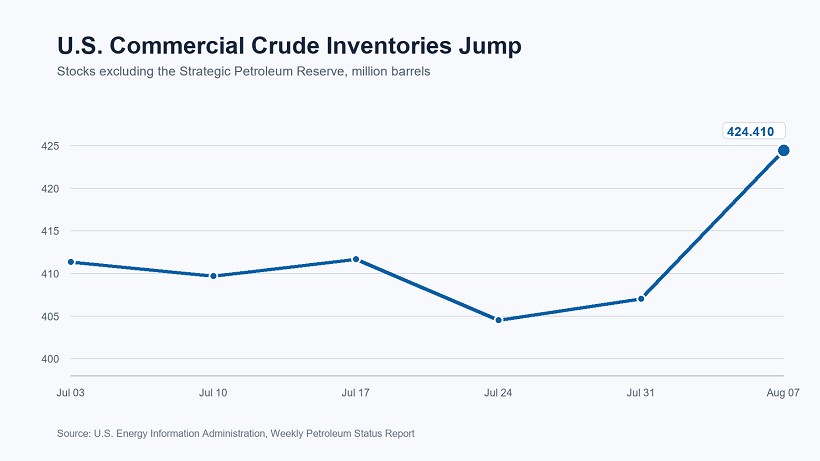
U.S. commercial crude inventories had remained in a relatively narrow range through late July before rising to 424.410 million barrels in the week ending August 7. The size and location of the move make the import-export swing particularly important when interpreting the headline build. Source: U.S. Energy Information Administration, Weekly Petroleum Status Report.
Strategic Petroleum Reserve Stocks Continue to Decline
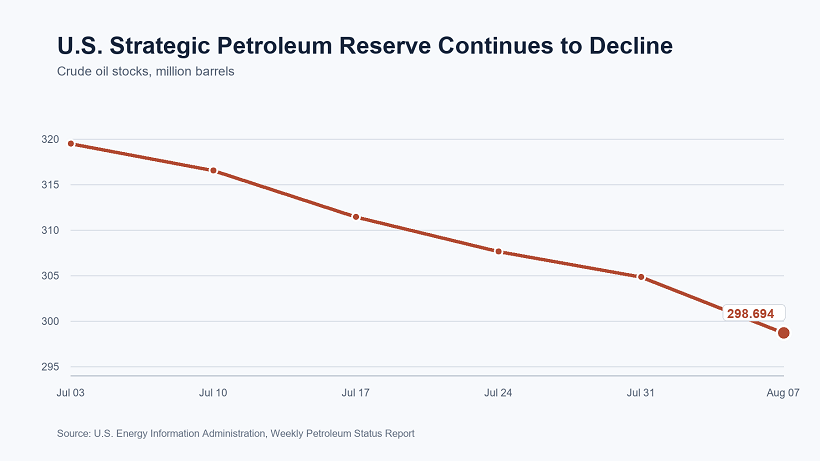
Strategic Petroleum Reserve crude stocks declined in each of the six reported weeks, reaching 298.694 million barrels on August 7. The opposite directions of commercial and strategic stocks show why the two categories should not be combined when assessing near-term market availability. Source: U.S. Energy Information Administration, Weekly Petroleum Status Report.
Market Outlook and Key Takeaways
Oil's near-term floor remains tied to constrained Middle East flows, tight U.S. product inventories and high refinery utilization. The main pressure comes from the latest U.S. commercial crude build, weak Chinese refinery processing and forecasts that assume supply routes and production gradually recover.
The largest uncertainty is not the existence of geopolitical risk but its measurable effect on physical barrels. Verified transit volumes, regional loadings and the next U.S. inventory report will show whether the current weakness is a temporary response to a flow-driven stock build or the beginning of a broader easing in balances. Until that evidence becomes clearer, the market is likely to remain caught between prompt supply risk and a softer medium-term demand outlook.
Sources and References
-
CME Group, Crude Oil Futures Quotes, delayed quote observed August 13, 2026.
-
ICE Futures Europe, Brent Crude Futures Pricing, delayed quote observed August 13, 2026.
-
U.S. Energy Information Administration, Weekly Petroleum Status Report, released August 12, 2026, for the week ending August 7.
-
U.S. Energy Information Administration, Short-Term Energy Outlook, released August 11, 2026.
-
National Bureau of Statistics of China, Energy Production in June 2026, published July 15, 2026.
-
ING Research, Warren Patterson and Ewa Manthey, The Commodities Feed: Oil higher as US-Iran deal hopes fade, August 11, 2026.
-
J.P. Morgan Global Research, Natasha Kaneva, Oil prices forecast: What's next for oil in 2026 and beyond?, July 16, 2026.
-
OCBC Global Markets Research, Research Monitor, August 3, 2026.
Enjoyed this article? Share it with your network!


RYOEX Official Media is an information platform created specifically for traders, offering the latest news, analysis, guides, and more. From beginners to experienced traders, we provide useful content to help you stay informed and succeed in your trading endeavors.


