


Crude Holds Firm as Hormuz Risks Clash With Weak Asian Demand

 August 12, 2026


Crude oil remained elevated in early Asian trading on August 12 as the market weighed persistent shipping risk around the Strait of Hormuz against signs of improving regional flows and weak demand indicators from China. At 01:15 UTC, publicly available delayed exchange data showed September WTI at $83.82 a barrel and October Brent at $89.53 a barrel. CME data were delayed by at least 10 minutes and ICE data by at least 15 minutes.
The central tension is no longer a simple choice between shortage and normalization. More barrels appear to be moving through the Gulf, but transit conditions remain politically and operationally fragile, while depleted inventories and tight middle-distillate supplies leave little room for another disruption. At the same time, softer Chinese factory activity and refinery runs are limiting the demand side of the price response.
Crude Oil Market Overview
Benchmarks Stay Elevated in a Volatile Market
The September 2026 NYMEX WTI contract was quoted at $83.82 a barrel at 01:15 UTC on August 12, while ICE Futures Europe's October 2026 Brent contract stood at $89.53. The contracts were the first-listed, most actively traded nearby months on their respective exchange pages at the observation time. CME's latest accessible official settlement for September WTI was $82.13 on August 10.
Oil remained highly sensitive to diplomacy and shipping headlines. The Associated Press reported on August 11 that U.S. Energy Secretary Chris Wright said nearly 9 million barrels per day were moving through the Strait of Hormuz and about 15 million barrels per day when pipeline flows were included. Those were government claims rather than independently reconciled tanker-flow data. Iran, meanwhile, continued to link a fuller reopening to U.S. concessions. The combination points to partial relief, not restored normality.
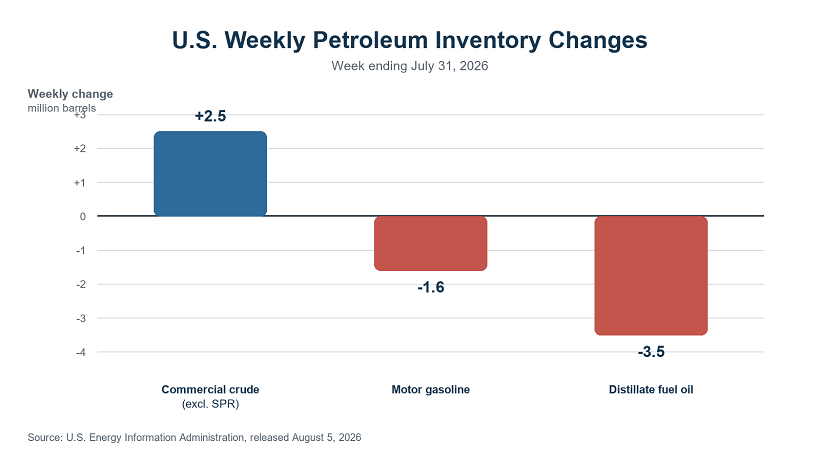
The latest available U.S. Energy Information Administration (EIA) weekly report, covering the week ended July 31, showed a mixed petroleum balance. Commercial crude inventories excluding the Strategic Petroleum Reserve rose by 2.5 million barrels to 407.0 million barrels. Gasoline stocks fell by 1.6 million barrels to 209.7 million, while distillate inventories dropped by 3.5 million barrels to 107.2 million. Commercial crude remained about 6% below its five-year seasonal average and distillates about 12% below. Refineries ran at 96.5% of operable capacity, and estimated domestic crude production was 13.804 million barrels per day.
That split matters. A crude build can temper immediate scarcity concerns, but falling gasoline and distillate stocks indicate that the product market remains tight. High refinery utilization also means the U.S. system has less easy scope to lift runs further if product demand or exports strengthen.
Key Market Drivers and Analysis
Shipping Recovery Has Yet to Remove the Supply Premium
The EIA's August Short-Term Energy Outlook, released August 11, assumes that severe constraints on Hormuz transits persist through August and ease only gradually from September. Under that scenario, the agency estimates global oil inventories fell by 4.2 million barrels per day in the second quarter and forecasts a further 3.8 million-barrel-per-day draw in the third quarter. It expects Brent spot prices to average about $85 a barrel in the third quarter and $78 in the fourth, before averaging $69 in 2027 as production and inventories recover. These are conditional forecasts, not observations of current flows.
Kpler's July 24 assessment was more cautious about the speed of recovery. It projected 10.5 million barrels per day of Gulf outages in August and said full regional production recovery could be delayed until early 2027. Kpler also noted that bypass routes provide meaningful relief, but longer voyages and exposure around the Red Sea raise freight and security costs. This makes safe, sustained transit—not a single day's flow—the key near-term supply test.
OPEC+ offers only a modest policy offset. Seven participating countries agreed on August 2 to implement a 188,000-barrel-per-day production adjustment in September. The figure is a target adjustment and should not be treated as already delivered supply. In a market shaped by multi-million-barrel-per-day uncertainty around Gulf output and transport, implementation and physical export capacity matter more than the headline target alone.
Chinese Demand Indicators Remain a Material Restraint
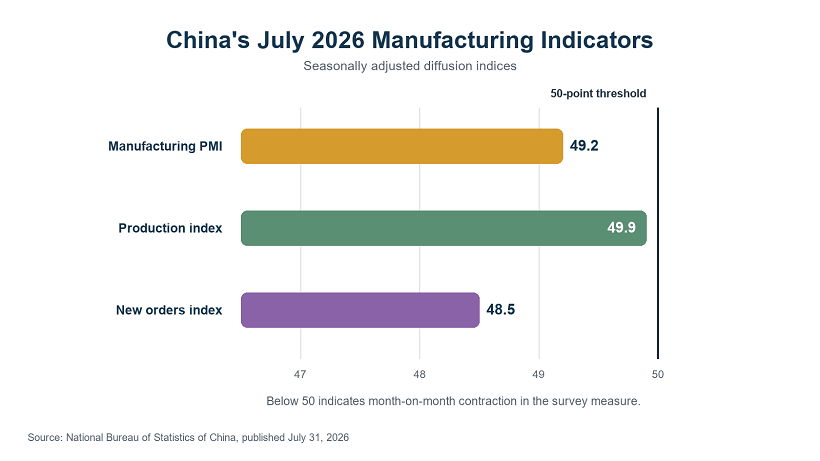
China's official manufacturing PMI fell to 49.2 in July, with the production index at 49.9 and new orders at 48.5. Readings below 50 indicate month-on-month contraction in the survey; they do not translate directly into a specific change in oil consumption. More directly, official data showed Chinese crude throughput at 51.24 million metric tonnes in June, down 17.7% from a year earlier. Throughput over the first half totaled 343.87 million tonnes, down 4.9%.
J.P. Morgan's July 16 outlook identified demand destruction and the pace of Gulf supply recovery as the main balancing forces. Its estimate of an August surplus of about 1.2 million barrels per day assumed Persian Gulf supply recovered to roughly 90% of pre-war levels. That assumption is substantially more optimistic than Kpler's later outage case, so the two estimates should be viewed as alternative scenarios rather than combined into a midpoint.
ING's July 9 base case put Brent at $80 a barrel in the third quarter and $74 in the fourth, while warning that renewed Hormuz disruption could push the benchmark toward $100. The International Energy Agency's July public Oil Market Report also highlighted a two-speed market: crude supply rebounded in June, but Gulf refinery outages and reduced Asian runs kept refined products tight. Its forecast called for global oil demand to contract by 1 million barrels per day in 2026 before year-on-year growth resumed later in the year.
Japan provides a regional buffer, but not an unlimited one. Official data for end-May showed total oil stocks equal to 204 days on Japan's statutory basis. That figure includes state, private and producer-country joint holdings, and it predates the latest market moves. Releases had already begun in March, while the private stockholding obligation had been reduced, making the age and basis of the figure important.
The Market Is Pricing Competing Recovery Paths
The institutional views differ mainly because their assumptions about Hormuz are different. A durable reopening would release stranded barrels, lower freight risk and allow idled production and refining to restart. A partial or contested reopening leaves the market exposed to renewed vessel attacks, insurance constraints and slow operational restarts. Weak Chinese refinery demand can cushion the loss of Gulf supply, but it cannot eliminate the logistics risk embedded in crude and product markets.
Key Charts and Market Data
U.S. Crude Built While Product Stocks Fell
The EIA's July 31 weekly data show the contrast between a 2.5 million-barrel commercial crude build and draws in gasoline and distillates. The composition of the change is more informative than the crude headline alone because it shows continuing pressure in fuels used for road transport, industry and aviation.
China's July Survey Signals Weaker Industrial Momentum
All three selected official PMI measures were at or below the 50-point threshold in July. New orders were the weakest of the group, consistent with a softer near-term industrial backdrop, although the survey cannot by itself quantify petroleum demand.
Market Outlook and Key Takeaways
Near-term support comes from fragile Gulf shipping, large forecast inventory draws and tight U.S. product stocks. The main offsets are improving reported flows through Hormuz, a weekly U.S. crude build, weak Chinese manufacturing and refinery activity, and a small planned OPEC+ supply adjustment for September.
The market's largest disagreement is the speed of physical normalization. A sustained rise in verified tanker traffic, safer passage through both Hormuz and the Red Sea, and visible restarts of Gulf production would strengthen the bearish recovery case. Renewed attacks, lower transit volumes or delays in restarting fields and refineries would reinforce the supply-risk premium.
The next major data checks are the EIA weekly petroleum report and the IEA's August Oil Market Report, both scheduled for later on August 12. Until those releases provide new evidence, shipping flows, U.S. product inventories and Chinese refinery activity remain the most useful indicators of whether the current balance is easing or merely becoming less acute.
Sources and References
-
CME Group, WTI Crude Oil Futures Quotes, observed August 12, 2026; and ICE Futures Europe, Brent Crude Futures Data, observed August 12, 2026.
-
U.S. Energy Information Administration, Weekly Petroleum Status Report, data for the week ended July 31, 2026; and Short-Term Energy Outlook, released August 11, 2026.
-
Associated Press, The Latest: Trump seeks an exit from his Iran war as Mideast violence spreads, August 11, 2026.
-
National Bureau of Statistics of China, Purchasing Managers' Index for July 2026, July 31, 2026; and Energy Production in June 2026, July 15, 2026.
-
OPEC, Seven OPEC+ countries adjust production and reaffirm commitment to market stability, August 2, 2026.
-
Kpler, Middle Eastern supply recovery postponed to early 2027, July 24, 2026.
-
J.P. Morgan Global Research, Oil prices forecast: What's next for oil in 2026 and beyond?, July 16, 2026.
-
ING Research, Oil off its highs but risks return, July 9, 2026; and International Energy Agency, Oil Market Report — July 2026, July 10, 2026.
Enjoyed this article? Share it with your network!


RYOEX Official Media is an information platform created specifically for traders, offering the latest news, analysis, guides, and more. From beginners to experienced traders, we provide useful content to help you stay informed and succeed in your trading endeavors.


