


Crude Gaps Lower on U.S.-Iran Pause, but Hormuz Disruptions Sustain Supply Risks

 July 27, 2026

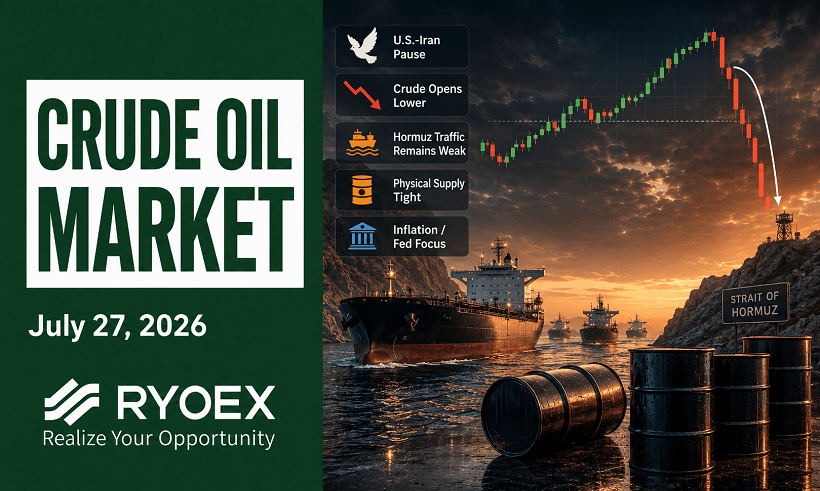
International crude prices ended a five-session rally on Friday and opened sharply lower on Monday after the United States and Iran paused their attacks. WTI still gained more than 10% for the week, while persistently weak vessel traffic through the Strait of Hormuz and a continuing physical crude deficit tempered expectations of a sustained correction. Markets are also assessing the inflation implications of oil prices ahead of Wednesday’s Federal Reserve decision.
Crude Oil Market Overview
Oil Retreats as U.S.-Iran Attacks Pause
International crude prices fell sharply during Friday’s session after reports that Pakistan was seeking to restart negotiations between the United States and Iran. The decline ended a five-session winning streak, although oil recorded a third consecutive weekly gain.
WTI crude fell as much as 5% to an intraday low of $88.11 a barrel before settling 2.05% lower at $90.89. It gained more than 10% for the week. Brent crude closed 1.85% lower at $93.16 a barrel.
Prices opened sharply lower on Monday as concerns about potential disruptions to Middle Eastern energy supplies eased. President Donald Trump ordered a suspension of U.S. airstrikes on Iran, while Tehran halted its reciprocal attacks. A senior Iranian source said Iran would continue to refrain from attacks as long as the United States maintained the ceasefire. Saudi media also reported that Iran had not withdrawn from negotiations and was willing to continue talks with the United States at several locations in Geneva. Brent fell as much as 7.4% and briefly traded below $90 a barrel before paring its decline.
Hormuz Traffic Remains Weak Despite Diplomatic Progress
The pause in attacks has not yet produced a material recovery in shipping through the Strait of Hormuz. Recent vessel traffic fell back to single-digit levels, reinforcing concerns that physical supply flows remain impaired despite growing expectations of diplomatic progress.
Iran said talks with Oman over the management of shipping through the strait had made progress. Qatar’s Ministry of Transport said all forms of maritime transport and vessel navigation would fully resume from July 26. Saudi Arabia also confirmed that a multinational coalition had carried out strikes against Yemen’s Houthi forces.
Security risks remain unresolved. Iranian media reported that a tanker struck a mine and exploded in the Strait of Hormuz. The source analysis said restoring the route would require more than diplomatic reconciliation, as mine clearance and the restoration of navigational security would likely take time and remain vulnerable to setbacks. Continued pressure on Hormuz traffic, along with constraints on Red Sea shipping, has prevented the geopolitical risk premium from dissipating quickly.
Physical Supply Constraints Limit the Downside
The source analysis described the physical crude market as remaining in deficit, with ongoing inventory drawdowns and low inventories across the supply chain providing underlying support. These constraints could limit the extent to which prices respond to the temporary pause in U.S.-Iran hostilities.
Pressure is also building in refined-product markets. Russia extended its gasoline export ban through the end of 2026 after repeated Ukrainian attacks weakened the country’s refining capacity. Diesel exports have also been restricted, following earlier controls on jet fuel and gasoline, as Moscow prioritizes domestic supply amid widespread fuel shortages and sharply higher prices.
In the United States, the Department of Energy issued grid emergency orders for 17 states because of extreme heat. The latest oil rig data showed that drilling activity edged lower in the week ended July 24, indicating that North American shale supply growth remained measured rather than accelerating sharply.
Central-Bank Decisions Put Oil’s Inflation Impact in Focus
The decline in oil prices eased some of the inflation concerns generated by July’s surge. Bond markets rallied as Middle East tensions moderated, but the duration of the disruption remains important for central banks. A short-lived energy shock may have limited effects, while a prolonged period of elevated prices could affect transportation and food costs, corporate pricing, wages, and broader inflation expectations.
Traders are watching whether the Federal Reserve raises interest rates on Wednesday after the recent oil-price surge complicated an otherwise relatively uneventful policy meeting. The Bank of England and Bank of Japan are also preparing to meet this week. Markets will focus on how policymakers characterize energy-related inflation risks, even if the Federal Reserve leaves policy unchanged.
Crude Oil Outlook: Global Market Views
This section reviews the main views on crude oil from global financial institutions and market participants. Each view has been summarized and restructured by the RYOEX Research Team based on publicly available information. References to any institution or individual do not imply endorsement of RYOEX or its views.
Phil Flynn | Pressure on Russian refining adds to global supply-chain strains
Phil Flynn said repeated Ukrainian attacks on Russian oil infrastructure had severely weakened the country’s refining capacity and forced Moscow to restrict refined-product exports. Russia is prioritizing domestic supply amid widespread fuel shortages and sharply higher prices, with diesel exports now restricted after similar controls on jet fuel and gasoline. Moscow is even considering refined-product imports to prevent domestic conditions from deteriorating further.
Flynn argued that restrictions imposed by a major energy exporter show that external pressure is having an effect. The resulting economic strain could force policymakers to reassess their options and potentially move Russia closer to peace negotiations. The Kremlin has said it will wait for a new U.S. proposal to resolve the conflict in Ukraine, but its signals after the latest negotiations remained cautious and included no clear commitment. Communication is continuing, although Flynn said a sudden breakthrough should not be expected.
With Russian refineries sustaining damage, refined-product exports constrained, and the war’s energy costs rising, Flynn said President Vladimir Putin’s established strategy was becoming increasingly expensive. Pressure on Middle Eastern oil transportation routes and Russia’s refining system is drawing close market attention. Oil may still reach the market, but the central question is how long the countries under pressure can continue absorbing the disruption.
Stephen Innes | Lower oil prices offer central banks limited relief
Stephen Innes described crude oil as one of the fastest-moving taxes in the global economy. A sharp increase quickly affects consumers at gasoline stations, raises operating costs for airlines and transportation companies, increases manufacturers’ logistics expenses, and prompts central banks to consider whether an initial supply shock could spread to broader inflation expectations.
Innes said Monday’s oil move therefore had implications beyond energy markets. If crude prices continue to fall, the near-term inflation shock could ease as the Federal Reserve, Bank of England, and Bank of Japan prepare for policy meetings this week.
Although the Federal Reserve is unlikely to change policy, in his view, the recent oil shock has made the meeting more complicated. Softer inflation data had given officials room to remain patient, but higher oil prices increased the risk of renewed inflation in transportation, food, and consumer goods. The pullback has not eliminated those concerns, but it has altered the policy calculation.
Central banks can look through a temporary increase in energy prices, Innes said, but a shock that lasts long enough to affect wages, corporate pricing, and inflation expectations is harder to ignore. The longer oil remains elevated, the more difficult it becomes to characterize the effect as temporary. The retreat gives Federal Reserve officials some room to focus on underlying inflation and labor-market conditions. The central bank’s language on energy prices will indicate whether policymakers believe the threat is fading or merely pausing between shocks.
James Hyerczyk | A sustained correction requires evidence of improved physical flows
James Hyerczyk said a single headline triggered selling on Friday, and another could bring buyers back on Monday. Although market signals have been frequent and inconsistent, he argued that tanker movements are the most important indicator.
A stronger bearish case would require normalized traffic through the Strait of Hormuz, lower insurance costs, and the ability of Saudi crude to move through the Red Sea without rerouting. Until those conditions emerge, another tanker attack or renewed expansion of U.S. military action could quickly restore buying interest.
Hyerczyk said the conflict would not need to spread to additional countries to support prices. Continued restrictions on the two transportation routes already under pressure could be sufficient. WTI and Brent both ended last week above key breakout levels. WTI is approaching a major high that, if breached, would formally shift the swing trend higher. Brent is trading just below its previous major high, while its technical price target is well above current levels.
As long as supply disruptions continue, Hyerczyk sees scope for further gains. A durable correction would require evidence that physical flows are improving. Until then, the principal bearish factors are crowded positioning and profit-taking pressure after oil gained more than 10% in one week.
Anand Krishnamoorthy | Pause in retaliation eases energy-supply and inflation concerns
Anand Krishnamoorthy said concerns about disruptions to Middle Eastern energy supplies eased after neither the United States nor Iran launched retaliatory attacks. Oil prices fell, while bond prices rose.
The United States halted an air campaign against Iran that had lasted almost two weeks. After 13 consecutive days of strikes, U.S. forces appeared to have remained inactive since late Friday without publicly explaining why, prompting speculation about Trump’s next step. Iran’s military said on Sunday that Tehran had also suspended its military response.
The reduction in tensions lifted U.S. Treasuries, European bond futures, and Asia-Pacific government bonds as inflation concerns receded. The benchmark 10-year U.S. Treasury yield fell 4 basis points to 4.64%. The dollar, which had been the preferred haven during the Middle East conflict, weakened against every other Group of 10 currency.
Krishnamoorthy said the pause set the tone for a week containing several important market events. Traders are assessing whether the Federal Reserve will raise interest rates on Wednesday after the oil-price surge intensified inflation concerns. Investors are also awaiting earnings from major technology companies amid renewed questions about heavy spending on artificial intelligence.
Middle East tensions drove oil sharply higher in July and overshadowed the positive effect of weaker-than-expected U.S. consumer inflation data for June. The softer inflation reading had appeared to give policymakers more room to leave interest rates unchanged.
Shoji Hirakawa | Suspension of attacks raises hopes for negotiations
Shoji Hirakawa, global chief strategist at Tokai Tokyo Intelligence Laboratory, said a resolution of the conflict would be a positive development. He added that the suspension of attacks had increased hopes that both sides would enter negotiations.
Evercore ISI | A Federal Reserve rate increase is unlikely but cannot be dismissed
Krishna Guha, Evercore ISI’s head of central-bank strategy, said the Federal Reserve was highly unlikely to raise interest rates. However, because Warsh had declined to clearly explain his policy strategy, Guha said the probability of an increase should not be set too low.
Key Crude Oil Market Charts
This section highlights charts that help explain recent moves in the crude oil market, with a focus on changes in supply and demand conditions and market sentiment. The charts and data are based on third-party information and do not represent RYOEX's views or indicate future price movements. Given the risk of sudden market swings, appropriate risk management remains essential.
U.S. Oil Rig Count Edges Down to 450
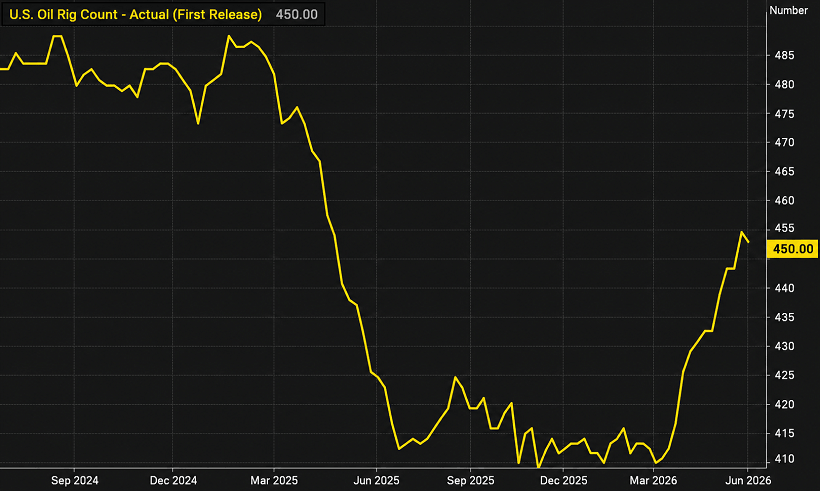
The total U.S. oil rig count fell to 450 in the week ended July 24 from 452 previously. Over the longer term, the rig count rose rapidly after the U.S.-Iran conflict began in March 2026 before consolidating at elevated levels.
The earlier rebound reflected shale producers’ delayed capital-spending response to high oil prices and strong refining margins. The latest decline to 450 suggests that producers remain measured in bringing new capacity online because of capital discipline and high refining costs, with no sign of an uncontrolled expansion. The source analysis expects incremental North American shale supply to fill the global supply gap only gradually. Against peak summer demand, the slight decline in drilling also limits supply flexibility and preserves underlying support from constrained supply and efforts to protect inventories.
Strait of Hormuz Vessel Traffic Falls Back to Single Digits
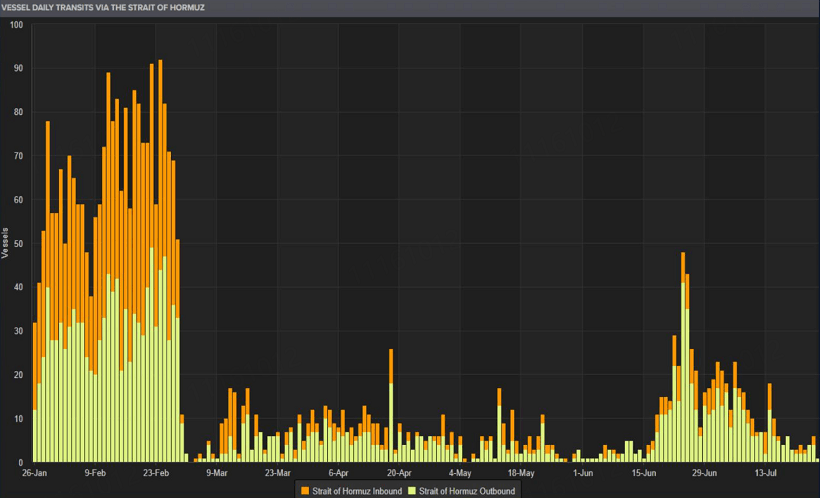
Recent data show that vessel traffic through the Strait of Hormuz has fallen back to single-digit levels. Traffic has not improved materially even after Trump ordered a suspension of U.S. airstrikes on Iran and Tehran halted its reciprocal attacks.
Iranian media also reported that a tanker struck a mine and exploded in the strait. The incident underscores continuing physical security risks to the supply chain and suggests that diplomatic progress alone may not quickly restore the route. Mine clearance and the restoration of navigational security could take time and remain vulnerable to repeated setbacks. The source analysis therefore expects continued disruption in the strait to support crude prices and prevent the geopolitical risk premium from dissipating rapidly.
CFTC Data Show a Rebound in WTI Net Positions
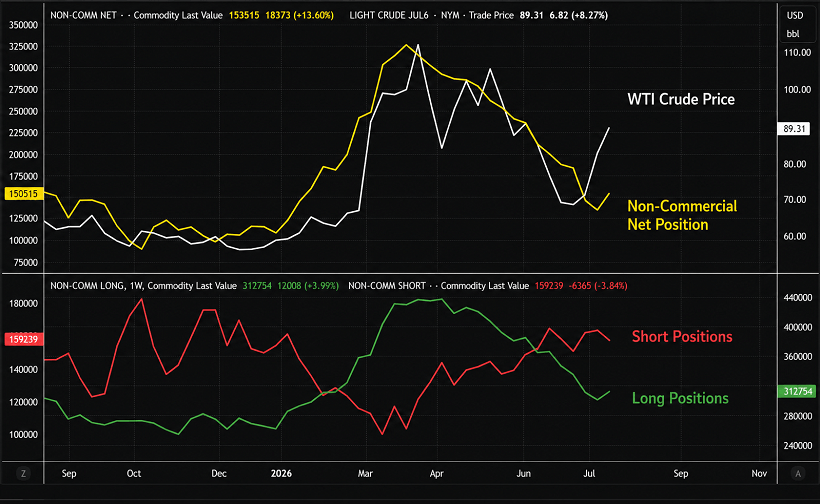
The latest CFTC positioning data show that non-commercial traders increased WTI long positions and reduced short positions, producing a marked rebound in net positions. The shift was closely aligned with the direction of prices.
Although the U.S.-Iran pause drove crude sharply lower at Monday’s open, the source analysis argued that anticipatory positioning and short-term reactions to headlines remain constrained by the continuing physical supply deficit. Ongoing inventory drawdowns and low inventories across the supply chain could keep the market fundamentally tight. After absorbing the immediate bearish impact of the pause in hostilities, crude is expected to remain firm but volatile as tight fundamentals interact with the risk of renewed geopolitical disruption.
Summary
Crude prices pulled back after reports of renewed negotiations and a pause in U.S.-Iran attacks, ending WTI’s five-session rally but leaving it more than 10% higher for the week. The easing of hostilities reduced immediate supply and inflation concerns, yet vessel traffic through the Strait of Hormuz remains depressed. A reported tanker mine strike has underscored physical shipping risks, while the source analysis continues to point to a physical crude deficit and low inventories. Restrictions on Russian refined-product exports add another source of supply-chain pressure. Markets are now assessing whether shipping flows improve and how the Federal Reserve addresses energy-related inflation risks at Wednesday’s policy decision.
Enjoyed this article? Share it with your network!


RYOEX Official Media is an information platform created specifically for traders, offering the latest news, analysis, guides, and more. From beginners to experienced traders, we provide useful content to help you stay informed and succeed in your trading endeavors.


