


Oil Extends Rally as Middle East Supply Risks Deepen and Near-Term Diplomacy Fades

 July 23, 2026


Crude prices advanced for a fourth consecutive session on Wednesday, with monthly gains approaching 30% as tanker attacks, U.S. strikes on Iran, and threats to shipping through the Strait of Hormuz and the Red Sea heightened supply concerns. The reports cited different Wednesday settlement snapshots, including Brent at $94.07 a barrel and WTI at $86.83, while an earlier recap put the benchmarks at $90.67 and $86.90, respectively. Markets are now awaiting U.S. initial jobless claims at 8:30 a.m. ET and the EIA’s weekly natural gas storage report at 10:30 a.m. ET.
Crude Oil Market Overview
Crude Extends Four-Day Rally as Supply Risks Mount
Oil prices rose sharply on Wednesday after Yemen’s Houthi movement said it had attacked two Saudi tankers in the Red Sea and the United States carried out an 11th consecutive night of strikes against Iran. International crude prices gained as much as 3% during the session. One market recap showed WTI briefly trading above $89 before settling 2.22% higher at $86.90 a barrel, while Brent moved back above $90 and closed 1.47% higher at $90.67.
A separate market assessment showed September Brent rising nearly 5% and breaking above $95 before settling at $94.07 a barrel, its highest close since June 8. That represented a gain of 3.4% and left Brent at a six-week high. The benchmark has advanced for four consecutive sessions, posting its largest four-day gain since April 29. September WTI gained nearly 3% to settle at $86.83, its highest level since June 11, after reaching an intraday high of $88.61.
Brent has gained more than 10% this week, while crude’s monthly increase is approaching 30%. The rally has been driven by fading expectations for an early diplomatic settlement and mounting risks of supply disruptions in the Middle East and other producing regions.
Hormuz and Red Sea Threats Put Two Major Shipping Routes at Risk
An Iranian official called U.S. President Donald Trump’s claim that Tehran had requested negotiations “completely baseless.” Iran said no formal talks were taking place and that the two sides were only exchanging messages. U.S. Secretary of State Marco Rubio said Washington remained willing to reach a diplomatic settlement but argued that Iran was not acting in good faith and had no intention of entering serious negotiations.
Trump warned that the United States would destroy an Iranian bridge or power plant each time Iran attacked a vessel passing through the Strait of Hormuz. He also threatened action if the Houthis interfered with Red Sea shipping and separately threatened strikes on Iranian nuclear facilities. Iran’s military responded that if Washington carried out its threats, Tehran would halt all oil flows through the Gulf and target regional oil, natural gas, power, and economic infrastructure.
Traffic through the Strait of Hormuz has nearly ground to a halt as tensions intensify. Three tankers have already been attacked near the strait. U.S. Central Command said its latest operations targeted Iranian aircraft hangars, maritime combat capabilities, and drone storage facilities to reduce Iran’s ability to attack commercial shipping. Israeli media reported that the United States had informed Israel of plans to escalate strikes against Iran in the coming days, while the United Kingdom withdrew its diplomatic personnel from Iran.
Risks are also rising in the Red Sea. The Houthis have been accused of deploying missiles and drones in preparation for attacks on commercial vessels and have announced a maritime blockade of Saudi Arabia. Some ships have suspended voyages or turned around, while others continue to transit the area. Three Saudi tankers abandoned passage through the Bab el-Mandeb Strait and rerouted via the Suez Canal. During the conflict, the Red Sea has served as an important route for Saudi exports seeking to bypass the Strait of Hormuz, exposing Middle Eastern crude flows to risks along two major shipping corridors.
Tight Inventories and Other Disruptions Amplify the Rally
Supply risks extend beyond the Middle East. The Caspian Pipeline Consortium terminal on Russia’s Black Sea coast, which handles most of Kazakhstan’s crude exports, has continued to face attacks. Loadings through the CPC terminal averaged about 1.7 million barrels per day in June. A prolonged shutdown could eventually force Kazakhstan to reduce upstream production.
Tightness is also evident in the futures curve. Prompt spreads for both Brent and WTI have widened to backwardation of more than $3 a barrel, compared with only a few cents under normal conditions. The structure indicates that traders are willing to pay a substantial premium for immediate supply.
U.S. Energy Information Administration data showed commercial crude inventories unexpectedly rose by 2 million barrels in the week through July 17, consistent with the earlier API signal. Refined-product inventories also increased, providing some near-term supply relief. The latest crude build reflected lower refinery throughput and wider net imports, but inventories at the Cushing delivery hub remained low.
The increase in commercial stocks was offset by a 5.1 million-barrel decline in the Strategic Petroleum Reserve to 311.4 million barrels, its lowest level since 1983. OECD inventories have fallen to 2.603 billion barrels from 2.824 billion at the end of February, while total U.S. commercial inventories have declined to 1.204 billion barrels from 1.271 billion. Inventory conditions are therefore substantially tighter than they were in March.
The earlier decline from above $120 to about $70 was supported by ample inventories, alternative transportation routes, rising non-OPEC+ supply, strategic reserve releases, sanctions waivers, expansion of the dark fleet, and demand destruction. Several of those buffers have since weakened. The United States has resumed sanctions on Iran, waivers related to Russia have expired, and the Houthi blockade could disrupt Saudi exports to Asia. An attack on Saudi Arabia’s east-west pipeline could put 5 million barrels per day of exports at risk.
Product Inventories Rise, but Refining Capacity Faces New Constraints
U.S. gasoline inventories increased by 765,000 barrels and distillate stocks rose by 1.395 million barrels, both exceeding expectations. Refinery utilization remained exceptionally high at 96.1%, while weekly gasoline production reached 9.7 million barrels. Consumption growth alone was insufficient to absorb that level of output.
Wider net imports, releases from the Strategic Petroleum Reserve, and the marginal impact of high prices on end-user consumption also contributed to an unexpected seasonal increase in product inventories. The build was characterized as a temporary mismatch between strong supply and weaker demand rather than evidence of a collapse in consumption.
At the same time, three major refineries in the United States, Europe, and Africa have experienced unplanned outages caused by fires, high temperatures, and operational strain. Together, the disruptions affected more than 1 million barrels per day of processing capacity. Even if crude supply recovers, refining bottlenecks could constrain fuel production, compounding product-market tightness and the risks affecting crude flows through Hormuz and Bab el-Mandeb.
Markets will next assess U.S. initial jobless claims for the week through July 18 at 8:30 a.m. ET, followed by the EIA’s natural gas storage report for the week through July 17 at 10:30 a.m. ET. Subsequent U.S. crude inventory and export data will also draw increased attention as buyers seek American barrels to offset possible Middle Eastern supply losses.
Crude Oil Outlook: Global Market Views
This section reviews the main views on crude oil from global financial institutions and market participants. Each view has been summarized and restructured by the RYOEX Research Team based on publicly available information. References to any institution or individual do not imply endorsement of RYOEX or its views.
TD Securities | Tail risks are rising as Iranian crude flows tighten
TD Securities said the tail risk of an extreme increase in oil prices is rising as Iran further restricts crude flows. Trend-following funds also began buying again after Brent broke above $93 a barrel.
Equinor | Low inventories make physical disruptions more consequential
Equinor ASA Chief Financial Officer Torgrim Reitan said current conditions differ from earlier periods because inventories are low and the market lacks an obvious supply surplus. As a result, actual supply disruptions can feed through to prices more quickly.
Bernstein | Brent could exceed $100 if the conflict persists and inventories fall
Bernstein expects Brent could break above $100 a barrel before year-end if the Middle East conflict continues and OECD commercial inventories decline further.
Goldman Sachs | Triple-digit crude is possible but not the base case
Goldman Sachs said crude prices could return to triple digits, although that outcome is not the bank’s base-case scenario.
XTB | Higher oil prices add to inflation and household cost pressures
Kathleen Brooks, head of research at XTB, said Brent’s gain of more than 10% this week would intensify the inflation challenge facing global central banks. Higher energy costs could also raise household expenses and reduce disposable income in the second half of the year. She said the escalating conflict was increasing risks to global supply chains and inflation.
TradeStation | The immediate crisis has eased, but the supply outlook remains fragile
David Russell, global head of market strategy at TradeStation, said the market had not yet entered an immediate energy crisis, but the current supply trajectory remained vulnerable. He described the situation as one in which “the pain has eased, but the bleeding continues.”
ING | Brent above $91 still understates persistent disruption risks
ING strategists Warren Patterson and Ewa Manthey said hopes for a short-term U.S.-Iran ceasefire had faded after Trump ruled out immediate negotiations. The United States had just completed a 12th consecutive night of strikes against Iran, while the Houthi declaration of a maritime blockade against Saudi Arabia had unsettled shipping companies and prompted several tankers to turn away from the Bab el-Mandeb Strait.
ING said the diversion would force tankers to use the Suez Canal when entering or leaving the Red Sea, significantly increasing the time and cost of voyages to Asia. The longer CPC terminal operations remain disrupted, the greater the possibility that Kazakhstan will be forced to reduce upstream production.
Given renewed disruptions in the Persian Gulf, risks to Saudi crude exports through the Red Sea, and developments in the Black Sea, ING said Brent at slightly above $91 a barrel appeared undervalued, particularly if the disruptions continued into August. Relief would require Middle Eastern oil flows to normalize, allowing refiners in the Middle East and Asia to raise operating rates, as well as an easing of Ukrainian attacks on Russian refineries.
Market Analysis | Oil may trade in a wide range near the upper end
The June 17 memorandum of understanding signed by Iran and the United States is subject to materially different interpretations. Under the Iranian version, Iran would supervise maritime traffic, vessels would be required to sail north, and fees could be imposed after 60 days. The U.S. version calls for unconditional access, permits vessels to use the southern channel, and prohibits fees. Unilateral control of the shipping lane would violate international law, leaving the document open to misuse.
The analysis expects a ceasefire eventually to be restored but does not expect stability to last. It argues that Iran has found its strategic leverage over the Strait of Hormuz to be greater than that provided by its nuclear program. A durable peace is viewed as unlikely, while a U.S. withdrawal would amount to a public humiliation. Removing the Iranian government would require ground forces and months of operations and could push oil well above $100 a barrel.
The assessment does not consider another break above $100 inevitable. It expects prices to remain within a broad range of $70 to $100, potentially closer to the upper end, and sees little prospect of a fundamental change before the November midterm elections.
Key Crude Oil Market Charts
This section highlights charts that help explain recent moves in the crude oil market, with a focus on changes in supply and demand conditions and market sentiment. The charts and data are based on third-party information and do not represent RYOEX's views or indicate future price movements. Given the risk of sudden market swings, appropriate risk management remains essential.
EIA Crude Inventories Rise More Than Expected
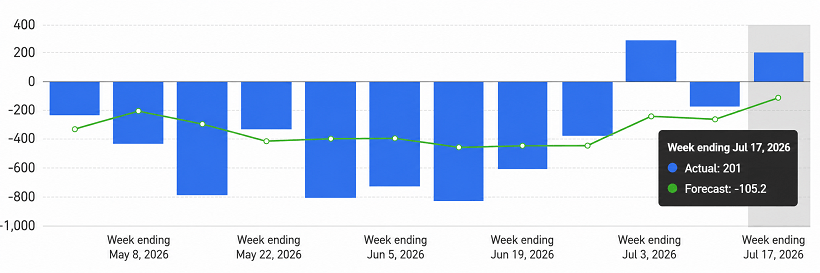
U.S. crude inventories increased more than expected in the week through July 17, according to the EIA, in line with the earlier API signal. Recent data have alternated between builds, draws, and renewed builds. The latest increase mainly reflected lower refinery throughput and wider net imports, but the Strategic Petroleum Reserve has fallen to a multidecade low and Cushing inventories remain depressed.
With flows through the Strait of Hormuz nearly halted and the Bab el-Mandeb Strait facing a blockade threat, a single weekly build does not by itself indicate a reversal in the broader supply-demand balance.
Gasoline and Distillate Inventories Post Unexpected Builds
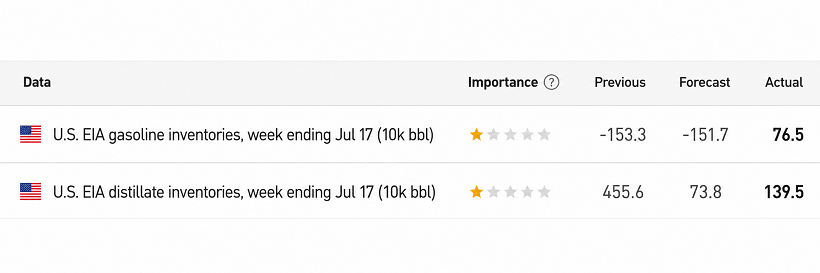
Gasoline stocks rose by 765,000 barrels and distillate inventories increased by 1.395 million barrels, both above expectations. Refinery utilization remained at 96.1%, and weekly gasoline production reached 9.7 million barrels. Wider net imports, Strategic Petroleum Reserve releases, and some pressure on demand from high prices contributed to the unexpected builds.
The increases point to a temporary mismatch between strong supply and weaker demand rather than a collapse in fuel consumption.
U.S. Crude Production Edges Lower
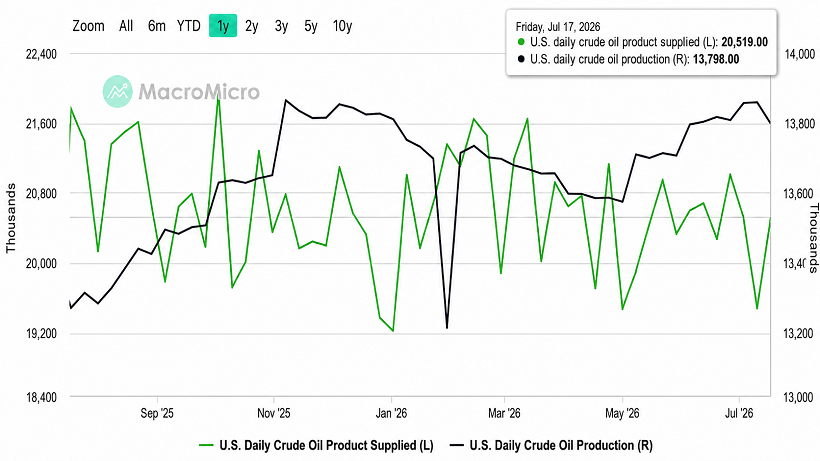
The chart shows a modest decline in U.S. crude production as the market places greater emphasis on American barrels to help offset potential supply losses from the Middle East.
Unplanned Refinery Outages Affect More Than 1 Million bpd of Capacity
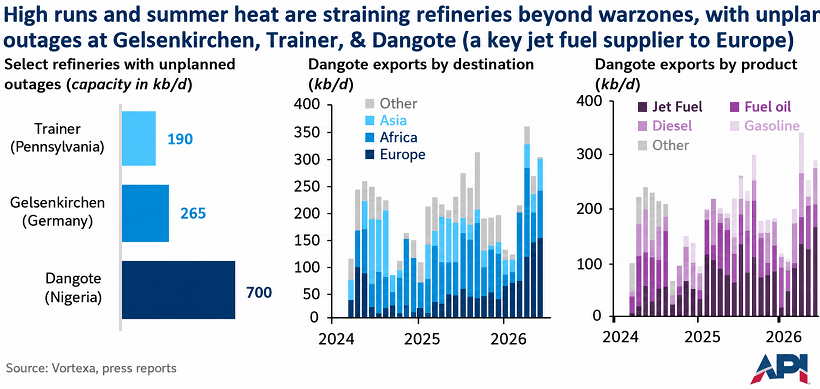
Three major refineries in the United States, Europe, and Africa have experienced unplanned shutdowns following fires, high temperatures, and operational strain. The outages affected more than 1 million barrels per day of combined processing capacity.
The disruptions indicate that tightness has spread from crude supply to refined-product markets. Even if crude flows recover, reduced refinery capacity could constrain fuel output while shipping through both the Strait of Hormuz and the Bab el-Mandeb Strait remains under pressure.
Summary
Crude prices extended their rally as the United States and Iran played down the possibility of near-term talks, attacks threatened shipping through the Strait of Hormuz and the Red Sea, and disruptions at the CPC terminal added another source of supply risk. Unexpected increases in U.S. crude and product inventories provided a limited buffer, but low OECD stocks, a 43-year low in the Strategic Petroleum Reserve, and unplanned refinery outages left the broader market vulnerable. The next scheduled catalysts are U.S. initial jobless claims at 8:30 a.m. ET and the EIA natural gas storage report at 10:30 a.m. ET, followed by further scrutiny of U.S. crude inventories, exports, and shipping conditions across the Middle East and Black Sea.
Enjoyed this article? Share it with your network!


RYOEX Official Media is an information platform created specifically for traders, offering the latest news, analysis, guides, and more. From beginners to experienced traders, we provide useful content to help you stay informed and succeed in your trading endeavors.


