


Crude Rises to Five-Week High as Hormuz and Red Sea Risks Threaten Supply Routes

 July 22, 2026


WTI and Brent gained more than 2% on Tuesday as tanker diversions in the Red Sea and a tenth consecutive night of U.S. strikes against Iran heightened concerns about disruptions along key Middle Eastern shipping routes. Expectations of a possible 10-day ceasefire capped some of the geopolitical risk premium, leaving the market focused on Wednesday’s U.S. inventory data at 10:30 a.m. ET.
Crude Oil Market Overview
Oil Prices Climb as Tankers Divert and U.S.-Iran Conflict Escalates
International crude prices rose to their highest levels in nearly five weeks on Tuesday. WTI began climbing before the U.S. session and settled 2.53% higher at $85.01 a barrel, while Brent gained 2.12% to close at $89.35 a barrel.
The rally followed reports that two tankers carrying Saudi crude to Asia reversed course in the Red Sea because of threats from Yemen’s Houthi movement and headed toward the Suez Canal. The move came as the United States carried out strikes against Iran for a tenth consecutive night, sustaining the geopolitical risk premium in both crude benchmarks.
President Donald Trump said Iran wanted to meet but that the United States was not interested. He also threatened an intense strike on Iran’s Jinshan area, which reportedly contains nuclear facilities, and said the United States would “take action” if the Houthis blocked the Red Sea. Iran’s military struck a U.S. Air Force base in Bahrain and said all U.S. and allied interests in the region would become targets if Washington attacked Iranian nuclear facilities.
Diplomatic efforts continued alongside the military escalation. Pakistan’s prime minister met Iran’s interior minister and said Pakistan would continue to act as a mediator. Iranian officials were also reported to have met mediators in Pakistan on Tuesday. Israeli media reported that Iran had proposed a 10-day ceasefire, while Trump demanded that Tehran “pay a price.” Expectations of a possible truce prompted some profit-taking after the recent rally, but ongoing strikes, attacks on vessels and risks to energy infrastructure limited the downside for crude.
Hormuz Slowdown and Red Sea Threats Raise Shipping Risks
The market is assessing simultaneous threats to shipping through the Strait of Hormuz and the Red Sea, as well as disruptions at a major export terminal on Russia’s Black Sea coast. Iran has continued attacking tankers passing through Hormuz, and another vessel carrying refined products was recently hit, bringing observed traffic through the waterway close to a temporary standstill. The British navy also reported an attack on a vessel near the strait.
Red Sea risks are rising as the Houthis threaten to block Saudi maritime transportation and urge shipowners to avoid Saudi ports. At least three tankers have reversed course in the southern Red Sea. Saudi Arabia said it would take all necessary measures under international law to protect its vessels.
Saudi Arabia has increased crude exports from Yanbu to about 4 million bpd to bypass the Strait of Hormuz, with roughly 2.5 million bpd moving south through the Bab el-Mandeb Strait. Traffic through Hormuz remains close to a standstill, with only a small and sporadic number of vessels from Gulf exporters passing through.
With the Persian Gulf’s main maritime export route largely obstructed, the market has become increasingly dependent on Saudi Arabia’s East-West pipeline and Red Sea ports. A disruption at Bab el-Mandeb would threaten Saudi crude shipments and remove one of the few alternative routes available to offset lower flows through Hormuz. Any impact on production facilities, export terminals or major shipping lanes could quickly tighten global supply while raising freight, insurance and replacement-cargo costs.
Outside the Middle East, the Caspian Pipeline Consortium terminal on Russia’s Black Sea coast has faced repeated attacks. Kazakhstan plans to suspend oil shipments to the Black Sea following an attack on a tanker. The terminal handles most of Kazakhstan’s crude exports, which at one point approached 1.8 million bpd.
Tight Product Supply Offsets Softer Demand Signals
U.S. demand indicators were comparatively weak. The U.S. Leading Economic Index fell 0.2% to 99.1 in June, missing expectations and pointing to a possible slowdown in business activity, consumption and industrial momentum. Trump’s decision to impose a 50% tariff on some Canadian goods could also increase North American trade friction and corporate costs, although the exclusion of energy products limits the direct effect on crude flows.
Tight U.S. crude and gasoline inventories continued to support the physical market. Gasoline and diesel futures traded near their highest levels since late May after refined-product prices rose throughout the previous month. The increase suggests retail fuel prices could rise further and reflects persistently low U.S. summer product inventories.
The market remains caught between selling prompted by diplomatic developments and support from conflict-related supply risks. Geopolitical tensions can sustain current price levels, but a lasting breakout would require clearer evidence of actual supply disruptions or resilient global demand.
EIA Inventories Become the Next Market Catalyst
The U.S. Energy Information Administration is scheduled to publish data on crude inventories, Cushing stocks and Strategic Petroleum Reserve inventories for the week ended July 17 at 10:30 a.m. ET on Wednesday.
The release follows an API report showing a 2.603 million-barrel increase in U.S. crude inventories, ending 13 consecutive weeks of withdrawals. The market will assess whether official figures confirm the build and what they indicate about refinery demand, inventory tightness and the effect of weaker economic momentum on transportation and manufacturing activity.
Crude Oil Outlook: Global Market Views
This section reviews the main views on crude oil from global financial institutions and market participants. Each view has been summarized and restructured by the RYOEX Research Team based on publicly available information. References to any institution or individual do not imply endorsement of RYOEX or its views.
Bank of New York Mellon | Geopolitical Tensions Sustain the Crude Risk Premium
Bank of New York Mellon said the U.S.-Iran confrontation and Houthi threats in the Red Sea continued to add a geopolitical risk premium to Brent and WTI. A disruption to shipping through the Strait of Hormuz could further tighten oil supply.
The bank noted that the conflict had escalated for a tenth day as mediators sought to restore a fragile ceasefire. U.S. Central Command said it had struck Iranian command centers, launch sites and air-defense systems, while Iran attacked U.S. military facilities in Kuwait and Jordan. The British navy also reported an attack on a vessel near Hormuz.
According to the bank, the standoff had pushed Brent to $88.45 a barrel and lifted U.S. gasoline prices above $4 a gallon. Higher crude prices signaled not only risk aversion but also a potential inflation shock, helping explain why U.S. Treasuries had not behaved like a conventional safe-haven asset.
Market Analysis | Threats to Major Shipping Routes Lift the Supply Premium
The market is assessing shipping risks across the Strait of Hormuz, the Red Sea and the Caspian Pipeline Consortium terminal on Russia’s Black Sea coast. TP ICAP energy specialist Scott Shelton said Brent could exceed $100 a barrel if tensions persisted for several weeks.
The analysis said the possibility of a 10-day U.S.-Iran ceasefire had removed part of the geopolitical premium and encouraged profit-taking. However, military strikes, attacks on tankers and threats to energy infrastructure continued to support prices. If a ceasefire is not reached, Hormuz remains obstructed and Red Sea risks intensify, the probability of a sharp rebound in oil prices would increase substantially.
Product markets are also tight. Gasoline and diesel futures have risen close to their highest levels since late May, while low U.S. summer inventories indicate limited buffers. In the near term, crude is expected to remain highly sensitive to inventory changes, refinery demand and any spread of economic weakness to transportation and manufacturing.
Goldman Sachs | Dual Shipping Threats Skew Near-Term Brent Risks to the Upside
Goldman Sachs said Persian Gulf shipping flows had fallen to less than 45% of prewar levels, pushing the Brent forward curve above its baseline forecasts of $80 for the fourth quarter of 2026 and $75 for 2027. The bank said near-term price risks were significantly tilted to the upside.
Higher pipeline flows to Yanbu have partly mitigated the threat of simultaneous disruptions to the Hormuz and Red Sea routes. Even so, damage to infrastructure from conflicts in the Middle East and between Russia and Ukraine could constrain medium- and long-term production capacity. Goldman said Brent could exceed $120 a barrel in the fourth quarter of 2026 if the Gulf bottleneck persisted through the year, although this is not its baseline scenario. The bank still expects Brent to average about $80 a barrel in the fourth quarter but noted that the Houthi threat has materially increased upside risk.
Goldman also said China’s highly price-elastic demand was helping limit the risk of an uncontrolled price surge. China’s seaborne crude imports fell sharply year over year in June because of lower refinery runs and a shift in inventory strategy from stockbuilding to destocking. With inventories of about 2 billion barrels and the ability to substitute coal-fired power, Chinese buying does not need to rebound immediately at elevated prices, making China a key stabilizing force in the crude market.
Against the risk of further geopolitical escalation, Goldman recommended taking long positions in European diesel calendar spreads from December 2026 through March 2027. The bank said refining balances were already tighter than crude balances, while Ukrainian drone attacks had kept Russian refineries offline and sharply reduced diesel exports. It also viewed diesel demand as less price-elastic than gasoline demand and noted that the fourth-quarter peak season would coincide with limited scope for additional capacity. Compared with U.S. diesel, European diesel was seen as less exposed to potential downside from U.S. policy and better supported by higher natural gas costs.
Key Crude Oil Market Charts
This section highlights charts that help explain recent moves in the crude oil market, with a focus on changes in supply and demand conditions and market sentiment. The charts and data are based on third-party information and do not represent RYOEX's views or indicate future price movements. Given the risk of sudden market swings, appropriate risk management remains essential.
Bab el-Mandeb Carries Nearly 7 Million Barrels per Day of Crude
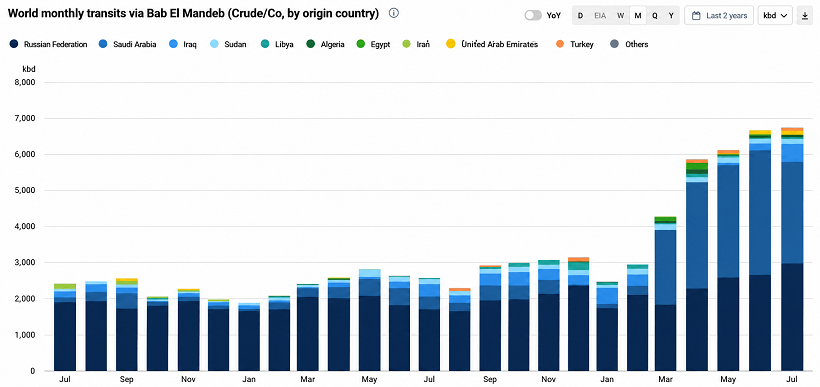
The Bab el-Mandeb Strait currently carries nearly 7 million bpd of crude. Before the Houthis began their Red Sea campaign in 2023, about 9.3 million bpd passed through the strait. Average flows fell to 4.2 million bpd after the attacks before recovering to 7.4 million bpd in June 2026.
The route is again under threat following the near-cessation of traffic through the Strait of Hormuz. A complete closure of Bab el-Mandeb would obstruct both major chokepoints and prevent Saudi Arabia from exporting through the Red Sea. Saudi Arabia’s East-West pipeline has peak capacity of 7 million bpd and terminates at Yanbu.
Saudi West Coast Crude Loadings Fall Amid Houthi Blockade Threat
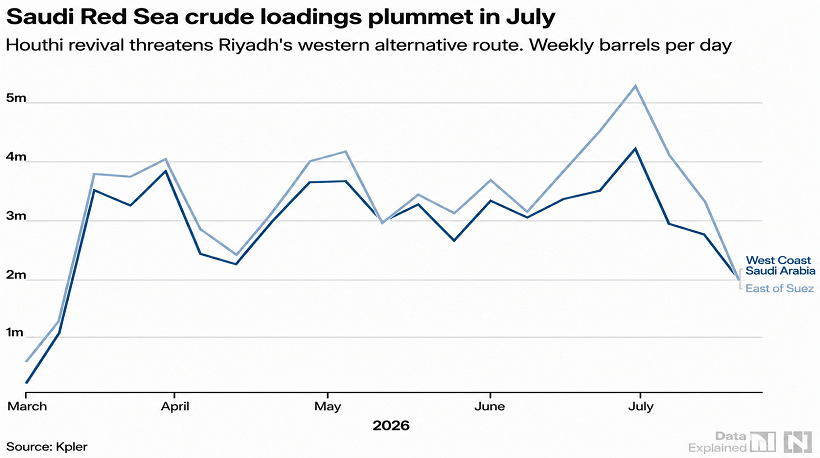
Kpler data show that Houthi activity has begun to affect traffic through Bab el-Mandeb. Crude loadings at Saudi Arabia’s Yanbu port reached a record average of 5.9 million bpd during the week of July 17 but averaged 5.5 million bpd over the seven days ended July 20. The Houthis formally announced a maritime blockade of Saudi Arabia on July 20, and two tankers carrying Saudi crude reversed course in the Red Sea.
Bloomberg analysis indicated that if crude prices rise 4% for every 1% reduction in supply, oil could return above $100 a barrel. Rerouting vessels around the Cape of Good Hope would add seven to 14 days to voyages and substantially increase transportation costs.
API Crude Inventories Rise After 13 Consecutive Weekly Draws
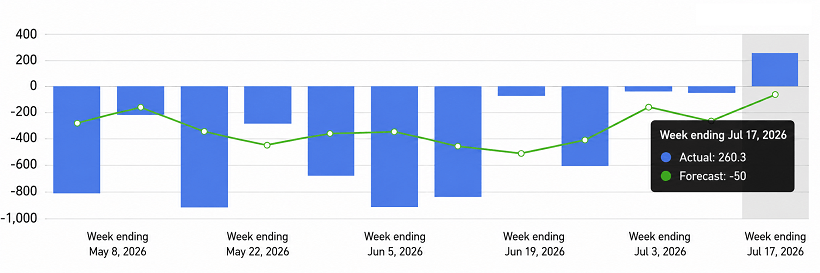
U.S. API crude inventories increased by 2.603 million barrels in the week ended July 17, ending a run of 13 consecutive weekly declines. The source analysis cited several possible reasons, including continued releases from the Strategic Petroleum Reserve and an influx of lower-priced SPR crude that may have obscured the underlying pace of commercial inventory draws.
A single weekly build does not establish a reversal in the inventory trend. The source analysis said that if geopolitical tensions do not ease fundamentally, reduced supply after SPR releases end, thin inventory buffers and a geopolitical risk premium could continue to support oil prices over the medium term.
Distillate and Gasoline Inventories Continue to Diverge
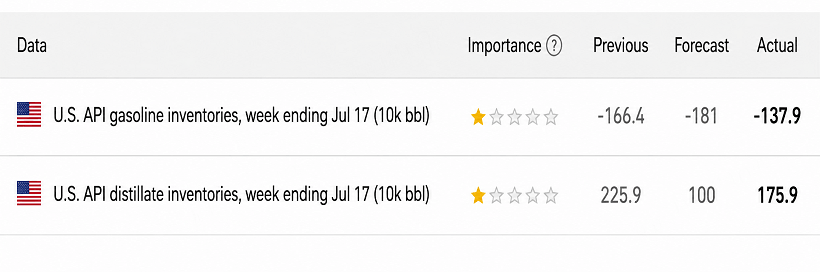
API data showed a 1.759 million-barrel increase in distillate inventories. Gasoline inventories continued to decline, but the draw was smaller than market expectations and the previous reading, suggesting that elevated oil prices had begun to restrain end-user demand.
The divergence between distillate and gasoline inventories adds to uncertainty about the strength of U.S. fuel consumption. Official EIA figures will provide the next indication of whether the API inventory build reflects a broader shift or a temporary slowdown in an otherwise tight market.
Summary
Crude prices reached nearly five-week highs as U.S.-Iran hostilities, tanker attacks and threats to Red Sea shipping raised the possibility of simultaneous disruptions at the Strait of Hormuz and Bab el-Mandeb. Diplomatic efforts and expectations of a possible 10-day ceasefire have capped part of the geopolitical premium, while weak U.S. economic indicators and softer fuel-demand signals provide additional counterweights. The market’s next focus is Wednesday’s EIA report at 10:30 a.m. ET, particularly whether official data confirm the API crude build and what inventories, refinery demand and strategic reserve flows indicate about an already fragile supply balance.
Enjoyed this article? Share it with your network!


RYOEX Official Media is an information platform created specifically for traders, offering the latest news, analysis, guides, and more. From beginners to experienced traders, we provide useful content to help you stay informed and succeed in your trading endeavors.


