


Oil Prices Rise as Shipping Risks Expose a Historically Thin Supply Buffer

 July 21, 2026


WTI and Brent crude settled higher Monday after a volatile session as traders weighed the prospect of renewed U.S.-Iran negotiations against new threats to shipping around the Arabian Peninsula. The market remains caught between possible diplomatic progress and an increasingly fragile physical market, with U.S. employment data, the WTI contract rollover, and API inventory figures providing the next scheduled catalysts.
Crude Oil Market Overview
Crude Settles Higher as Diplomacy and Escalation Pull Prices in Opposite Directions
International crude prices gained nearly 1% during Monday’s session. WTI opened higher but then retreated steadily, briefly approaching the psychologically important $80-a-barrel level before recovering some of its losses. It settled up 0.7% at $82.91 a barrel. Brent rose 0.86% to close at $87.50 a barrel. Both benchmarks recently reached their highest levels in more than a month.
Reports that mediators had proposed a 10-day U.S.-Iran ceasefire initially sent prices sharply lower. Iran’s Foreign Ministry confirmed that it had received a proposal from mediators and said negotiations with the United States might be possible based on Iran’s national interests. U.S. media also reported that President Donald Trump remained focused on making Iran pay for recent events even as talks between the two countries continued.
The prospect of diplomacy limited panic buying. Profit-taking also weighed on the market after a buildup in long positions and short covering had lifted prices substantially the previous week. Oil had also risen by about 3% on Sunday. Traders have increasingly waited for evidence of actual supply disruptions rather than chasing prices solely on threats.
Military and Maritime Risks Keep the Market Well Supported
The downside remained limited as military and shipping risks intensified. The United States carried out strikes for a ninth consecutive night against Iranian capabilities used to target shipping in the Strait of Hormuz and continued moving military aircraft into the Middle East. Iran withdrew from an earlier ceasefire agreement and attacked targets in Jordan, Kuwait, and Bahrain, while the Islamic Revolutionary Guard Corps continued to threaten shipping routes.
Trump’s warning of further retaliation had a stronger market impact than the latest confirmed U.S. strikes. After two U.S. soldiers were killed in an attack in Jordan, Trump said Iran would pay several times over for every American death and that he had issued instructions to the military. Oil prices recovered by nearly $2 over about two hours following the statement. By contrast, the subsequent U.S. announcement of a tenth night of strikes produced only a limited response, suggesting that the market was more sensitive to escalation risks that had not yet materialized than to military action already reflected in prices.
Shipping concerns widened after Yemen’s Houthi movement announced a maritime ban against Saudi Arabia and threatened to close the Bab el-Mandeb Strait. Saudi Arabia said it was taking necessary military action to ensure safe navigation through the strait. The route handles about 12% of global trade, and a prolonged disruption could increase risks to energy shipments through the Red Sea and beyond.
The Caspian Pipeline Consortium said oil loadings had been suspended again after briefly resuming following another attack on a tanker on July 20. By contrast, Yemen resumed oil exports. Average U.S. gasoline prices also rose above $4 a gallon for the first time in a month.
Thin Inventories Magnify the Impact of New Supply Threats
Physical supply conditions remain fragile. Persian Gulf exports have stayed below prewar levels, and Iranian activity continues to affect tanker passage through the Strait of Hormuz. Confirmed oil flows through the strait fell from 12.5 million barrels per day a week earlier to 5.1 million bpd, including about 1.7 million bpd of Iranian exports, according to JPMorgan.
U.S. crude inventories offer limited protection against another disruption. The Strategic Petroleum Reserve contains about 319.5 million barrels, close to its lowest level since 1983. Including strategic stocks, U.S. crude supply coverage has fallen to about 45 days, compared with a long-term historical average of 65 days, marking the lowest level in 45 years.
Global crude in transit has reached roughly 1.3 billion barrels, but much of that volume is effectively inaccessible while the Strait of Hormuz remains restricted. About 150 million barrels of floating storage is stranded within the Persian Gulf. If normal shipping resumes, the concentrated release of that supply could put significant downward pressure on prices. If restrictions persist and crude already in transit or floating storage is depleted, the market could face a more severe physical shortage.
OPEC+ has only about 2.5 million bpd of nominal spare capacity, a historically low level. Even if idle Middle Eastern production is brought online, those barrels would still struggle to bypass restricted shipping routes. Russia’s 213-vessel shadow fleet, including 98 vessels added in 2025-2026, can deliver some alternative supplies to Asia but cannot offset a Middle Eastern shortfall measured in tens of millions of barrels.
U.S. Data and Inventories Are the Next Scheduled Catalysts
The United States is scheduled to release the weekly ADP employment change for the week ended July 4 at 8:15 a.m. ET. The WTI futures contract rollover is scheduled for 2:30 p.m. ET, followed by API crude inventory data for the week ended July 17 at 4:30 p.m. ET.
From a technical perspective, $83 is the first near-term resistance level. A break above it would shift attention to $84 and $85. Initial support is around $82, while the psychological $80 level remains a key support threshold.
Crude Oil Outlook: Global Market Views
This section reviews the main views on crude oil from global financial institutions and market participants. Each view has been summarized and restructured by the RYOEX Research Team based on publicly available information. References to any institution or individual do not imply endorsement of RYOEX or its views.
Joshua Gibson | Markets Price New Supply Threats Faster Than Peace Prospects
Analyst Joshua Gibson said the United States had struck Iranian military capabilities used against shipping in the Strait of Hormuz for nine consecutive nights, while the Islamic Revolutionary Guard Corps continued to threaten the route. At the same time, Washington kept the door open to diplomacy and shelved an earlier proposal for a 20% Strait of Hormuz transit fee.
Those developments, combined with profit-taking after Sunday’s roughly 3% gain, pushed oil below $80 before prices rebounded quickly. Gibson said the recovery showed that the market was reluctant to continue selling at those levels.
He identified Trump’s retaliation warning as the development that reversed the move. Oil recovered nearly $2 in about two hours after Trump said Iran would pay several times over for each American death and that he had issued instructions to the military. The limited reaction to the subsequent announcement of a tenth night of U.S. strikes suggested that traders were more focused on escalation threats that had not yet materialized than on military operations already priced into the market.
Gibson attributed this asymmetric response to fragile physical supply. Persian Gulf exports remain below prewar levels, Hormuz tanker traffic continues to be affected by Iran, and the U.S. Strategic Petroleum Reserve stands at about 319.5 million barrels. With little inventory protection, the market is gradually pricing in the prospect of peace but rapidly adding a premium when new supply threats emerge.
Zaye Capital Markets | Prolonged Disruption Could Push Brent Beyond $90
Naeem Aslam, chief investment officer at Zaye Capital Markets, noted that Brent had approached $90 a barrel and WTI had climbed above $84. He said renewed escalation between the United States and Iran had intensified concerns about crude shipments through the Strait of Hormuz, which handles about one-fifth of global oil trade.
Lower vessel traffic, higher tanker insurance costs, and possible delays to crude and refined-product exports have led the market to price in a larger geopolitical risk premium. Aslam said the expansion of U.S. military strikes had raised concerns that the conflict could last longer and extend beyond its original objectives.
If production facilities, export terminals, or critical shipping routes are affected, a global supply shortfall could emerge before other producers have time to increase output. Prices could retreat if military tensions ease, shipping returns to normal, or disruptions prove temporary. If attacks continue or Hormuz traffic becomes more restricted, however, Brent could remain above $90 and face a greater risk of advancing toward $100.
Saxo Bank | Escalation and Partial Hormuz Suspension Lift Brent
Saxo Bank said the U.S.-Iran conflict escalated further over the weekend, while Iran suspended passage through the Strait of Hormuz for some vessels. Those developments supported gains in Brent crude.
JPMorgan | A Negotiated Outcome Remains More Likely Than a Prolonged Blockade
JPMorgan said the recovery in Strait of Hormuz vessel traffic had come to an abrupt halt. Confirmed oil flows fell to 5.1 million bpd from 12.5 million bpd a week earlier, with Iranian exports accounting for about 1.7 million bpd.
The bank described the situation around Hormuz as a cycle of negotiation, breakdown, escalation, and renewed negotiation. Despite another intensification of the military conflict, JPMorgan said both sides were more likely to be applying pressure to advance negotiations than seeking a prolonged confrontation.
A new ceasefire agreement therefore remains possible. A long-term mutual blockade is a tail risk rather than JPMorgan’s base-case scenario.
Rebecca Babin | Ceasefire Prospects Curb Panic Buying, but Shipping Threats Limit the Downside
Rebecca Babin, senior energy trader at CIBC Private Wealth, said the market continued to view diplomatic channels as partially open. The possibility of a ceasefire therefore limited panic buying.
Traders have also become accustomed to forceful rhetoric that is later softened, making them more inclined to wait for actual supply disruptions rather than buy solely on threats. A buildup in long positions and short covering had already lifted prices substantially during the previous week, prompting some investors to take profits and reducing their willingness to chase further gains.
Babin said downside potential was also constrained by the ninth consecutive night of U.S. strikes, additional U.S. military aircraft deployments, Iran’s withdrawal from the earlier ceasefire, and Iranian attacks on targets in Jordan, Kuwait, and Bahrain. The Houthi maritime blockade against Saudi Arabia and threat to close Bab el-Mandeb added another layer of risk to Red Sea shipping and global energy flows.
SEB | Political Constraints Raise the Risk of a Prolonged Conflict
SEB said the U.S.-Iran conflict had entered a new phase after nine consecutive days of military strikes. The earlier memorandum of understanding had a weak foundation and contained little that could support lasting peace beyond a reconstruction fund, a temporary easing of restrictions on Iranian oil exports, and the release of some frozen assets. Differences over the interpretation of its terms quickly returned both sides to conflict.
Iran viewed continued Israeli strikes against Hezbollah in Lebanon and efforts to move commercial ships through the southern Strait of Hormuz without Iranian coordination as violations of the agreement. The United States argued that Iran had never genuinely ensured safe passage through Hormuz and launched new airstrikes after Iranian attacks on vessels using an alternative route.
SEB said the military and energy fundamentals had changed little from the previous phase. Airstrikes alone were unlikely to deliver a decisive U.S. strategic outcome, while Washington faced ammunition constraints and domestic political pressure. Iran retained the ability to attack U.S. bases in the region and was seeking to force renewed negotiations by controlling Hormuz, raising oil prices, and accelerating inventory withdrawals.
Iran is also under substantial pressure. The war has severely damaged its economy, and some forecasts indicate that gross domestic product could fall 10% this year as currency depreciation and poverty worsen. Iran’s leadership may nevertheless fear an unfavorable peace more than an unfavorable war. It could reject any agreement that fails to protect the government’s survival, the allocation of interests, and its political future, increasing the risk of a prolonged conflict.
Under the more optimistic scenario, current U.S. action represents a final attempt to avoid strategic failure. Rising military, fiscal, and domestic political costs could ultimately lead both sides to accept a reopening of Hormuz that preserves some Iranian influence. Under the more pessimistic scenario, political constraints could prevent a sustainable agreement. The collapse of the memorandum of understanding has increased the risks of miscalculation, misunderstanding, and further escalation, potentially leaving Hormuz unstable or closed for an extended period and causing persistent damage to Middle Eastern economies and global energy markets.
Key Crude Oil Market Charts
This section highlights charts that help explain recent moves in the crude oil market, with a focus on changes in supply and demand conditions and market sentiment. The charts and data are based on third-party information and do not represent RYOEX's views or indicate future price movements. Given the risk of sudden market swings, appropriate risk management remains essential.
Strait of Hormuz Oil Flows Fall by More Than 10 Million Barrels per Day
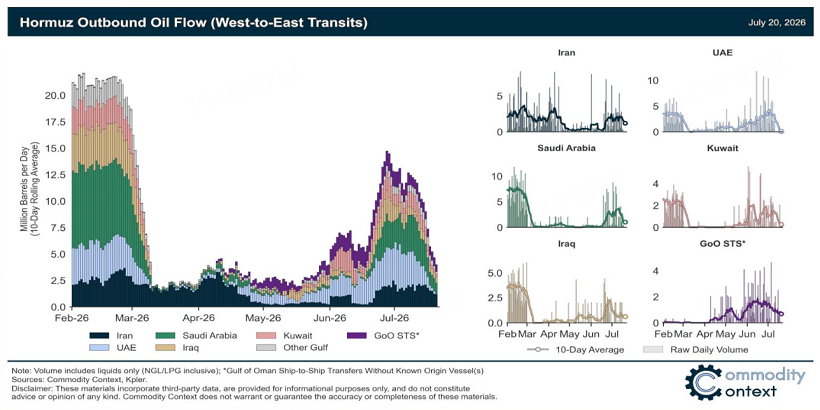
Oil flows through the Strait of Hormuz have fallen by more than 10 million bpd. Following the breakdown of the U.S.-Iran memorandum of understanding, data through July 20 showed that only one oil or gas carrier had passed through the strait, leaving effective Persian Gulf crude-export throughput close to zero.
U.S. Crude Supply Coverage Falls Far Below Its Historical Average
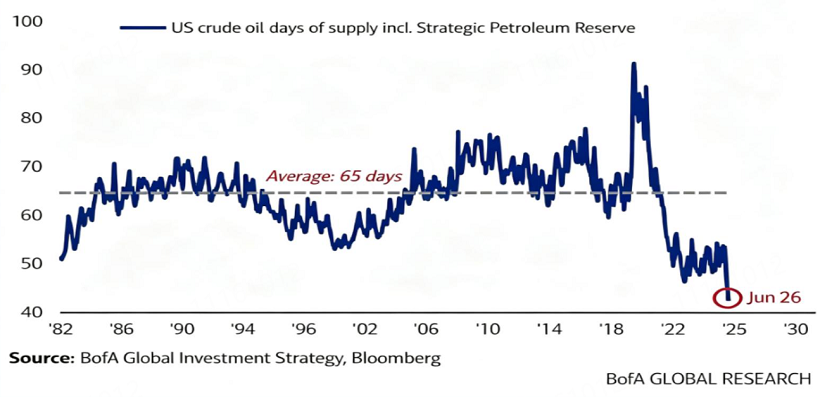
Including the Strategic Petroleum Reserve, U.S. crude inventories provide about 45 days of supply. That is well below the long-term historical average of 65 days and represents the lowest level in 45 years, leaving the market with very limited protection against additional supply disruptions.
Crude in Transit Reaches 1.29 Billion Barrels
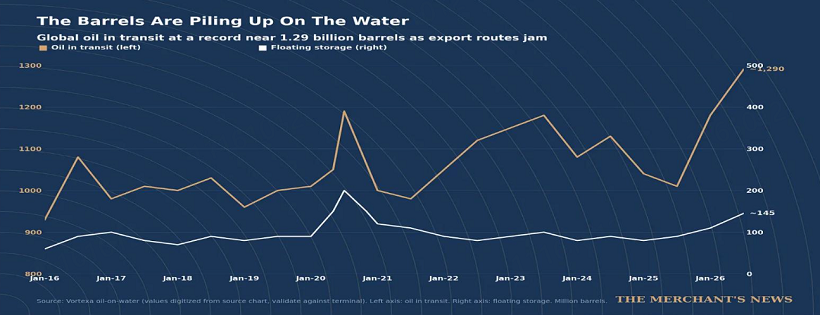
Global crude in transit has reached about 1.29 billion barrels, a record high. Much of that volume is effectively stranded and cannot reach end markets while Hormuz remains restricted. Around 150 million barrels of floating storage is held within the Persian Gulf and could put substantial downward pressure on oil prices if normal passage resumes.
Russia Becomes the Leading Flag State for Shadow Tankers
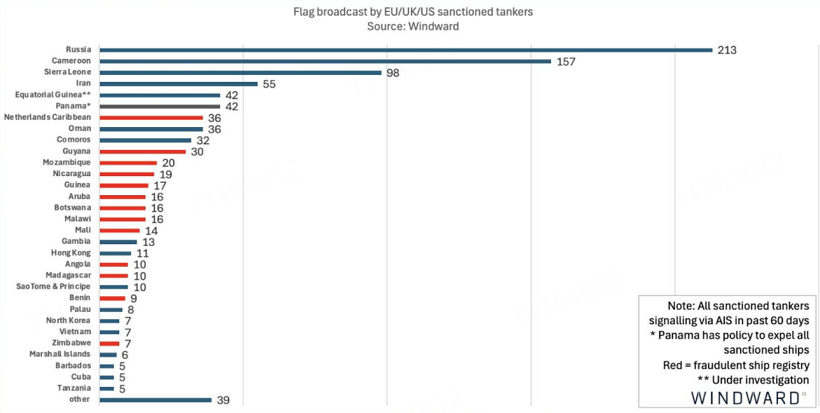
Russia’s shadow fleet totals 213 vessels, including 98 added in 2025-2026. The fleet can deliver some alternative crude supplies to Asia, but it cannot offset a Middle Eastern shortfall measured in tens of millions of barrels.
Summary
Crude prices ended Monday higher as the prospect of renewed U.S.-Iran negotiations limited panic buying, while military escalation and threats to the Strait of Hormuz and Bab el-Mandeb kept supply risks elevated. The market’s effective buffer is exceptionally thin: U.S. inventory coverage is at a 45-year low, OPEC+ nominal spare capacity is about 2.5 million bpd, and much of the record volume of crude in transit remains inaccessible. A reopening of Hormuz could release roughly 150 million barrels of floating storage and trigger a sharp correction, while a prolonged closure would increase the risk of severe physical shortages. The next scheduled catalysts are U.S. ADP employment data at 8:15 a.m. ET, the WTI contract rollover at 2:30 p.m. ET, and API crude inventory figures at 4:30 p.m. ET.
Enjoyed this article? Share it with your network!


RYOEX Official Media is an information platform created specifically for traders, offering the latest news, analysis, guides, and more. From beginners to experienced traders, we provide useful content to help you stay informed and succeed in your trading endeavors.


