


【2026 Latest】FX Arbitrage Guide: Beginner-Friendly Strategies to Start Safely and Maximize Profits

 2026-04-03
"I don’t want to suffer big losses in FX that feels like gambling anymore." "I want to grow my funds steadily as a side income, but I’m worried about the risks." "Is FX arbitrage really safe? I want to fully understand the methods and potential pitfalls before getting started."
If these thoughts brought you here, this guide is for you.
-
FX Arbitrage Basics: How it works, with key pros and cons
-
4-Step Setup: From broker selection to precise order execution
-
Risk Control: Hidden costs, negative spreads, and how to avoid losses
-
Fit Check: Is FX arbitrage right for your trading style?
This is a complete FX arbitrage guide designed for cautious traders who want to avoid losses and fully understand every step before starting. Take your time, follow along carefully, and move forward with confidence.

【Illustrated】How FX Arbitrage Works

What Is FX Arbitrage?
“FX arbitrage” is a trading strategy that aims to generate steady profits by leveraging price differences or swap rate differentials between two brokers or currency pairs, while minimizing exposure to major market fluctuations. Unlike traditional FX trading, where you predict whether the market will go up or down and take a single position, arbitrage involves holding positions in both directions simultaneously. This makes it easier to limit potential losses regardless of market movement. However, it is important to note that arbitrage is not completely risk-free. You may incur spreads and fees from multiple brokers, face swap reversals (negative carry), or experience breakdowns in correlation between currency pairs that previously moved together.

While FX arbitrage allows you to trade without predicting market direction and helps limit downside risk, always remember that it is not a zero-risk strategy.
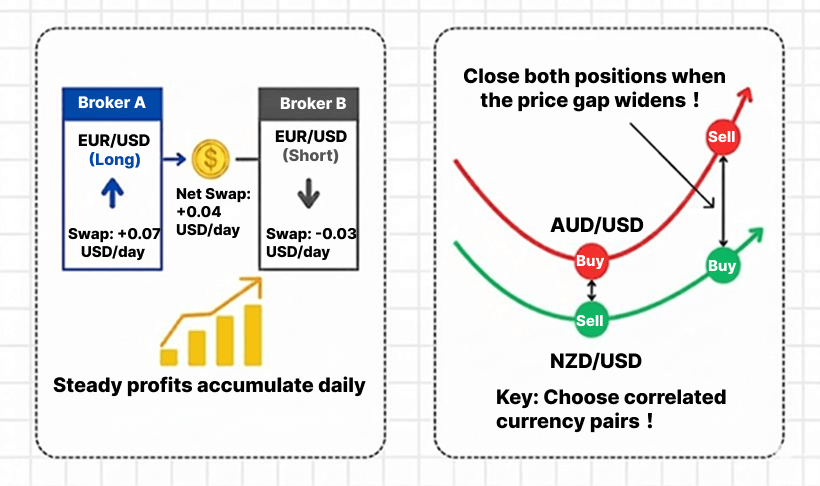
How FX Arbitrage Works
-
1.
Open simultaneous buy and sell positions on the same currency pair (e.g., EUR/USD) across two different brokers, and earn profits by accumulating the daily swap rate differences
-
2.
Trade two highly correlated currency pairs (e.g., AUD/USD and NZD/USD), capturing profit opportunities when the price gap widens or narrows through hedged entry and exit
Pros and Cons of FX Arbitrage
| Advantages | Disadvantages |
|---|---|
| No need to worry about major market fluctuations | Higher trading costs (spreads and commissions) |
| Lower risk of large losses | Losses may occur due to correlation breakdown or negative carry |
| Reduced psychological stress | Profit potential is often limited |
4-Step Beginner Guide to FX Arbitrage: How to Start Safely

FX arbitrage can be a steady and disciplined strategy—even for beginners—if you follow the right preparation and sequence. Below are four practical steps to help you get started without costly mistakes.
STEP 1: Choose Your Strategy and Currency Pair
The most important decision when starting FX arbitrage is selecting the right strategy—specifically, which currency pairs to trade and what level of risk you are willing to take. In FX arbitrage, the following high-yield currencies are commonly used:
| Currency Pair | Key Features & Advantages | Risks & Considerations | Recommended Level | Strategy Approach |
|---|---|---|---|---|
| MXN/USD (Mexican Peso) | High swap & stability Low unit price, suitable for small capital starting from a few thousand yen equivalent. | Relatively balanced with no major drawbacks. | Beginner | Low-risk, steady accumulation of swap differentials over time. |
| ZAR/USD (South African Rand) | Popular high-yield currency Widely offered by brokers, making swap comparisons easier. | Higher volatility compared to MXN. | Intermediate | Capture swap inefficiencies across brokers for mid- to long-term gains. |
| TRY/USD (Turkish Lira) | Extremely high returns Largest swap differentials, offering strong profit potential. | High volatility & downside risk Significant risk of sharp declines and forced liquidation. | Advanced | Strict risk management with short- to mid-term arbitrage opportunities. |
STEP 2: Combine Two Complementary Trading Accounts
FX swap arbitrage requires using two separate brokers. The goal is to positive swap on one account while minimizing or eliminating swap costs on the other.
In global markets, traders typically combine:
-
A carry-focused broker (for long positions with positive swap)
-
A swap-free or low-cost broker (for short positions)
For example, you may hold a long position with a broker offering high swap rates, while hedging the same position with a swap-free broker such as XMTrading, Exness, or RYOEX.
This structure allows you to capture the swap difference while keeping market exposure neutral.
Note: ensure both positions use the same lot size and contract specifications to avoid unintended risk.
 Open an Account with RYOEX (Free)
Visit the Official RYOEX Website
Open an Account with RYOEX (Free)
Visit the Official RYOEX Website
STEP 3: Start Small to Understand the Trading Flow
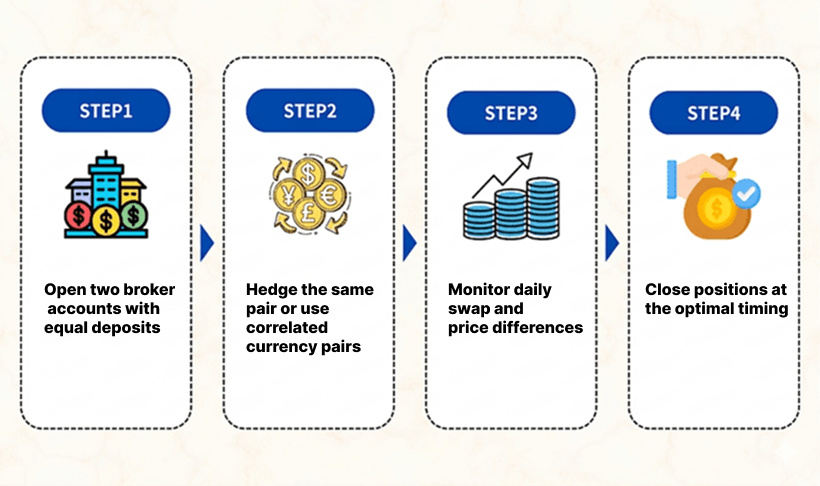
▼ FX Arbitrage Execution Process
-
1.
Fund Both Accounts and Set Up Your Environment
Deposit equal amounts into both selected accounts (e.g., a domestic broker for long positions and RYOEX for short positions). Keeping capital balanced across accounts helps reduce the risk of forced liquidation during sudden market movements. -
2.
Open Simultaneous Positions on the Same Pair (Hedging)
To neutralize exchange rate risk, place a buy order on one broker and a sell order on another using the same currency pair. If using correlated pairs (e.g., USD/HUF and USD/ZAR), open both positions simultaneously to offset price fluctuations. -
3.
Monitor Swap Differentials and Price Gaps Daily
After opening positions, check daily whether swap earnings are accumulating as expected and ensure there is no reversal in swap differentials. If you entered based on a price gap, track how that spread evolves over time. -
4.
Close Positions Simultaneously at the Optimal Timing
When your target swap income is reached or the price gap narrows as expected, close both positions at the same time. Executing simultaneous exits ensures that exchange rate risk remains minimized until profit is secured.
To minimize losses caused by price fluctuations, it is essential to execute orders simultaneously. Use split-screen functionality or multiple devices to ensure there is no delay—even by a fraction of a second.
STEP 4: Scale Up to Full Trading Operations
Once you understand the full process through small-scale trading, you can increase your capital to maximize returns. As your position size grows, decisions should be driven by data and risk metrics—not intuition.
Before committing larger capital, make sure the following three criteria are fully met:
-
Return Validation: Does the swap differential sufficiently exceed the initial trading costs (spreads)?
-
Risk Safety Margin: Are the margin levels (maintenance margin ratio) in both accounts kept within a safe range (e.g., above 300%) to withstand market shocks?
-
Exit Strategy: Have you clearly defined your exit rules—such as target profit levels and conditions for closing positions if the swap differential narrows?
FX arbitrage follows a disciplined process: strategy selection → account setup → small-scale execution → full-scale deployment. Even if it feels time-consuming, comparing two accounts and starting with small capital is the key to minimizing risk and avoiding losses.
3 Common FX Arbitrage Pitfalls and How to Avoid Them

FX arbitrage is often considered a low-risk strategy, but there are hidden pitfalls that can lead to losses—especially for those who underestimate the risks. Below are three common mistakes beginners make and how to avoid them.
The Hidden Trap of Spreads, Fees, and Costs
Since FX arbitrage involves using two brokers or currency pairs, trading costs can effectively double. Spreads (the difference between bid and ask prices), commissions, and deposit/withdrawal fees can accumulate—sometimes eroding most or even all of your profits.
| Cost Type | Common Pitfall | How to Manage |
|---|---|---|
| Spread | Applied on both brokers | Compare spreads across brokers before trading |
| Commission | May vary by broker | Check official fee structures in advance |
| Deposit/Withdrawal Fees | Frequent fund transfers increase costs | Avoid excessive transfers; plan efficiently |
Key Point: Even if trades appear profitable, total costs can result in a net loss. Always calculate and compare all costs in advance.
Swap Rate Risk and Negative Carry
The main appeal of FX arbitrage is earning swap differentials, but negative carry and sudden swap changes are critical risks to watch closely.
| Risk | Common Scenario | How to Mitigate |
|---|---|---|
| Negative Carry | Positive swap suddenly reverses | Monitor swap trends at least weekly |
| Sudden Changes | Economic events or policy shifts alter conditions | Reduce positions before major announcements |
| Policy Changes | Brokers adjust swap rules without notice | Check broker updates and support regularly |
Key Point: A position that was profitable yesterday can turn into a loss due to negative carry today. This risk is especially high with high-yield and emerging market currencies.
Correlation Breakdown and Execution Errors
Even highly correlated pairs are not guaranteed to move together. Sudden divergence or order slippage (execution errors) can quickly lead to amplified losses.
| Risk | Example / Failure Case | Mitigation |
|---|---|---|
| Correlation Breakdown | AUD/USD and NZD/USD move in opposite directions | Set stop-loss rules in advance |
| Execution Errors | Order slippage prevents proper execution | Choose brokers with strong execution quality |
| Server Downtime | Unable to trade during critical moments | Diversify across multiple brokers or backup accounts |
While FX arbitrage is generally considered safer than standard FX trading, lack of preparation or understanding can still lead to losses. Understanding worst-case scenarios is essential for consistent and disciplined trading.
【Self-Assessment】Is FX Arbitrage Right for You?
So far, we’ve covered how FX arbitrage works and the steps to implement it effectively. However, understanding the strategy is one thing—whether it fits your lifestyle and personality is another. While FX arbitrage is considered low-risk, it lacks the excitement of traditional trading and requires consistent, detail-oriented management.
To avoid starting with the wrong expectations, use the checklist below to assess whether this strategy suits you.
| Checklist | YES | NO |
|---|---|---|
| 1. I prioritize capital preservation over chasing high returns | ||
| 2. I am comfortable with detailed tracking and comparisons | ||
| 3. I verify strategies and conditions myself, even if they seem safe | ||
| 4. I am willing to open and manage accounts across multiple brokers | ||
| 5. I can stay patient and consistent despite slow returns |
→ If you answered YES to 3 or more, FX arbitrage is likely a good fit for you.
Frequently Asked Questions About FX Arbitrage

Summary: FX Arbitrage as a Practical Side Income Strategy

FX arbitrage is an ideal strategy for those who want to grow their capital steadily while minimizing downside risk. In this guide, we covered everything from the core mechanics to step-by-step execution and a self-assessment to help you get started with confidence.
-
Risk Management: Match lot sizes across brokers and ensure precise simultaneous execution
-
Ongoing Monitoring: Review swap conditions regularly (at least once a week)
-
Discipline: Stick to your predefined rules without emotional decision-making
FX arbitrage may not be flashy, but it is a highly effective strategy for building a structured and consistent side income. Start with a demo or small capital, gain confidence, and take the next step in your trading journey.
Open an Account with RYOEX (Free)
Visit the Official RYOEX Website
Enjoyed this article? Share it with your network!


RYOEX Official Media is an information platform created specifically for traders, offering the latest news, analysis, guides, and more. From beginners to experienced traders, we provide useful content to help you stay informed and succeed in your trading endeavors.


