





Battery storage investment heats up as pre-completion trades spread
 2026-08-16
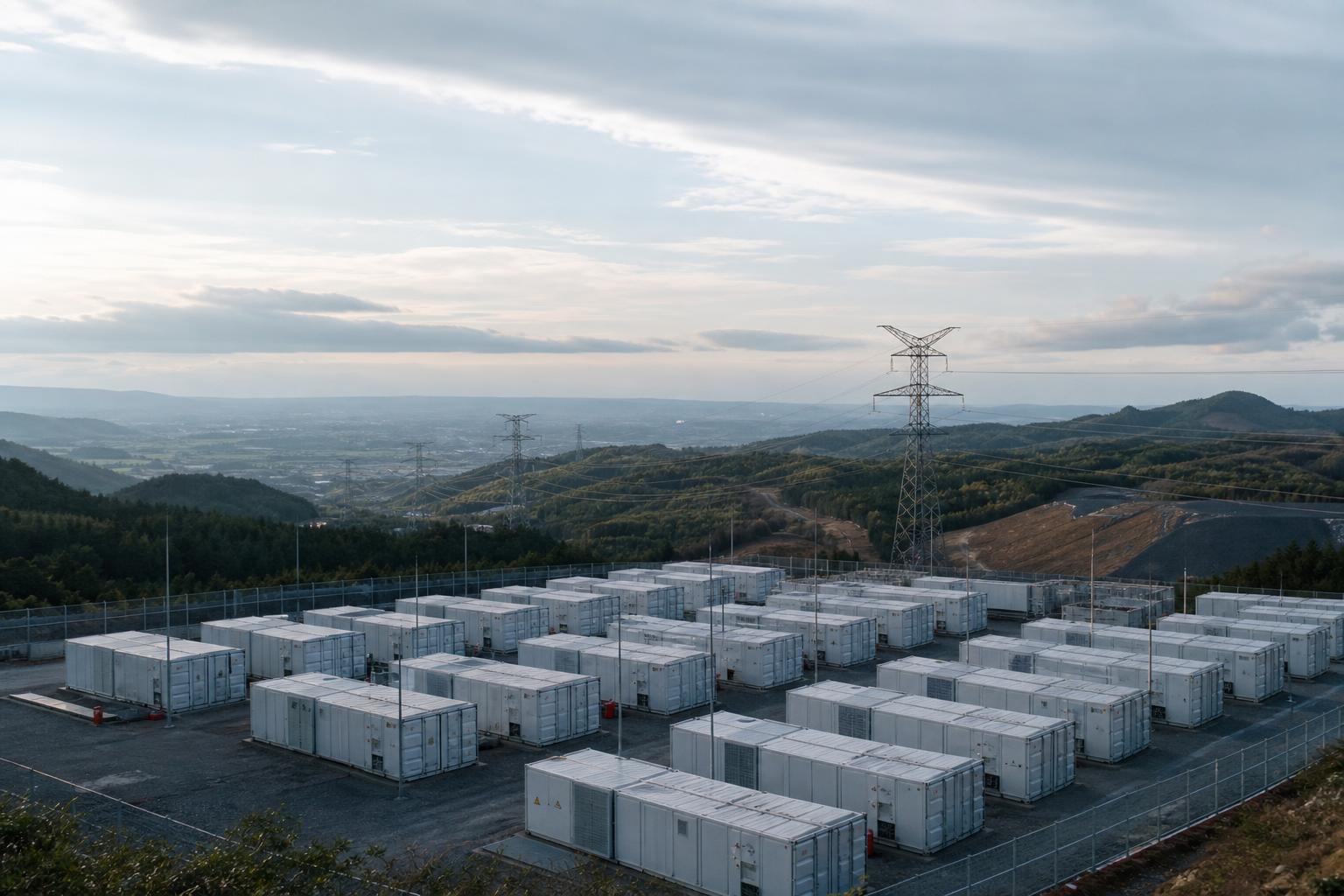
Trading in pre-completion facilities also grows
Investment aimed at asset management is spreading around battery storage plants, which are indispensable for the wider adoption of renewable energy. Even trading in facilities before completion has emerged. Concerns about disorderly development are also intensifying, as it recalls the boom in solar power development.
On RE100 Denryoku's 'Grid Battery Channel' sales site for battery storage plants in Tokyo's Chuo ward, information is listed on about 30 battery storage plants scheduled for completion. Executive officer Yusuke Hogaki said there is at least one inquiry a day, with a wide range of industries involved, including finance, construction and trading houses. Many are for asset management purposes.
Connection waits lengthen
To expand renewable energy sources such as solar power, whose output is unstable, battery storage plants that store surplus electricity during the day and release it at night are essential. Since the government began offering subsidies for development from fiscal 2021, plans have followed one after another across the country.
In addition to energy companies such as ENEOS Holdings and Kansai Electric Power, entries by players from other industries, including real estate, finance and trading houses, are also noticeable. Kazuo Takeda, senior managing director of Sun Village, which develops solar power plants and battery storage plants in Tochigi prefecture's Ashikaga city, said, 'It feels similar to around 2012, when the solar power plant development boom began.'
The capacity of battery storage plants for which developers considering projects have inquired about the possibility of connecting to major utilities' transmission networks reached 191 gigawatts as of the end of March 2026. That is 227 times the capacity of battery storage plants in operation and equivalent to 191 nuclear reactors in terms of output. Connection requires reinforcement of power lines and substations, leaving many battery storage plants waiting to start operations. In some cases, the wait has stretched to about five years. Government subsidies will also rise to 35 billion yen in fiscal 2026, more than double the previous year's level.
Funds flow into profitability
Behind the increase in entries are the government's creation of a market where profits are easier to earn and the short period from development to investment recovery. Through the 'supply and demand adjustment market,' battery storage operators receive income from transmission and distribution companies according to their power adjustment capability.
Until mid-March, the upper limit on the selling price set by the government was 19.5 yen per kilowatt per 30 minutes. If sold at that level, a typical battery storage investment, said to be around 600 million yen, could be recovered in a few years. Focusing on the speed of recovery, moves to treat battery storage plants as yield products or speculative targets are also conspicuous. A business has also emerged that resells land or battery storage plants that secured transmission network connections early.
The government is concerned about an increase in businesses entering for speculative purposes. This is because the costs paid by transmission and distribution companies through the power market are passed on to household and corporate electricity bills. If speculative entries increase, it may become harder to gain understanding of this mechanism.
Backlash to price cuts
Even if the aim is to curb pass-through to electricity bills, lowering the upper limit on the selling price is not easy. When the Agency for Natural Resources and Energy presented a proposal at an experts' meeting in October 2025 to cut the cap to 7.2 yen, opposition from operators spread. The lower selling price would significantly undermine business plans, including debt repayment, and experts also repeatedly pointed out that it could drive companies to withdraw.
In the end, the debate was settled by setting the upper price at 15 yen from March and 10 yen from September. An Agency for Natural Resources and Energy official said, 'We need to create a system that efficiently procures adjustment capability while keeping the impact on the public burden minimal.'
The renewable energy industry has a bitter experience from the solar power plant development boom. While solar power spread rapidly under the feed-in tariff system for renewable energy, it also drew in unscrupulous operators who illegally cut down forests without permission. A development company executive said that in battery storage, 'If disorderly development continues, disputes with nearby residents over noise will probably increase.' The question is how to ensure healthy market growth.
Enjoyed this article? Share it with your network!