





China expands coal chemicals amid Hormuz jitters
 2026-08-09
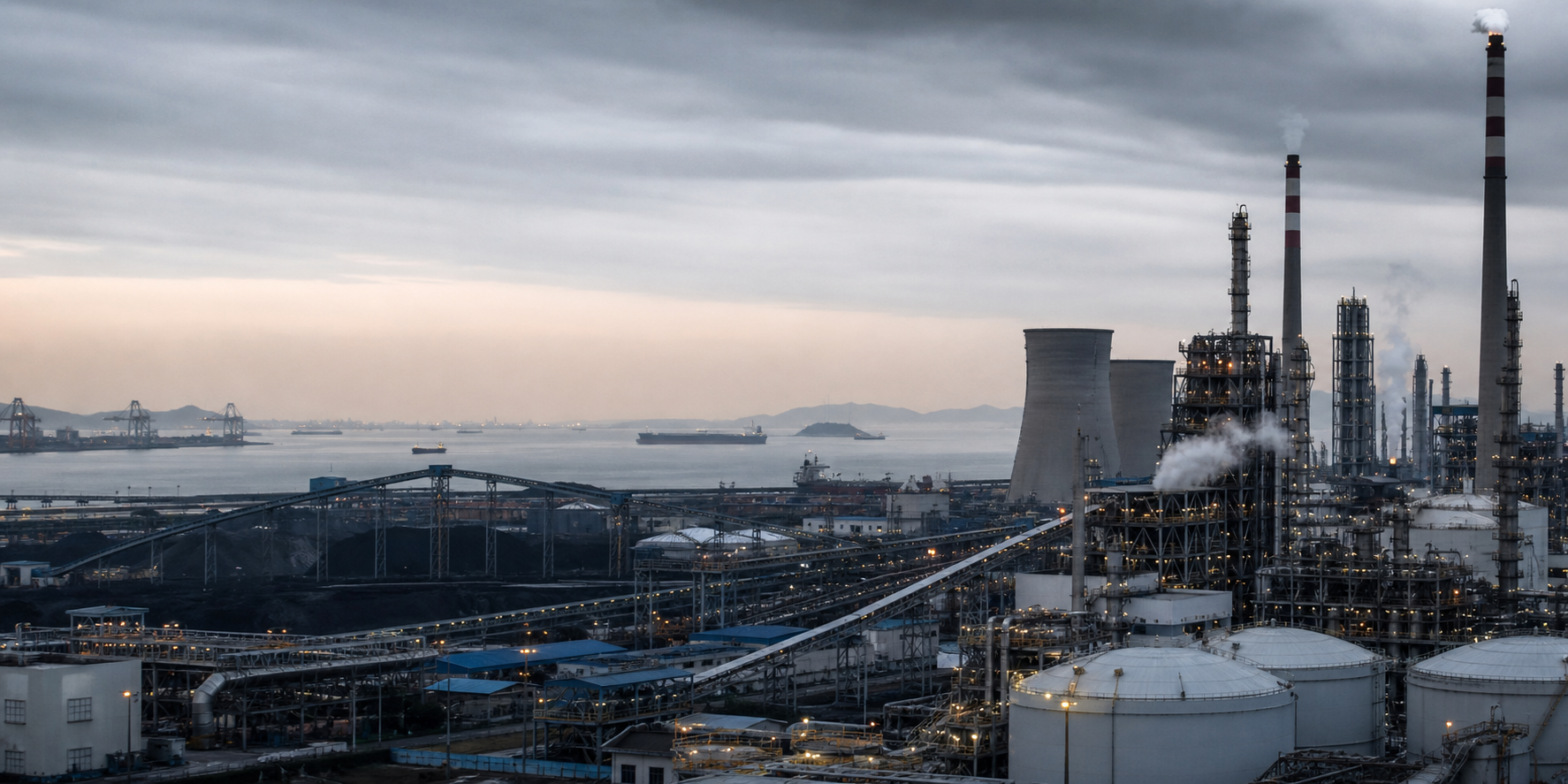
Energy security in focus
The Chinese government is pressing ahead with the expansion of the coal chemicals industry, which produces resins and other products from coal. With tensions between the United States and Iran clouding the outlook for safe passage through the Strait of Hormuz, China aims to use domestically produced coal to strengthen energy security. Chinese media say the value of related projects exceeds 600 billion yuan ($84 billion).
China has followed a path similar to Japan, which once produced city gas and chemicals from coal. But while Japan shifted feedstocks to oil and liquefied natural gas (LNG) amid environmental measures, China has continued to develop coal technologies. While President Xi Jinping has called for carbon emissions to peak by 2030, the country has kept its reliance on coal alongside the expansion of solar and wind power.
One of the world's largest projects in the Mu Us Desert
In the Mu Us Desert in inland China, Shaanxi Coal and Chemical Industry Group, a state-owned company in Shaanxi province, is building one of the world's largest coal chemicals complexes. Coal is reacted at high temperatures with oxygen and steam to make synthesis gas, from which chemicals are produced. The total site area at completion will be about 16 square kilometers, equal to eight Tokyo Disney Resorts. Annual coal consumption is expected to reach about 30 million tons, or roughly 30 percent of the coal used for power generation in Japan. Total investment is 230 billion yuan, and full operations are planned for the end of 2027.
The first phase, which involved an investment of about 50 billion yuan, is already operating and producing feedstock for polyester resins and other products. In June 2026, construction of the second phase began in earnest with an investment of about 180 billion yuan. In addition to general-purpose resins such as polyethylene, the project is expected to produce materials for vehicle batteries and solar panels.
Investment expands in coal-producing regions
In Yulin, Shaanxi province, at the edge of the Mu Us Desert, another coal chemicals complex is being built by China Energy Investment Corp, a state-owned enterprise overseen by the central government. Some parts are already in operation, and from September 2025 it began building additional facilities with an investment of about 80 billion yuan to produce polyethylene and other products. At full capacity, it is expected to use more than 10 million tons of coal a year.
According to a Chinese chemicals trade media outlet, construction is also progressing in coal-producing areas of the Xinjiang Uygur Autonomous Region, Inner Mongolia Autonomous Region and Ningxia Hui Autonomous Region. The combined investment in plants under construction, or those that have received government approval and are preparing for construction, exceeds 600 billion yuan.
Oil substitution and profitability in focus
The Chinese government is stepping up efforts in coal chemicals to ease dependence on imported crude oil. Risks to traffic through the Strait of Hormuz are increasingly in focus, and the United States has also attacked Venezuela in South America, one of China's crude suppliers. China relies on imports for about 70 percent of its crude oil needs.
Great Wall Securities said in a report in late July that if crude prices remain high on the back of the geopolitical conflict between the United States and Iran and risks to traffic through the Strait of Hormuz, that would indirectly support the coal industry. Zhao Dong, vice chairman of Sinopec, also said in late March that coal chemical companies were operating at full capacity and had postponed major maintenance.
In 2021, when Xi visited Shandong province, which is rich in resources such as oil and coal, he said China, as a manufacturing power, must secure its own energy supply on its own. When he visited Yulin in the same year, he said the coal chemicals industry had great potential.
Chinese media say the coal chemicals market in 2025 is estimated at 1.33 trillion yuan and is expected to expand to 1.75 trillion yuan in 2032, up 30 percent from 2025. Some experts, however, believe company profits could face significant downward pressure if crude prices fall below a certain level.
Enjoyed this article? Share it with your network!