





Weak yen and North America sales underpin Toyota, policy risk looms
 2026-08-04
U.S. sales support earnings
Toyota Motor's dependence on U.S.-related earnings is increasing. While a weak yen and firm sales in the U.S. are supporting results, the United States is pushing for more domestic production through moves such as a review of the United States-Mexico-Canada Agreement (USMCA), leaving earnings vulnerable to policy changes under the Trump administration.
Global sales in April-June fell 3% from a year earlier to 2.55 million vehicles. Sales in China slumped 28% to 320,000 vehicles, but that was offset by a 1% increase in North America to 670,000 and an 18% rise in Japan to 410,000. Takatoku Azuma, Toyota's head of accounting, said, 'There were negative regions, but positive regions that exceeded expectations provided support.'
With purchase subsidies for electric vehicles (EVs) abolished in the U.S., automakers are being forced to rethink their strategies. U.S. sales in April-June fell 4% year on year at General Motors (GM) and 10% at Ford Motor. Tesla did not disclose vehicle sales, but a survey by U.S. research firm Cox Automotive showed a 13% decline.
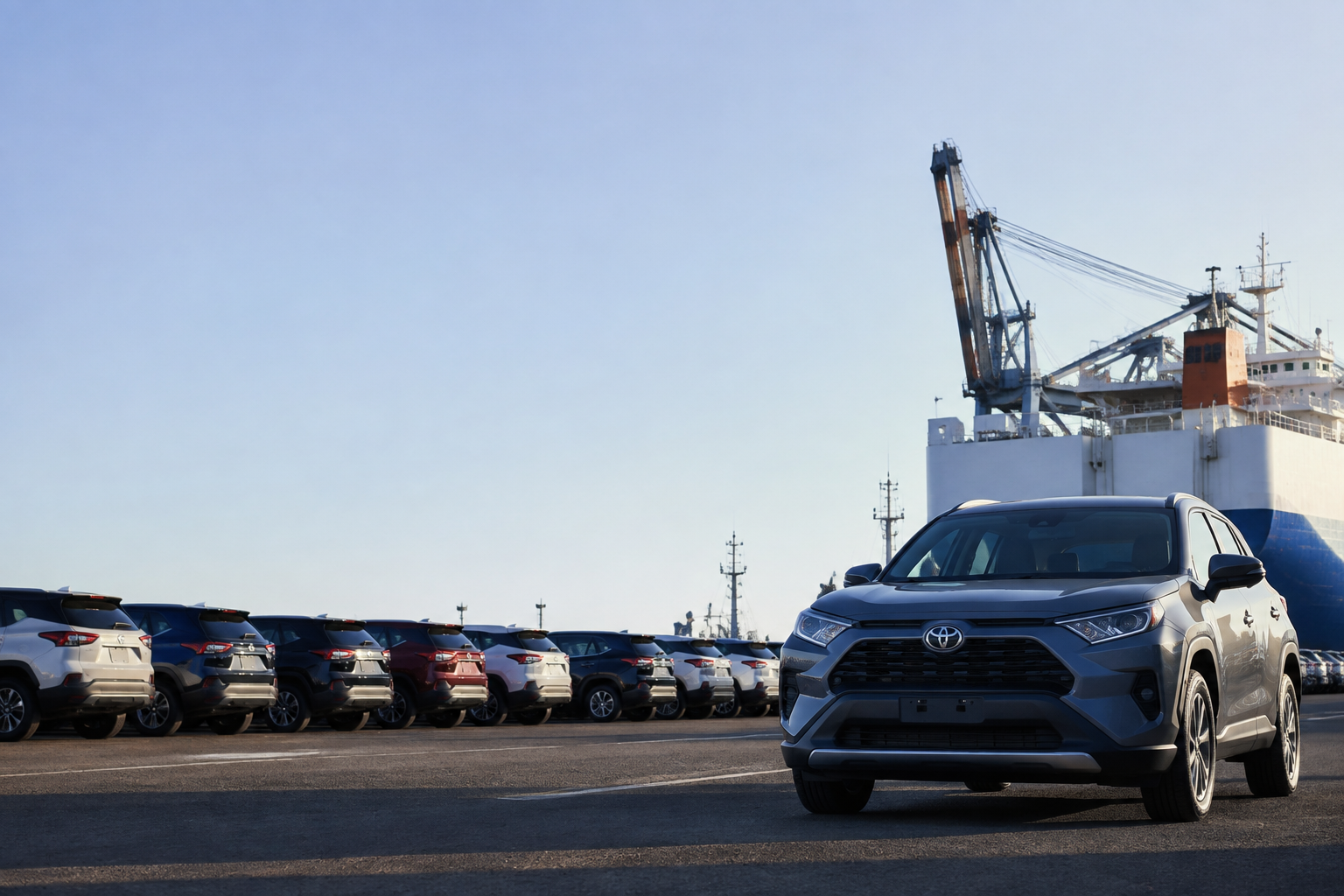
Toyota, which promotes an all-round strategy and offers everything from gasoline vehicles to hybrid vehicles (HVs) and EVs, maintained its revenue growth trend. New models of the Camry sedan and the RAV4 sport utility vehicle (SUV) led sales, and HVs are less exposed to price competition in the U.S. and have higher margins.
Weak yen and USMCA review
A weak yen boosts Toyota's profits. For the year ending March 2027, it will add 480 billion yen to the company's initial forecast. The impact from the Middle East situation has also eased somewhat, and the profit hit from lower production and higher raw material costs has narrowed to 510 billion yen from the 670 billion yen initially assumed. Toyota expects to book 60 billion yen in expenses, including losses from the cancellation of development of the next-generation EV LF-ZC, but the weaker yen will offset that.
Toyota's U.S. sales ratio has risen from 23% to 26% over the past five years. Azuma said, 'It is desirable for exchange rates to move stably.' However, recent currency moves have been volatile, with the yen strengthening after intervention by Japanese and U.S. authorities.
The North American market that supports Toyota also carries policy risk. The USMCA faces its first review deadline on July 1, and the U.S. is refusing to renew the current agreement. It is seeking to raise the auto rules of origin from the current 75% to 82%, and has also proposed a minimum 50% share of U.S.-made parts. U.S. consulting firm AlixPartners expects revisions to increase costs by as much as $1,200 per vehicle, or about 200,000 yen, because of additional expenses for origin certification and steel and aluminum production in North America.
In July, Toyota said it would shift some production of Tacoma pickup trucks made at its factory in Mexico to the U.S. by 2030. It will invest a total of $3.6 billion to build new production lines at a factory in Texas in the southern U.S. Azuma said, 'We considered logistics efficiency and the impact of tariffs and examined a system that would deliver to customers at the lowest possible cost.' In November 2025, Toyota also announced a plan to invest up to $10 billion over five years and is stepping up output of engines and parts for HVs.
Sluggish shares and buyback
Even with solid profits, there has been little sign of aggressive buying of Toyota shares. Since the end of 2025, the stock has fallen 13%, in contrast to a 27% rise in the Nikkei average and a 4.9-fold gain in Kioxia Holdings. As generative AI adoption draws funds into semiconductor memory, auto stocks are struggling to attract buying amid concerns over export competition with Chinese rivals and higher raw material costs.
Some plants have halted operations due to the Kumamoto earthquake, but Toyota said it is still assessing the impact on its business and has not factored it into its outlook for the year ending March 2027. Azuma said the company will use its strong cash generation and financial base to strengthen earnings power and improve capital efficiency. On the 4th, Toyota also announced a share buyback of up to 1 trillion yen. As it continues to expand globally, the company is being pressed to build a production system and supply chain that can withstand geopolitical risks and policy shifts.
Enjoyed this article? Share it with your network!