





FY2026 capital spending plans hit record high on AI investment
 2026-08-02
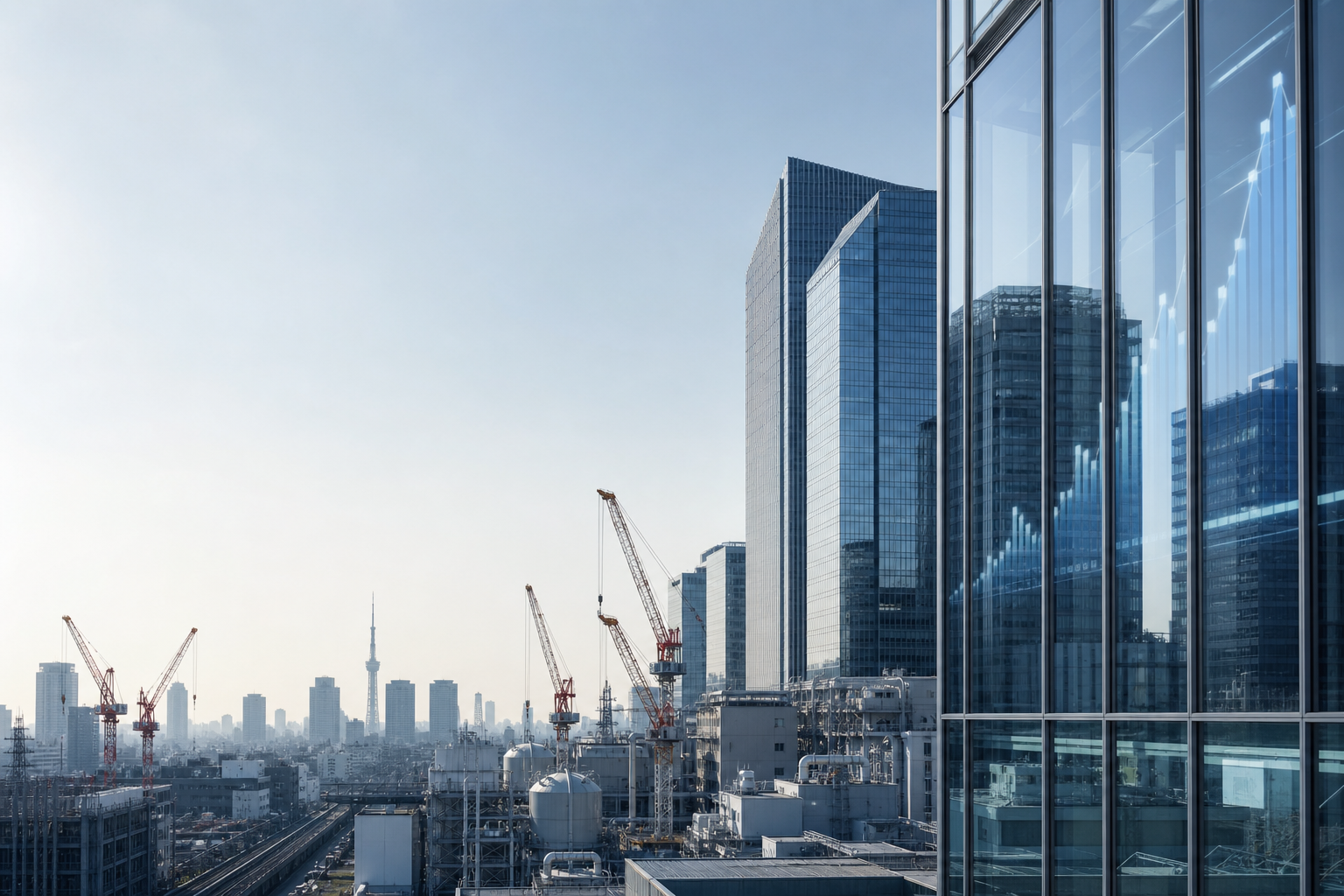
A Nikkei survey of capital spending plans for fiscal 2026 showed the total for all industries at 35.6734 trillion yen, up 14.2% from the previous year’s actuals. That was a record high, and the growth rate topped 10% for the first time in four years. The range of investment tied to artificial intelligence (AI) is widening, including data centers, semiconductors and power transmission and distribution equipment.
AI-related investment broadens
The survey covered listed companies in Japan and leading firms with capital of at least 100 million yen. It totaled 715 companies, excluding firms with consolidated ties, from 813 respondents. Manufacturing investment rose 13% to 21.4923 trillion yen, while nonmanufacturing spending increased 16.2% to 14.1811 trillion yen. From the standpoint of economic security, investment in AI infrastructure and energy stood out.
Spillover around data centers
NTT, the biggest spender, expects data center investment to rise on the back of growing AI use, lifting capital spending 4.5% to 2.43 trillion yen. NTT Data Group plans to invest about 500 billion yen in data centers, a rise of about 30% from a year earlier. Kazuhiko Nakayama, president of the company, said, 'Demand is growing in a doubling game.' Data centers use a broad range of components, including advanced semiconductors, cables for optical communications, electronic parts, server cooling equipment and power receiving and distribution systems.
Investment also rises in manufacturing and utilities
Kioxia Holdings plans to continue increasing output of NAND flash memory and expects capital spending in fiscal 2026 to rise 58.6% to 450 billion yen. TDK expects spending to rise 23.9% to 370 billion yen, to support higher production of precision components for hard disk drives used in storage devices. Sumitomo Electric Industries will increase capital spending in its information and communications business, including data center-related parts, by 2.9 times. A large portion of the investment is for boosting output of optical devices that convert electrical signals from servers into optical signals. President Osamu Inoue said, 'We simply have to increase production to cope with the rise in orders.'
Utilities and overseas investment also increase
In power supply, which is essential for data center operations, Hokkaido Electric Power plans capital spending of 420 billion yen, up 73.8%. This reflects expected medium- to long-term growth in electricity demand as Rapidus prepares to start operations at its advanced semiconductor plant in Chitose, Hokkaido. It also plans safety work at nuclear power plants aimed at restart. Overseas investment, which fell in fiscal 2025 amid U.S. tariff policies, rose 1.4% across all industries and turned higher for the first time in two years. Furukawa Electric will raise investment 3.7-fold to 74.5 billion yen to expand production of data center components in Southeast Asia. Nippon Steel expects domestic and overseas investment to rise 51.7% to 1.43 trillion yen, a record high driven by investment in U.S. steelmaker U.S. Steel.
Energy and autos
There are also moves to secure stable energy resources. INPEX will expand investment to increase output in oil and natural gas projects in Southeast Asia and Australia. Eneos Holdings aims to stabilize its supply network through maintenance and renewal investment at aging domestic refineries. By industry, automobiles ranked first with spending up 10.1% to 5.7639 trillion yen. Honda, following a review of its electric vehicle strategy, plans to invest 1.25 trillion yen, up 66.4%. It plans to roll out 15 hybrid vehicle models by fiscal 2029 and will use the funds to upgrade production lines.
Enjoyed this article? Share it with your network!