





U.S. carrier presence in Pacific stays at one for over 5 months
 2026-06-25
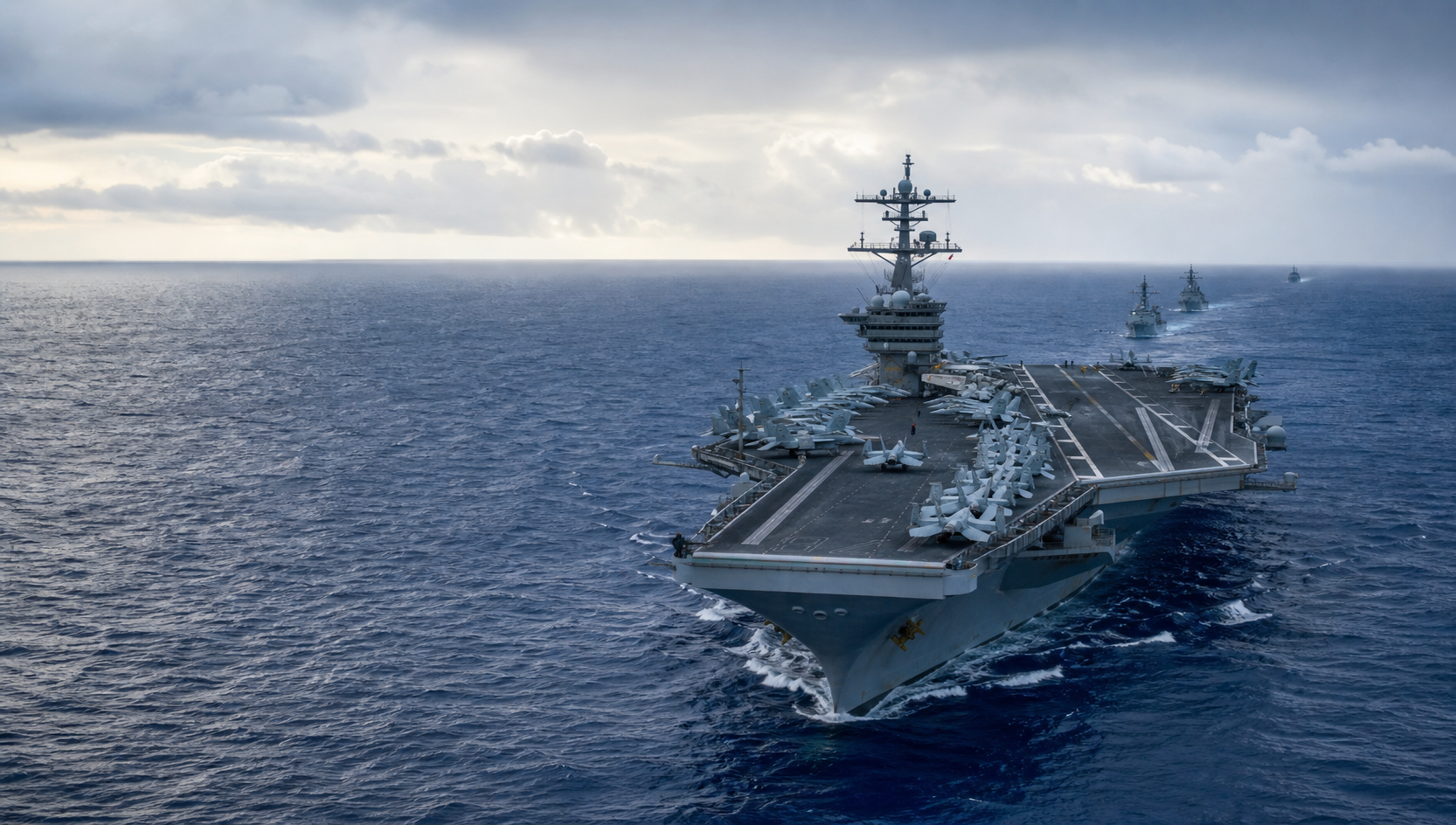
The number of U.S. Navy aircraft carriers operating in the Pacific is declining. In the area under the U.S. Pacific Command, the once-standard two-carrier posture has broken down, leaving only one carrier for about five months since January. Concerns are mounting that the regional military balance is shifting as China commissions a third aircraft carrier.
Two-carrier deployments had become routine
According to a tally based on location data published by the U.S. Naval Institute, U.S. aircraft carriers were deployed together in numbers of two or more in the Pacific-centered area under U.S. Pacific Command for only three weeks in January after the start of the year. In the same period a year earlier, that figure had reached 24 weeks, covering almost the entire stretch.
At present, the only U.S. aircraft carrier confirmed in the Pacific region is the George Washington, homeported at the U.S. naval base in Yokosuka, Japan. The single-carrier posture has continued since January and entered its 21st week in late June. It has continued to set a new longest run since 2021.
Impact from shifting forces to the Middle East
After the attack on Iran at the end of February, the U.S. military redirected three of its seven operational aircraft carriers to the Middle East. The situation highlights how difficult it is to carry out operations in East Asia and other regions at the same time when forces are being allocated to the Middle East.
The U.S. military has long said it aims to maintain the capability to deal with two conflicts occurring simultaneously in different parts of the world. Aircraft carriers, which carry aircraft and can be rapidly deployed around the globe, are regarded as core forces supporting that premise. The U.S. Navy has 11 carriers, about half of the world total.
As China expands its naval power, the U.S. military in recent years has been closely focused on scenarios including a Taiwan contingency. In addition to the one carrier homeported in Yokosuka, it has continued to deploy carriers based on the U.S. West Coast to the Pacific, and since 2016 it has arranged for two or more to operate in the same area almost every year.
In 2022, it conducted an exercise in the South China Sea involving two aircraft carriers. Rear Admiral Martin, who was then commander of the carrier strike group, stressed that the U.S. military could bring overwhelming naval power to bear to defend the Indo-Pacific region, and he also underscored the importance of protecting sea lanes.
If the two-carrier posture can be maintained, it would leave more room to respond even when one carrier needs maintenance. Taking into account the time required to cross the Pacific, the approach has been to keep forces ready through rotations.
China is continuing to build up its naval capabilities and widen the scope of its activities in the Pacific. In June 2025, it was confirmed for the first time that its two existing aircraft carriers were operating simultaneously on the Pacific side. In November that year, its third aircraft carrier, Fujian, entered service.
Japan grows uneasy
In Japan, there are concerns about the U.S., its only ally, becoming thinner on Pacific forces. The government is stepping up its posture of expanding defense cooperation with like-minded countries in the Pacific region, placing emphasis on ties with Australia, New Zealand and South Korea.
Revisions to three national security documents are scheduled for the end of the year. The Liberal Democratic Party recently compiled security policy recommendations for the government and called on it to 'bring about a transformation in defense capabilities within five years in both equipment and structure,' with an eye to increasing defense spending.
The recommendations said a 'gap' has emerged in Pacific defense and called for improvements in force structure and equipment. It voiced a strong sense of urgency, saying that 'if a protracted war were to break out, attacks on Japan from the Pacific side could also occur.'
Enjoyed this article? Share it with your network!