





H3 sixth mission succeeds, JAXA advances toward lower costs
 2026-06-12
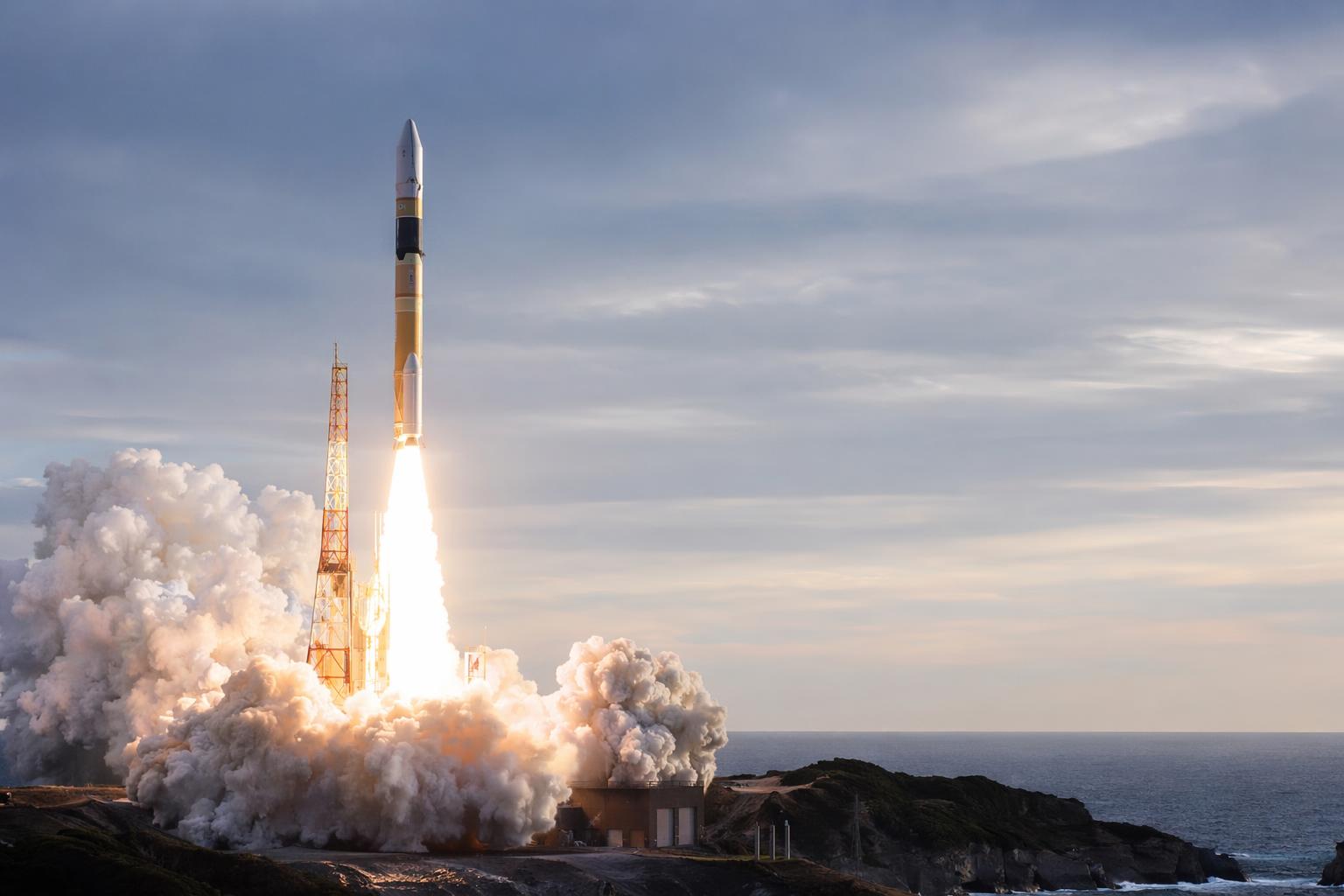
Successful orbit insertion in 30 configuration
The Japan Aerospace Exploration Agency (JAXA) successfully launched the sixth H3, the country's large flagship rocket, from the Tanegashima Space Center in Kagoshima Prefecture on the 12th. About 15 minutes and 15 seconds after liftoff, the rocket passed its planned orbit as the second-stage engine finished firing, and the small satellite it carried was also separated. JAXA successfully demonstrated the easiest-to-lower-cost 30 configuration, giving it a path to compete with U.S. SpaceX on launch cost per rocket.
At a press conference after the launch, JAXA project manager Makoto Arita said, 'It was a half-year that felt short yet long. I am relieved that we managed to achieve it.' Following this success, H3 will resume operations, and at least three launches are expected within fiscal 2026.
Restarting the drive to lower costs
After a launch failure in December 2025, Epsilon S, the small rocket developed by JAXA, also exploded during an engine firing test, leaving its launch timing undecided. Japan had lost its means of carrying satellites into space, but the H3 success will help rebuild that capability.
H3 has, in addition to the 30 configuration that flies with only a liquid-fueled main engine, the 22 configuration with two main engines and two solid rocket boosters, and the 24 configuration with the same two main engines and four boosters. The 22 and 24 configurations have already been launched successfully, and with the success of the 30 configuration this time, JAXA has completed verification of the version that is easiest to keep costs down among the various vehicle setups.
Development of H3 began in 2014, with the original goal of cutting in half the launch cost of 10 billion yen for its predecessor, H2A. With this success, JAXA has set a clear course toward securing cost competitiveness that could challenge SpaceX, which dominates the global satellite launch market. As with H2A, launch operations are expected to be transferred to Mitsubishi Heavy Industries, and JAXA Chairman Hiroshi Yamakawa said, 'We are thinking in terms of moving to private-sector-led launches at an early stage.'
Masayuki Eguchi, a senior executive officer at Mitsubishi Heavy Industries, said in anticipation of the transfer, 'To increase the number of launches, we need to expand manufacturing facilities and launch resources at Tanegashima. We will respond step by step toward more launches.' The company is also incorporating many of the highly reliable technologies that achieved a 98% success rate with H2A, and if a series of successful missions continues, there is ample possibility that the transfer to the private sector will advance.
Competition intensifies in the global market
If the transfer to the private sector progresses, it will become easier to win overseas satellite launch contracts. That is because Mitsubishi Heavy Industries would be able to manage everything from rocket production to launch in an integrated manner, making it easier to adjust launch timing to customer needs.
As space infrastructure for communications, Earth observation and security advances around the world, the number of rocket launches is also rising. According to the Cabinet Office, the number of global rocket launches in 2025 reached 316, about four times the level 10 years ago.
H3 is also targeting the global market, but the competitive environment is tough. In May, SpaceX successfully conducted a launch test of its next-generation rocket Starship. It has more than four times the payload capacity of the company's mainstay Falcon 9, can carry large satellites and is expected to reduce cost per unit of payload significantly.
In Europe, there is the flagship Ariane 6 rocket, while in the United States, rocket-development startups are emerging one after another. Atsushi Uchida, chief research fellow at the Mitsubishi Research Institute, said, 'The SpaceX dominance will continue, but H3 also needs to steadily build a track record in order to capture demand that the company cannot cover.' Kota Umeda, a researcher at the Institute of Geoeconomics in Tokyo's Minato Ward, said, 'This success is a major step forward for the future. It became one step toward entering the same competitive field as rival companies, including SpaceX.'
Enjoyed this article? Share it with your network!