





Nikkei slumps on US rate hike bets; AI, chip shares sold
 2026-06-08
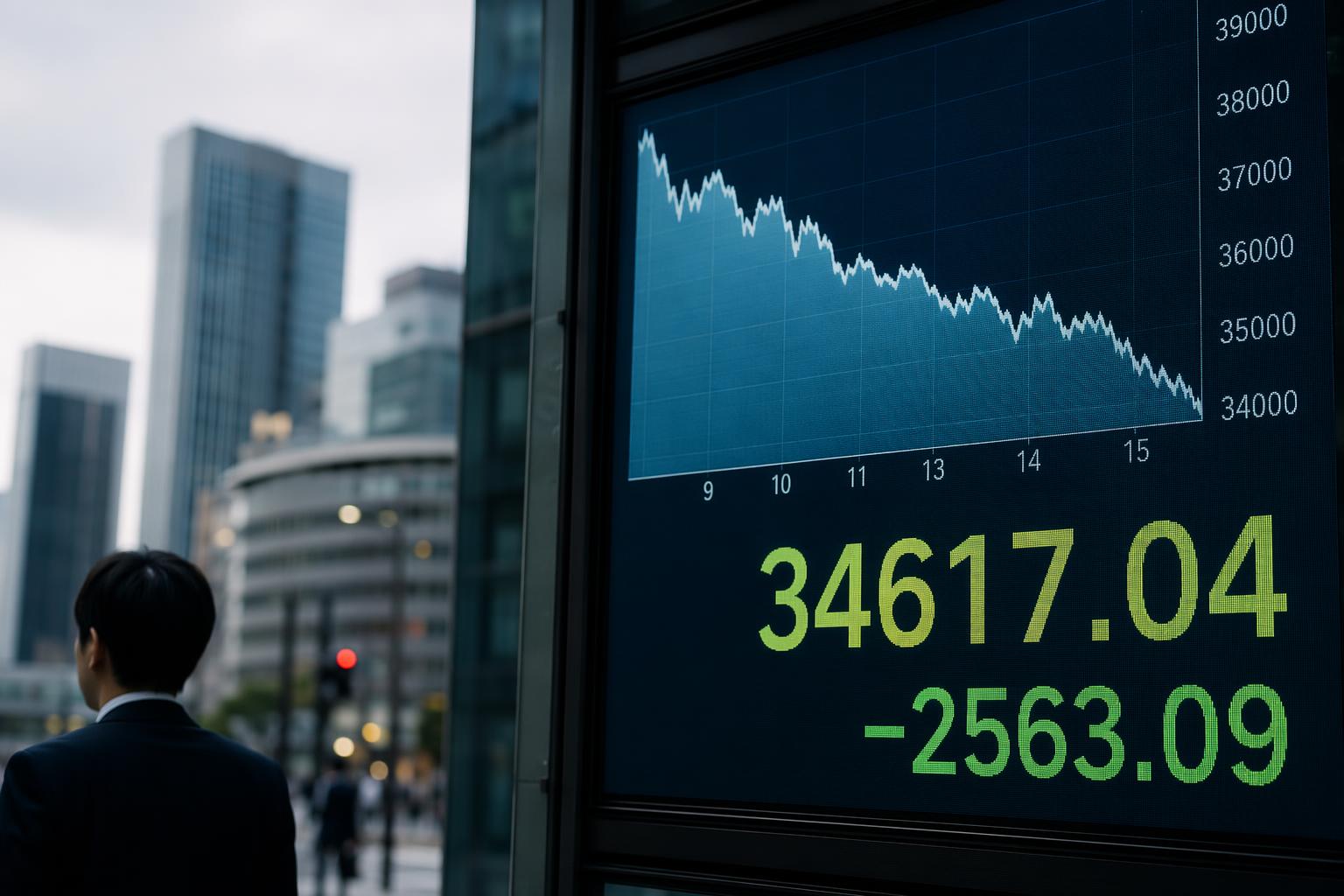
Japan's Nikkei share average closed down 2,563 points from the previous Friday at 64,024 on the Tokyo stock market on the 8th. The index fell 3.85%, marking the second-largest decline in 2026, behind the 2,892-point drop on March 9. Expectations of a US rate hike strengthened after the previous Friday's US employment report, and selling spread mainly across artificial intelligence (AI)-related shares.
Global sell-off spreads
On the US market late the previous week, major stock indexes fell sharply, and the Nikkei at one point dropped more than 3,000 points in Tokyo on the 8th. The sell-off also spread across Asian markets, with South Korea's benchmark KOSPI at one point falling more than 8%, triggering a circuit breaker that halted trading.
Rising US yields weigh on markets
The catalyst was the May US employment report. Nonfarm payrolls rose by 172,000, well above market forecasts of 80,000 to 110,000. The Federal Reserve had been cutting rates amid concerns about a slowing labor market in the second half of 2025, but views quickly strengthened that the next policy move would be a rate hike rather than another cut.
In FedWatch, which uses moves in the US interest rate futures market to gauge policy rates, the probability of the Fed raising rates by year-end topped 80% as of the evening of the 5th US time, up sharply from about 50% the previous day. In response, the US 10-year Treasury yield rose to the mid-4.5% range on the 5th, the highest level in two weeks. In Japan's bond market on the 8th, the 10-year yield also rose to the mid-2.7% range, reinforcing selling on concerns that equities looked relatively expensive.
AI and chip shares sold off
The biggest declines were in AI and semiconductor-related shares, which had led the market's recent gains. SoftBank Group Corp. (SBG) and Kioxia Holdings at one point fell more than 10%, Tokyo Electron dropped just over 8%, and Advantest lost just over 7%. High-tech shares as a whole were sharply lower.
Growth stocks such as AI and semiconductor-related shares generally trade at high price-to-earnings ratios, which tend to mean lower earnings yields. When interest rates rise, equities' earnings yields are more likely to look less attractive than bond yields, increasing selling pressure. The yield spread, calculated by subtracting the expected earnings yield for the Tokyo Stock Exchange Prime Market as a whole from the yield on newly issued 10-year government bonds, has been narrowing on the negative side, signaling that stocks look expensive.
Yoshikiyo Shimamine, senior fellow at Dai-ichi Life Asset Management's Institute of Economic Research, said, 'Government bond yields have been staying above expected inflation rates, making them more attractive as investments. Rising rates have prompted a phase in which the stock market is, for the time being, becoming calmer.' The 10-year expected inflation rate, measured by the gap between government bond yields and inflation-linked bond yields and also known as the breakeven inflation rate, or BEI, has recently risen to the low 2.2% range, above the Bank of Japan's 2% price stability target.
Concerns over a stronger yen
There is also a view that if the sell-off continues, it could lead to a stronger yen and further declines in share prices. Eiji Kinouchi, chief technical analyst at Daiwa Securities, said overseas investors often build positions in Japanese stocks paired with short yen positions when investing in Japan, in order to hedge foreign exchange risk.
However, in a falling market, those positions can unwind in reverse, leading to selling of Japanese stocks and buying of yen. Kinouchi said, 'Foreign investors are said to hold about 30% of Japanese shares, or just over 300 trillion yen, and even if half of that is hedged, the pressure from selling Japanese stocks and buying yen would be substantial.' He said the unwinding of Japanese stock purchases and yen shorts helped accelerate declines during the 'Reiwa Black Monday' in the summer of 2024.
Market participants generally see strong long-term prospects for the AI market, which could bring major structural change once every 30 to 40 years, and many view the recent drop as a speed correction. Still, given the abrupt slide centered on AI and semiconductor shares, Takayuki Ishibashi, vice president at Goldman Sachs Securities, said, 'It is natural to be alert for a second and third round of stock market declines for a while.'
Enjoyed this article? Share it with your network!