





China launches Shenzhou 23 with Hong Kong-born astronaut aboard
 2026-05-24
First use of Hong Kong-born astronaut
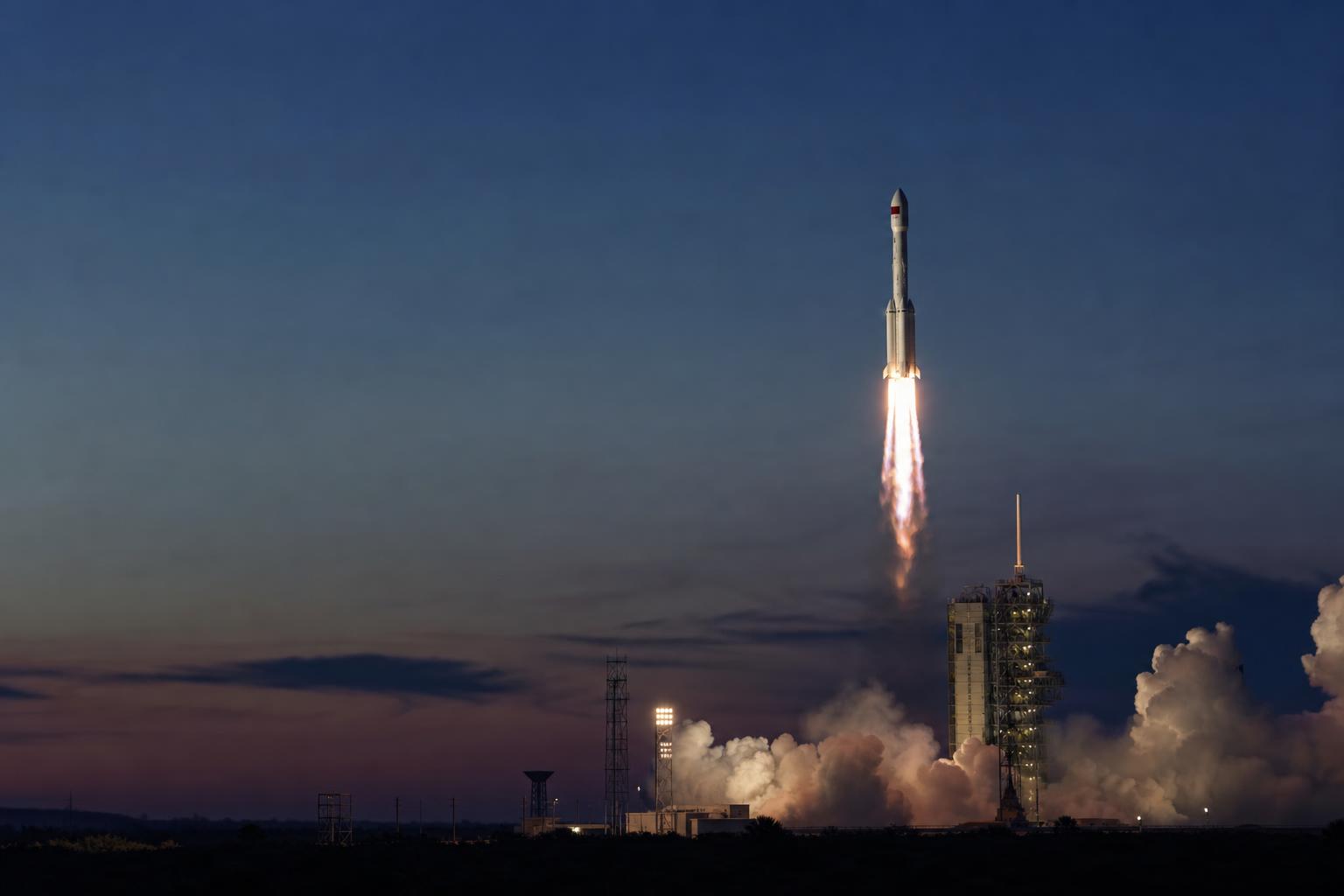
According to China Central Television (CCTV), China successfully launched the crewed spacecraft Shenzhou 23 shortly after 11 p.m. on the 24th, or midnight on the 25th Japan time. It was the first time a Hong Kong-born astronaut had been on board, underscoring ties with Hong Kong while promoting its drive to become a major space power.
Shenzhou 23 was launched from the Jiuquan Satellite Launch Center in northwest China aboard a Long March 2 rocket. Three astronauts are on board and are due to dock with China's own space station, Tiangong.
Tiangong operations and experiments expanded
The three astronauts will replace another trio that has been living on Tiangong for about six months. So far, stays on Tiangong have generally lasted around half a year, but one member of the new crew will remain for one year to study effects on the human body, among other things.
They will also carry out about 100 scientific experiments. In advanced materials, this includes experiments on high-performance magnets using rare earths, an area in which China has strengths in mining and production, and it aims to speed up the development of related technologies.
International cooperation also for a space power
The leadership under Xi Jinping is aiming to become a 'space power' capable of standing up to the United States, and completed Tiangong in 2022 as a core part of that effort. The United States has set out the Artemis program, which aims for crewed lunar exploration during President Trump's term, while China has set a goal of sending astronauts to the moon by 2030.
China is also expanding international cooperation in space. It has agreed with Russia to jointly build a lunar base, and is also considering accepting foreign astronauts on Tiangong. A Pakistani astronaut has emerged as a candidate with an eye on activities aboard Tiangong.
The Xi leadership has built up a track record in space development. It successfully landed a lunar probe in 2013, and in 2019 became the first in the world to land a probe on the far side of the moon. In 2024, it brought back soil samples from the far side of the moon for the first time in the world.
Meanwhile, China's space development has long been regarded as closely linked to the military. Against this backdrop, it was disclosed in April that Ma Xingrui, who served as general manager of state-owned China Aerospace Science and Technology Corp and as head of the China National Space Administration, was under investigation on suspicion of serious disciplinary violations.
Enjoyed this article? Share it with your network!