





US and China Agree on Trade Panel, Boeing Deal
 2026-05-15
Trade Talks Framework
US President Donald Trump and Chinese President Xi Jinping wrapped up two days of talks on the 15th. The United States and China appear to have agreed to set up a framework for discussions to promote bilateral trade and investment, underscoring the stability of their economic ties.
The two leaders met on the 14th and 15th at the Great Hall of the People in China and at Zhongnanhai, where the top leadership of the Chinese Communist Party works. It was Trump's first visit to China in nine years, and he boarded Air Force One on the 15th to return home.
After talks with Xi at Zhongnanhai on the 15th, Trump said, "It was a wonderful visit. I think many good results were achieved. We made some truly great trade deals for both countries." On the Iran situation as well, they confirmed a policy of working together to open the effectively blocked Strait of Hormuz.
Expand Exports in Noncompeting Areas
According to US Trade Representative Jamieson Greer, the United States and China will establish a "trade committee" to promote bilateral trade. It will identify sectors where trade volumes should be increased and discuss specific measures, he told Bloomberg News.
After Trump's tariffs took effect in 2025, trade between the United States and China shrank by 30%. The US side wants to increase exports to China in areas with limited impact on US-China competition, such as aircraft, agricultural products, and energy, and will advance working-level talks through the committee.
In addition, they will consider an "investment committee" to determine in which industrial sectors mutual investment is possible.
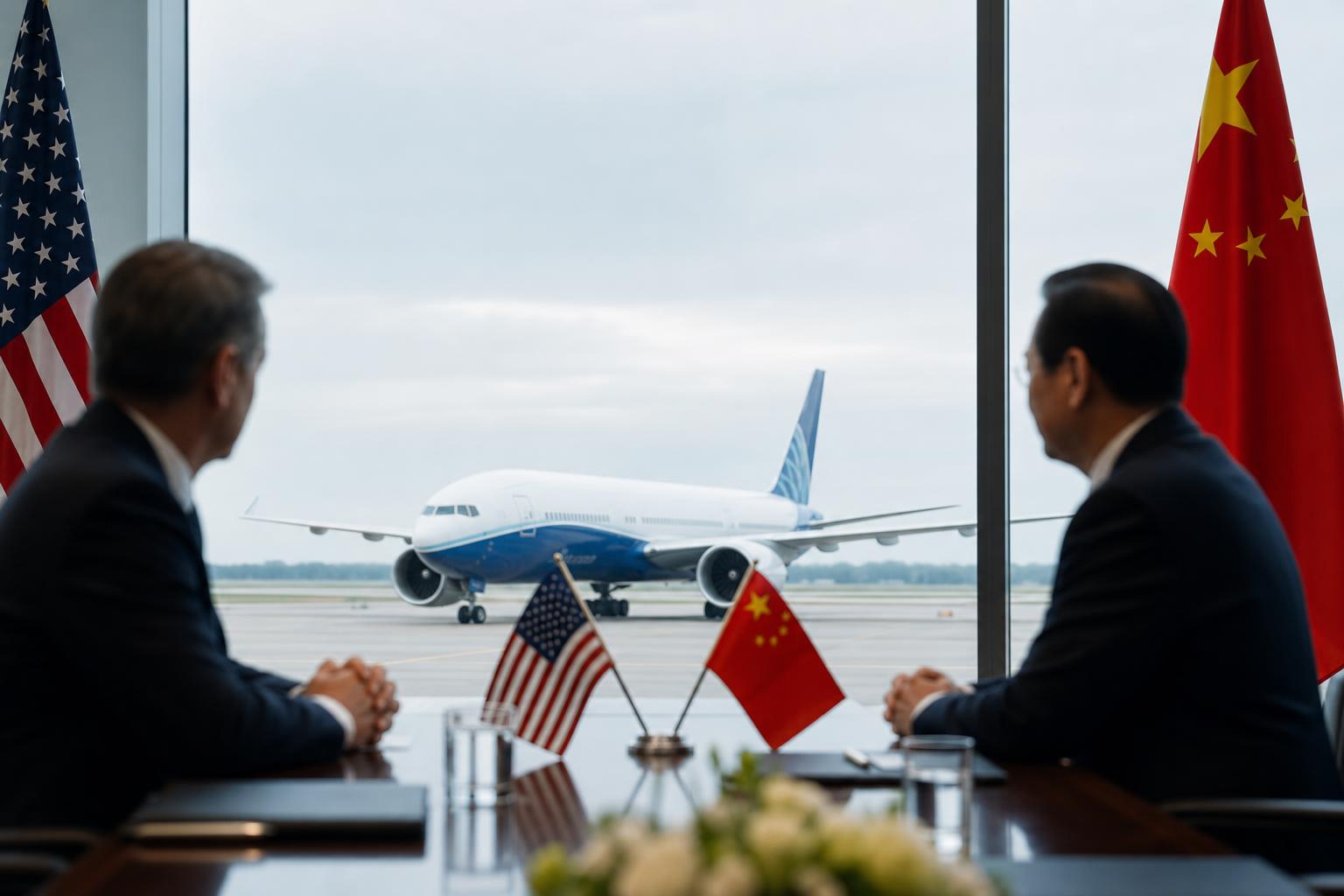
On the specific agreement, Trump told Fox News that China had promised to buy 200 Boeing aircraft from the United States. According to Greer, China will purchase tens of billions of dollars' worth of US agricultural products each year over the next three years.
Expanding exports of soybeans and other products to China is a key issue for winning support in agricultural states in the November midterm elections. At the 2025 US-China summit, China promised to buy at least 25 million tons of US soybeans a year from 2026 to 2028. It is unclear whether the latest deal is additional purchases or a confirmation of the existing agreement.
China has long imported large amounts of soybeans, corn, and other goods from the United States, but after tensions with Washington intensified, it increased sourcing from South America and elsewhere.
Lingering Flashpoints
Issues such as extending the trade-war truce appear to have been left unresolved. At their meeting in October 2025, the two leaders agreed to halt tit-for-tat high tariffs for one year. How to deal with the "truce deadline" after this autumn was not made clear at the summit.
Instead of the reciprocal tariffs and fentanyl tariffs that were ruled unconstitutional and invalid, the United States is currently imposing an additional 10% tariff on countries and regions including China. The Trump administration is expected to launch new punitive tariffs as early as late July, but Greer declined to comment on the rate for China.
China is wary of new tariffs and has also hinted at possible countermeasures. With domestic demand sluggish, strong external demand is helping support the economy, and Beijing wants to avoid another round of high tariffs between the United States and China.
Semiconductor Curbs Not on Agenda
It is also unclear whether there was any agreement on exports of Nvidia semiconductors to China. For the "H200," which is not a cutting-edge chip, the Trump administration allows exports to China under certain restrictions, but China has not accepted them.
Jensen Huang, the company's CEO, also joined the trip to China and drew attention. According to Greer, semiconductor export controls were not on the agenda at the summit.
During this visit to China, Trump suggested that Xi visit Washington on September 24. The US government believes that, including this trip, there could be up to four chances for US and Chinese leaders to meet in 2026.
Enjoyed this article? Share it with your network!